AI
Game Creation AI Tests Multimodal Agent Coordination at Scale
SEELE AI's platform demonstrates how agents manage interconnected tasks across code, 3D assets, and user feedback—a proving ground for industrial automation.
Key takeaways
- SEELE AI's game creation platform demonstrates multimodal agent coordination across code, 3D assets, audio, and user feedback in a closed-loop workflow.
- Game development tests whether agents can maintain project coherence when changes ripple across interconnected systems—a challenge shared by industrial automation.
- 3D-native models treat geometry, materials, and spatial relationships as native information rather than derived representations, enabling applications in simulation and digital twins.
- Successful agent systems require explicit goals, persistent context, inspectable intermediate results, and the ability to learn from outcome feedback.
- Browser-playable game creation provides an accessible testing ground for agent interface design before deploying similar workflows in operational environments.
Automation systems are typically evaluated by counting discrete tasks they complete. A more revealing metric examines whether a system can pursue a goal across multiple tools, formats, and feedback cycles. Game development provides an unusually comprehensive test environment because functional games require coordinated handling of language, code, 3D geometry, audio, game rules, and player interaction.
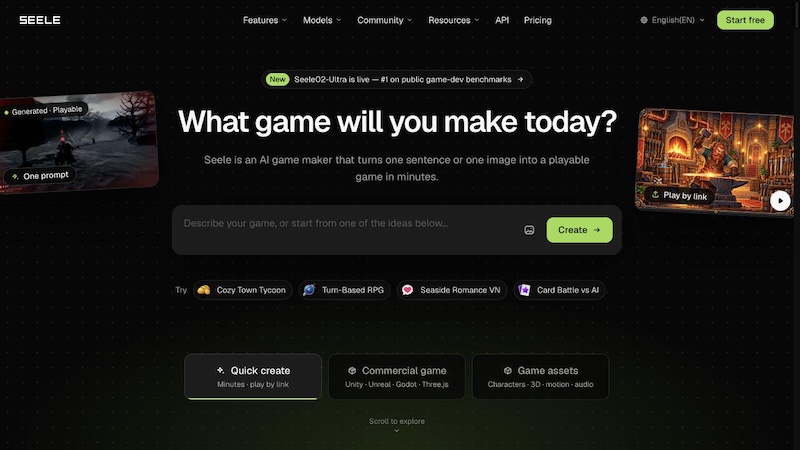
SEELE AI has built a platform that transforms prompts or images into browser-playable games complete with code, 3D assets, audio, and level design. Creators can then describe changes and watch the agent update the entire project. According to Automation Watch, which first reported on the platform, this workflow mirrors the agentic loops that robotics and industrial AI researchers are pursuing: perceive a goal, act within an environment, observe outcomes, and revise the plan.
Why it matters
Multimodal agents that coordinate across interconnected systems represent a step beyond single-task automation. Game creation exposes coordination challenges in an inspectable format—when a level change requires simultaneous updates to collision detection, navigation, camera framing, sound, and UI, the agent must maintain project coherence. These same challenges appear in industrial settings where robots must integrate sensor data, physical constraints, and safety protocols. The game workflow offers a lower-stakes environment to refine agent architectures before deploying them in physical systems.
Closed-Loop Interaction Replaces Fixed Scripts
Traditional automation follows predetermined sequences. Agentic systems select actions based on current state. When a creator tells the SEELE platform that players cannot identify active doors, the agent must locate the relevant scene elements, apply appropriate changes to materials or lighting or interface components, and generate a testable build. The output is not documentation of changes but a new state humans can evaluate directly.
This closed loop—instruction, implementation, testing, observation, revision—differs fundamentally from one-shot generation. For automation professionals, the game environment simplifies inspection of how agents maintain world coherence while objectives shift.
3D-Native Models Handle Spatial Relationships
Three-dimensional assets carry geometry, materials, scale, hierarchies, collision properties, and spatial relationships. Models that generate textures may fail to produce objects that behave correctly within scenes. SEELE's research direction includes 3D-native models and world models alongside game foundation models, treating mesh, space, and temporal changes as native information rather than derived representations.
This capability extends beyond entertainment into simulation, training environments, digital twins, and spatial design. Game workflows demand objects that are both visually plausible and operationally functional—a door must look correct, occupy appropriate space, respond to interaction, and communicate state to players.
Design Principles for Agent Systems
Several patterns emerge from game agent workflows that apply broadly:
- Agents require explicit success conditions, whether playable levels or completed industrial tasks
- Persistent project context prevents inconsistency across isolated generations
- Intermediate results should be inspectable before committing to large changes
- Player hesitation and failed interactions provide system evidence, not just aesthetic feedback
- Fast drafts can guide engineering, but production demands review and reliability checks
These principles transfer to simulated robot cells, digital twins, and other agent-driven systems where world models, tool interfaces, and outcome-based learning matter.
Accessible Testing of Agent Interfaces
Browser-playable games make agent loops visible without technical manuals. Users enter intentions, receive interactive worlds, test them, and request changes. This accessibility helps teams evaluate agent interface clarity before deploying similar workflows in operational environments.
The long-term significance of AI game makers may extend well beyond entertainment, demonstrating how agents coordinate creative and technical work while preserving context across multiple interactions and producing human-testable artifacts. These remain central challenges in automation.
These details were first reported by Automation Watch.