Flexiv Unveils Force-Sensing Robots With Tactile Feedback
Enlight robotic arm and Mico dual-arm platform integrate sensors at every joint to enable whole-body touch sensitivity for industrial tasks.
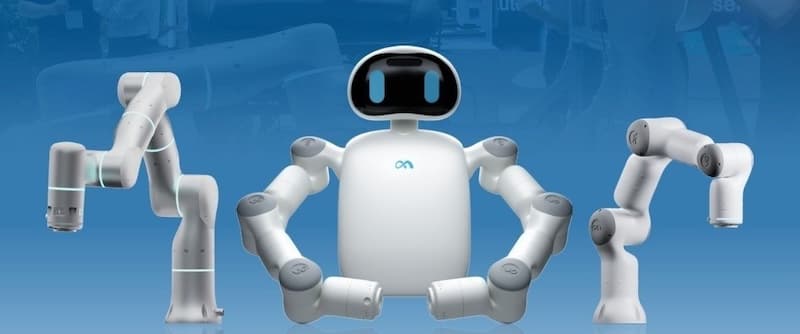
Flexiv has introduced two adaptive robotic systems that integrate force-torque sensors throughout their mechanical structures, aiming to expand the range of tasks industrial robots can perform in variable environments.
The company launched its Enlight robotic arm and Mico dual-arm platform, both designed around what Flexiv calls whole-body touch sensitivity — the ability to detect contact, track multiple touch points simultaneously, and recognize tactile patterns through sensors embedded in each joint.
Architecture and capabilities
The Enlight serves as the foundation for both products. This seven-axis arm weighs 15 kilograms and incorporates multi-dimensional force-torque sensors at all seven joints, according to details first reported by Robotics and Automation News. Four of those joints can rotate through 720 degrees, giving the system an extended working envelope while maintaining a compact physical profile for constrained spaces.
Flexiv combines this force-control architecture with vision systems to handle tasks that traditional industrial robots struggle with — specifically those involving high variability or unpredictable contact scenarios.
The Mico platform pairs two Enlight arms under unified control software, enabling synchronized dual-arm operation for applications requiring coordinated manipulation. Flexiv offers Mico in four configurations — Armor, Core, Plus, and Ultra — allowing organizations to match hardware specifications to specific use cases.
Demonstrated applications
Flexiv showcased industrial applications developed with technology partners, including manipulation tasks involving graphics cards. The company used Nvidia's Isaac Sim simulation platform to develop force-controlled robotics behaviors before deployment.
"We have brought to market a level of human-like adaptability and tactile feedback never before available to industrial users," said Shuyun Chung, Flexiv's chief robotics scientist. "These robots are safer, simpler to program, and uniquely capable of operating in highly constricted environments."
Why it matters
Force control represents a longstanding challenge in industrial robotics. Most factory robots operate with position control — moving to predetermined coordinates — which limits their effectiveness in tasks requiring physical interaction or adaptation to variable conditions. By distributing force sensing across the entire kinematic chain rather than just the end effector, Flexiv's approach could enable automation in assembly, inspection, and material handling scenarios that currently require human workers. The dual-arm Mico configuration specifically targets applications where bimanual coordination matters, such as flexible part assembly or delicate component handling.
Company background
Founded in 2016, Flexiv develops adaptive robots that integrate force control, computer vision, and AI for manufacturing and industrial automation. The company operates facilities in Silicon Valley, Shanghai, Beijing, Munich, and Singapore.
Robotics and Automation News first reported details of the product launch.
This is an original analysis by the Omega editorial team. Source reporting: Automation Watch.
Want systems like this working for your business?
Book a Call