Five Dimensions of Sovereign AI That Most Organizations Miss
Data residency is just one quarter of the answer—and the financial sovereignty lesson is hitting CFOs hardest in 2026.
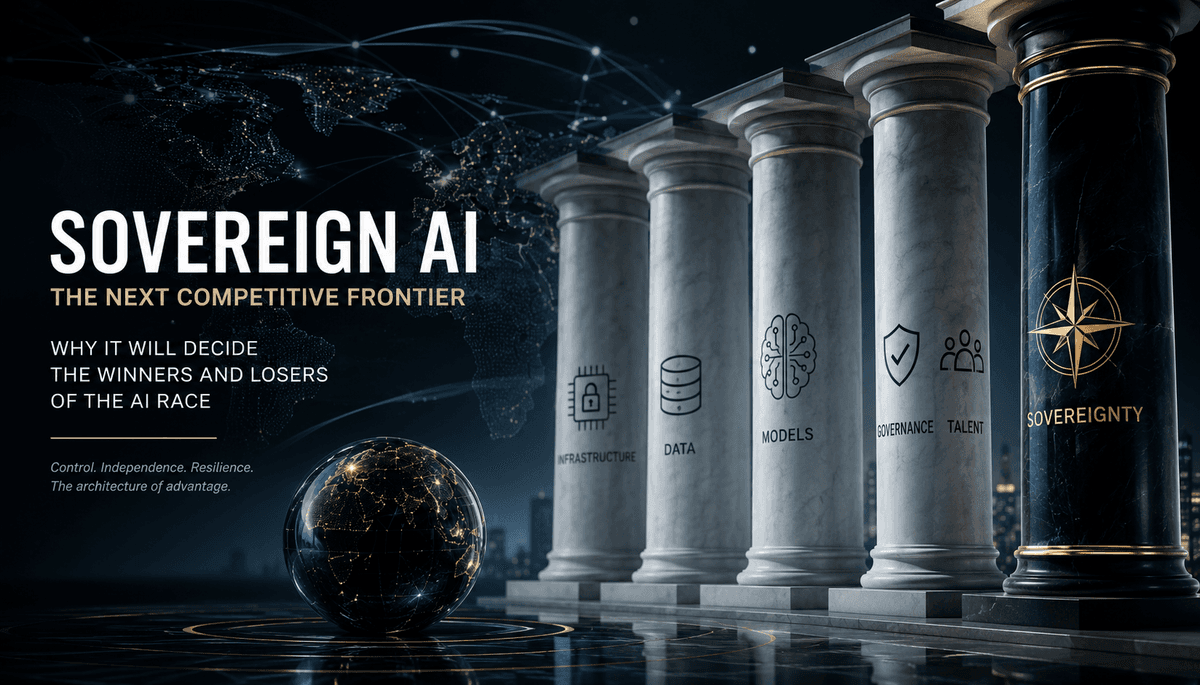
The sovereignty gap
Sovereign AI has become shorthand for data residency in most enterprise conversations—pick the right AWS region, check the GDPR box, move on. But that approach addresses roughly 25% of what sovereignty actually requires, according to a new analysis from SiliconANGLE.
The gap between perception and reality is creating strategic exposure for organizations that believe they've solved for sovereignty when they've only addressed geography. By the time the limitations become obvious—through vendor lock-in, compliance failures, or budget overruns—the window to correct course has typically closed.
The issue is structural, not semantic. Organizations building AI strategies on an incomplete definition of sovereignty are constructing systems on false foundations.
Why it matters
Three major enterprises—Uber, Microsoft, and Google—are now serving as cautionary examples of what happens when organizations lack financial sovereignty over their AI deployments. Uber burned through its entire 2026 AI budget in four months after rolling out Claude Code to 5,000 engineers. Microsoft canceled thousands of Claude Code licenses in May 2026 despite strong user preference, redirected engineers back to GitHub Copilot by fiscal year-end because token-based billing consumed budgets faster than finance teams could adapt. These aren't edge cases—they're the defining enterprise AI story of early 2026.
The four core dimensions
Genuine sovereign AI requires control across four interconnected dimensions, as detailed by SiliconANGLE:
Territorial sovereignty covers where data and compute physically reside. This is the dimension most organizations have addressed, but stopping here leaves three-quarters of the problem unsolved.
Operational sovereignty determines who actually manages and secures the environment. Sovereign servers operated by foreign-headquartered managed service providers under foreign employment law aren't sovereign—the control boundary extends beyond organizational reach.
Technological sovereignty addresses who owns the underlying stack and IP. A deployment built entirely on proprietary model APIs, orchestration frameworks, and policy engines hasn't eliminated vendor dependency—it's relocated it from infrastructure to software, where migration is harder and more expensive.
Legal sovereignty establishes which jurisdiction governs access. The U.S. CLOUD Act allows law enforcement to compel American companies to produce data stored anywhere globally, regardless of GDPR. Jurisdiction follows the company, not the data center.
McKinsey's December 2025 survey of 300 executives found 71% characterize sovereign AI as an "existential concern" or "strategic imperative," yet most lack detailed strategies, action plans, or budgets to execute.
The fifth dimension: financial control
Financial sovereignty—the ability to own, predict, and control AI costs without unilateral vendor pricing changes—is emerging as the dimension enterprise technology leaders are learning about in real time on live budgets.
Anthropic's move toward usage-based token pricing for agentic workloads exemplifies the challenge. As agentic AI runs multistep tasks autonomously in the background, token consumption becomes nonlinear, continuous, and nearly impossible to forecast with traditional budgeting methods. At BlackRock's 2026 Infrastructure Summit, OpenAI's Sam Altman described the direction: "We see a future where intelligence is a utility, like electricity or water, and people buy it from us on a meter."
Self-hosted open-weight models make inference a compute cost—predictable, owned, optimizable. When organizations control the orchestration layer, they choose when to upgrade and on whose schedule.
Open source as architectural requirement
Technological sovereignty requires the ability to audit, fork, and operate systems independently—definitionally impossible with closed proprietary stacks, according to the analysis. The orchestration layer becomes a black box, the policy engine remains vendor-controlled, and inference APIs can be modified, restricted, or repriced without customer input.
The CLOUD Act applies to software IP just as it does to data. A U.S.-headquartered software vendor is subject to U.S. legal process, meaning the software they control, keys they hold, and modifications they can be compelled to make are within reach of U.S. law enforcement. No hosting geography resolves this.
Open-source-first architecture means the orchestration engine can be audited, forked, and self-hosted. Model weights can be inspected and fine-tuned locally. The policy engine is code the organization owns and version-controls. This enables genuine portability—the ability to move workloads between providers, across jurisdictions, across hardware generations—without vendor captivity.
The EU Data Act, which prohibits cloud switching charges and data egress fees from January 12, 2027, represents the policy layer of this structural shift.
Global momentum
The forces driving sovereign AI from concept to operational imperative are converging rapidly. The U.S. Stargate initiative committed $500 billion to own the global AI supply chain in January 2025. Europe's Summit on European Digital Sovereignty in Berlin convened over 900 participants in November 2025 and produced more than €12 billion in announced investments. Mistral raised $830 million in institutional debt from a seven-bank consortium to fund a sovereign GPU data center outside Paris.
Saudi Arabia's HUMAIN is building eleven data centers at 200 MW each, with a $10 billion AMD partnership for 500 MW of compute. The CNAS Sovereign AI Index tracks 130-plus national sovereign AI initiatives, with more than 80% of disclosed investment concentrated in the Middle East and East Asia.
The details were first reported by SiliconANGLE as part of a new editorial series on sovereign artificial intelligence.
This is an original analysis by the Omega editorial team. Source reporting: AI Watch.
Want systems like this working for your business?
Book a Call
