Factory Automation Shifts From Hardware to Software Skills
As industrial robot installations exceed half a million annually, manufacturers face a workforce challenge centered on digital fluency rather than mechanical expertise.
The New Face of Factory Automation
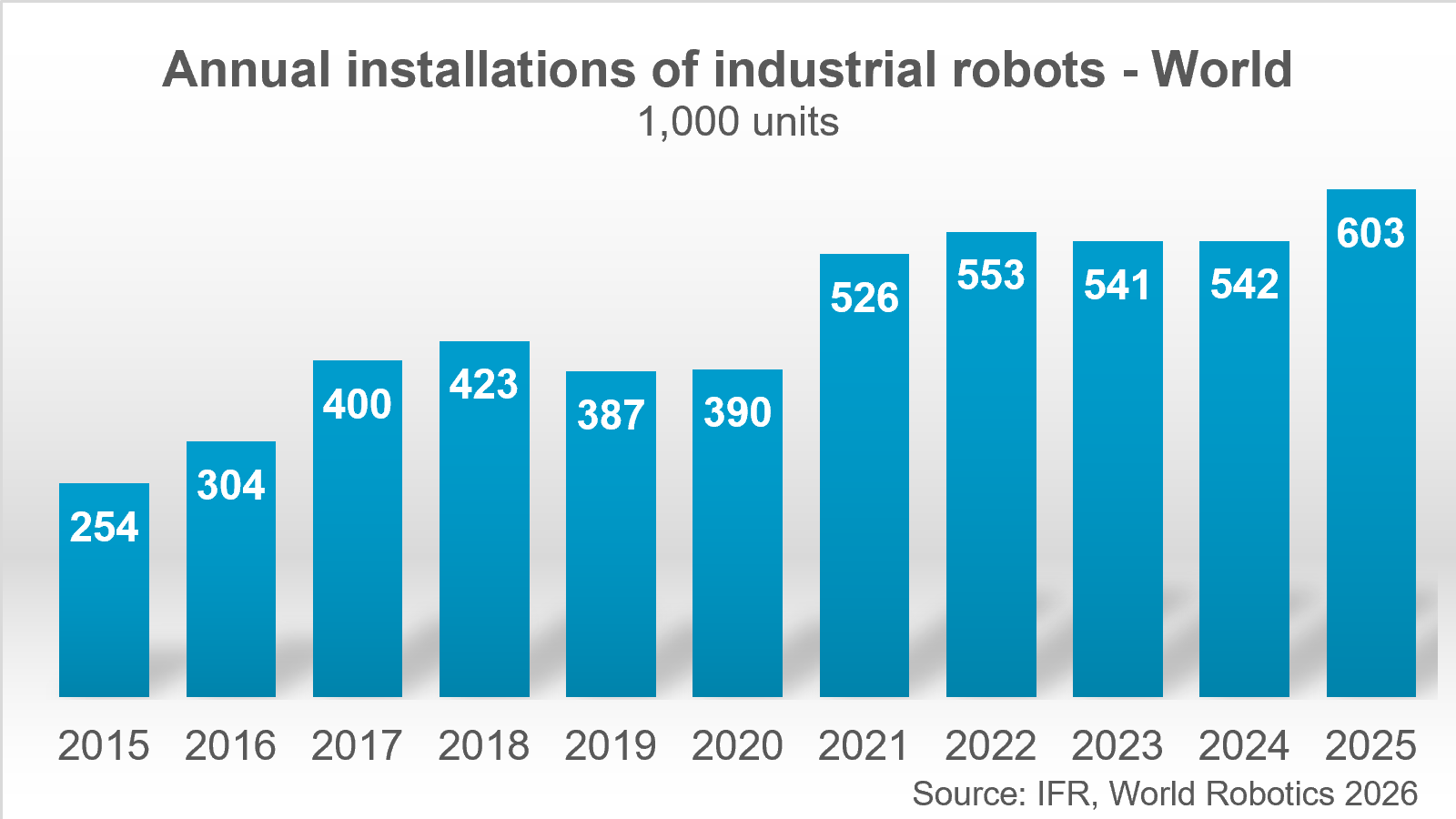
Factory automation has crossed a threshold. More than half a million industrial robots were installed worldwide in 2024 alone, according to the International Federation of Robotics, bringing the global operational total close to 5 million units. For four consecutive years, annual installations have topped that half-million mark, transforming automation from a capital investment story into a daily management reality.
The shift is fundamental: automation is becoming a software problem. While robots still weld, lift, assemble, and pack at remarkable speeds, the workers who keep production running now spend more time interpreting dashboards, responding to alerts, and making data-driven decisions than they do adjusting mechanical components.
Why it matters
This transition redefines workforce requirements at a time when 63% of employers cite skills gaps as a major barrier to transformation, and 59% of the global workforce may need reskilling by 2030. For manufacturers, the challenge isn't turning production workers into programmers—it's building broad digital fluency across the factory floor, where software literacy now directly protects uptime, quality, and safety.
From Machine Minder to System Interpreter
Robot density figures illustrate the scale of change. In 2024, Western Europe averaged 267 robots per 10,000 manufacturing employees, North America reached 204, and Asia averaged 131. Behind each robot sits a web of interfaces, settings, permissions, and maintenance data that someone must monitor and interpret.
A line operator's role has evolved accordingly. Checking vibration readings, temperature trends, cycle-time patterns, and error logs is now routine. When a motor drifts outside normal parameters, the response is often software-led: review alert history, compare shift data, then decide whether immediate intervention is needed or the issue can wait for scheduled maintenance.
On a packaging line where a collaborative robot switches between product sizes multiple times daily, the mechanical task may be straightforward, but the surrounding judgment is complex. A poorly chosen setting can slow throughput without triggering obvious alarms. A mismatch between warehouse management and production scheduling systems can strand pallets. In each case, human workers add value by understanding how the digital layer shapes physical outcomes.
Security Enters the Production Floor
Connected robots bring cybersecurity concerns into traditionally mechanical environments. Remote diagnostic access, tablet-based status checks, and plant-wide data synchronization create potential network vulnerabilities. A weak password or missed security patch can expose entire systems.
Good cyber hygiene in manufacturing starts with basic behaviors: reading update messages, controlling shared device access, and recognizing warning signs. Workers closest to the machines are often first to spot anomalies.
Training Must Reflect Reality
Traditional robotics training—safety procedures, teach-pendant basics, fault recovery—remains essential but insufficient. Effective programs now walk workers through complete alert cycles: What did the dashboard show? Which data points mattered? Who had permission to change settings? How was the fix documented?
The World Economic Forum's Future of Jobs Report 2025, drawing on input from over 1,000 employers representing more than 14 million workers, places skills gaps at the center of business transformation. For manufacturers, closing that gap means treating software confidence as a core productivity asset, not an IT department concern.
Factory automation still involves hardware, but competitive advantage increasingly depends on workers who can connect what they observe on the line with what software systems reveal. These details were first reported by Robotics and Automation News.
This is an original analysis by the Omega editorial team. Source reporting: Automation Watch.
Want systems like this working for your business?
Book a Call