Define the Blast Radius Before You Automate Any Decision
Accuracy metrics tell you how often a system is wrong, but blast radius reveals how much damage one mistake can do.
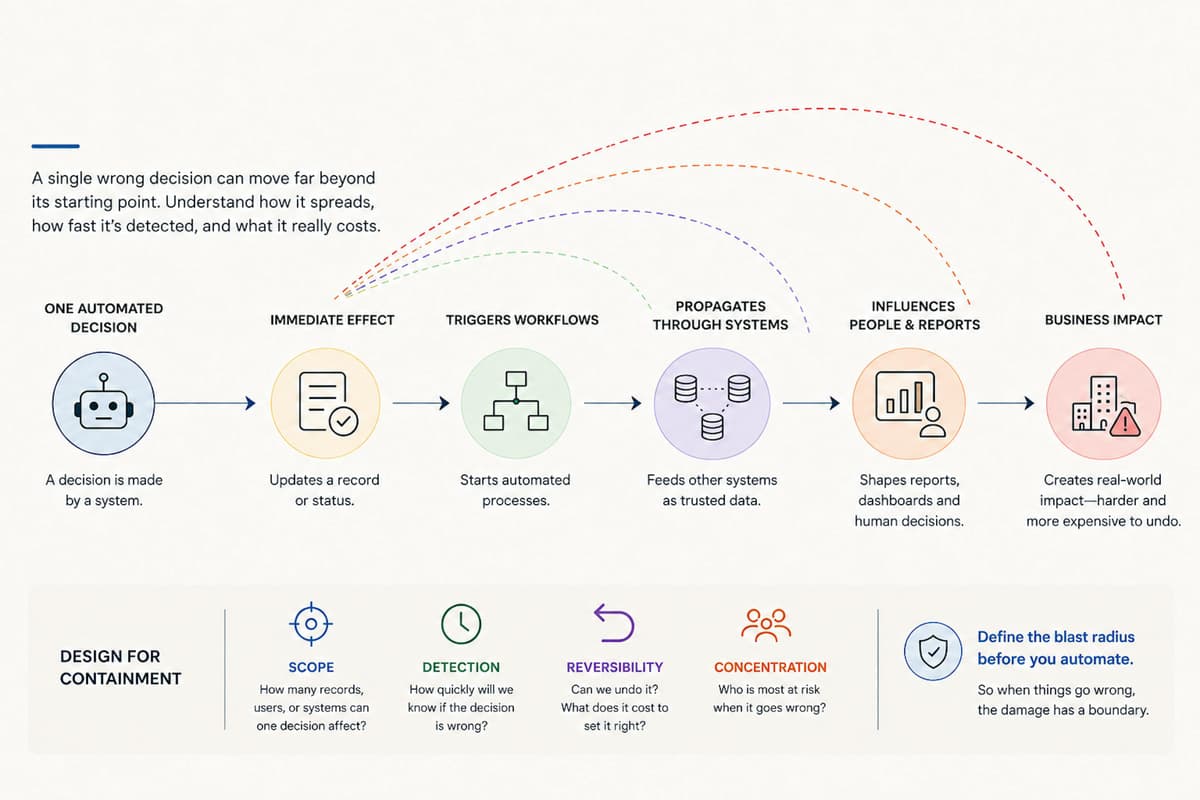
A correct system can still produce catastrophic outcomes
Enterprise teams building automated decision systems obsess over accuracy, latency, and data quality. Those metrics matter, but they miss a critical question: when your system makes a mistake, how far does the damage spread before anyone notices?
This is the blast radius of an automated decision—a concept borrowed from infrastructure reliability engineering that deserves equal attention in data and AI systems. A support ticket classifier running at 99.9% accuracy sounds impressive until you realize those 1,000 errors per million decisions are triggering downstream workflows, altering records in other systems, and becoming trusted inputs for additional automation.
Once a bad decision becomes data, other systems build on it without questioning the assumptions that produced it.
Why it matters
Most organizations evaluate automation readiness by asking whether a system can make accurate decisions. The harder question is what the organization has allowed that decision to influence. A highly accurate model with broad downstream impact creates more operational risk than a less accurate system with contained failure modes. Understanding blast radius before deployment determines whether you're building resilient automation or a cascading failure waiting to happen.
Four dimensions that define decision blast radius
According to a detailed analysis first reported by Automation Watch, blast radius should be evaluated across four practical dimensions:
Scope measures how many records, users, workflows, or systems one wrong decision can touch. In enterprise environments, dependencies grow organically over time. A status field designed for one application gets reused in reports, exports, dashboards, and eventually operational processes—often without the original team's knowledge.
Detection answers how long the system can produce incorrect outcomes before anyone realizes something is wrong. The most dangerous failures are quiet ones: the job succeeds, the dashboard refreshes, no alerts fire—but the numbers are simply wrong. Traditional infrastructure monitoring won't catch a technically healthy system operating on outdated business assumptions.
Reversibility isn't binary. Some actions can be undone in seconds. Others require hours of cleanup across multiple systems. Still others can be corrected in databases while their real-world consequences remain permanent. The harder an action is to reverse, the more carefully you should gate the system's authority.
Concentration reveals where failures accumulate. Aggregate performance can mask patterns where one product category, region, or customer segment absorbs most of the errors. A system can appear healthy overall while consistently failing the same workloads.
Design containment before you need it
Production systems will eventually encounter incorrect data, misunderstood assumptions, and edge cases. The question isn't whether your automated decision will fail—it's whether you've designed clear boundaries where mistakes can stop.
Before putting automated decisions into production, teams should be able to answer: If this decision is wrong, what happens next? Who consumes the result? What gets triggered downstream? Can we return to recommendation-only mode without shutting down the entire system?
The systems worth trusting aren't designed around the assumption they'll always be right. They're designed so that when they're wrong, the mistake has somewhere to stop.
Expand automation only as fast as you can contain failure. Start with limited scope—one workflow, one business unit, low-impact scenarios—and observe whether the entire decision chain works before granting the system broader authority.
This analysis was originally published by Automation Watch, which examines the operational realities of enterprise automation beyond model accuracy metrics.
This is an original analysis by the Omega editorial team. Source reporting: Automation Watch.
Want systems like this working for your business?
Book a Call