DeepMind Alumni Startup Claims Small AI Model Beats Claude, GPT
Inherent's 27-billion-parameter agent reportedly outperformed frontier models at replicating scientific research, using reinforcement learning to teach 'research taste.'
Small Model, Big Claims
A London-based AI startup founded by former Google DeepMind researchers says it has built an AI agent that outperforms much larger systems from Anthropic and OpenAI at a specialized scientific task — while running on a model with just 27 billion parameters.
Inherent, which emerged from stealth weeks ago with $50 million in seed funding, released benchmarks showing its Faraday agent exceeded the performance of Anthropic's Claude Opus 4.8 and OpenAI's GPT-5.5 at independently replicating findings from published scientific papers. The task requires an AI system to reproduce research results without being given the answers beforehand, according to details first reported by TechCrunch.
The company's agent runs on Qwen 3.6, a model dwarfed by the frontier systems it was tested against. Parameter count serves as a rough proxy for model size and training costs, making Inherent's efficiency claim noteworthy if validated.
Why It Matters
If Inherent's benchmarks hold up under scrutiny, the results suggest that specialized training methods — not just raw model scale — can produce competitive performance on complex reasoning tasks. That matters for the economics of AI development: smaller models cost less to train and run, potentially democratizing access to advanced AI capabilities. The approach also challenges the assumption that bigger is always better in the race toward artificial general intelligence.
Teaching AI 'Research Taste'
Cofounder and chief scientist Edward Hughes told TechCrunch the real innovation isn't the benchmark victory itself, but the training methodology. Inherent uses reinforcement learning — a technique that rewards AI systems for good outcomes rather than prescribing explicit rules — to develop what Hughes calls "research taste."
This means training the agent to recognize which experiments are worth conducting and how to design them effectively, skills human PhD students typically develop through years of practice. Paper replication serves as a standard training exercise in scientific fields, Hughes noted.
Rather than building every component from scratch, Faraday leverages existing tools like OpenAI's GPT-5.5 Codex for coding tasks, mirroring how human researchers use available software. Hughes said the goal is creating an AI teammate that returns with unsolicited insights: "I got curious about this, and I went off and I did these experiments. What do you think of these results?"
London Ambitions and Hiring Constraints
Inherent's dozen employees work entirely in person from King's Cross, the London neighborhood that became an AI hub partly due to DeepMind's presence. Hughes expressed confidence in London's AI talent density but criticized the UK's "garden leave" practice, which prevents departing employees from joining competitors for months after resignation — a restriction uncommon in the United States.
The startup plans to expand to 20-25 employees by year-end. With DeepMind co-founder Demis Hassabis now in a new role that has reportedly unsettled some staff, Inherent could attract talent from its founders' former employer.
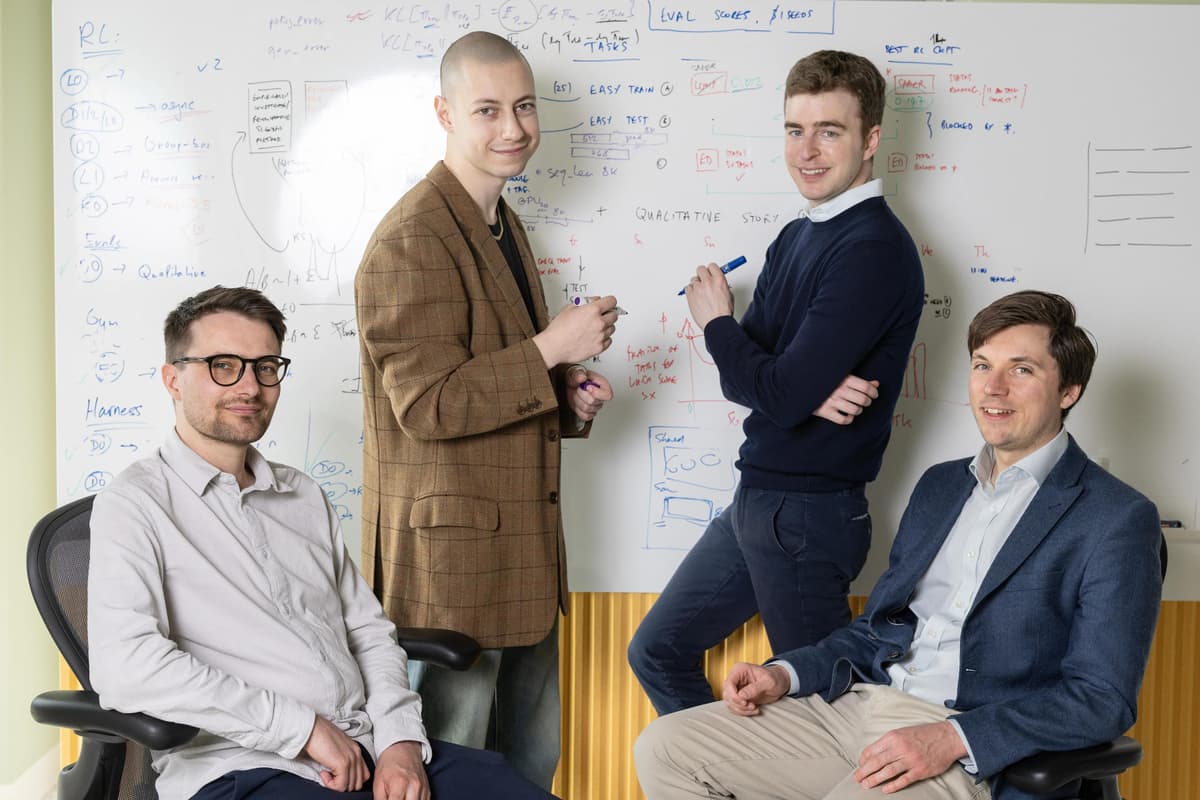
Inherent's longer-term goal extends beyond replicating existing research to discovering genuinely new scientific knowledge across multiple fields. The company's four co-founders include Hughes, Louis Kirsch, Kaloyan Aleksiev, and Tantum Collins, all DeepMind alumni.
These details were first reported by TechCrunch.
This is an original analysis by the Omega editorial team. Source reporting: AI Watch.
Want systems like this working for your business?
Book a Call