CTC and ROBO-HI Target 50–200 Ton Factory Transport Automation
Partnership brings unmanned guided vehicles and centralized robot management to heavy industry sites facing labor shortages.
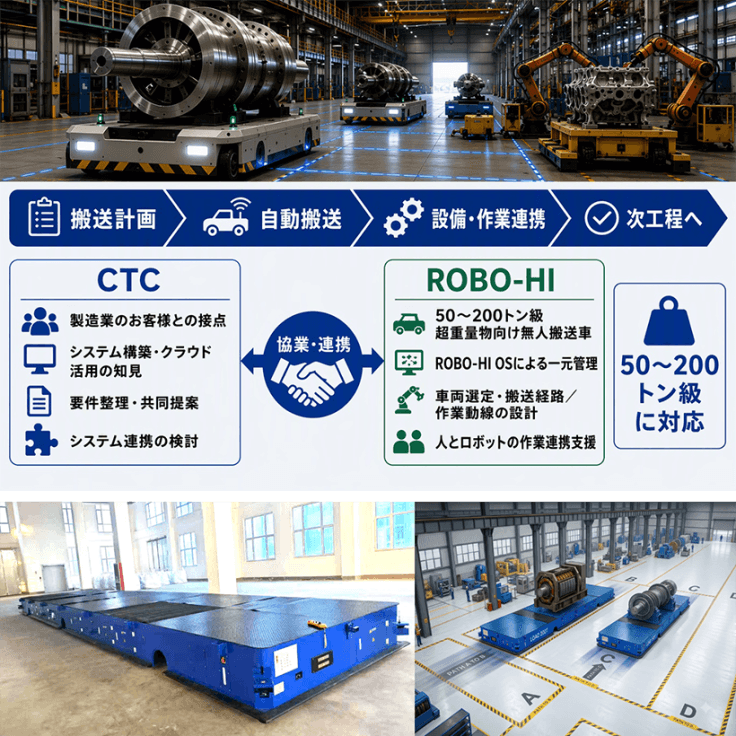
ITOCHU Techno-Solutions Corp. (CTC) and ROBO-HI have launched a partnership to automate the movement of ultra-heavy loads—ranging from 50 to 200 tons—at large manufacturing facilities, the companies announced August 4.
The collaboration targets sectors where standard automated guided vehicles fall short: heavy industry, shipbuilding, steel production, and construction machinery manufacturing. In these environments, products and components routinely exceed tens of tons, leaving transport operations heavily reliant on manual labor despite broader factory automation trends.
Why it matters
Labor shortages and productivity pressures are driving manufacturers to automate wherever possible, but ultra-heavy transport has remained a stubborn bottleneck. Manual handling of massive loads creates safety risks, limits throughput, and causes idle time when workers wait for cargo or subsequent processes stall after delivery. A solution that integrates heavy-duty autonomous vehicles with existing production systems could unlock efficiency gains in capital-intensive industries where downtime is expensive.
How the partnership works
ROBO-HI will supply its automated guided vehicles designed for ultra-heavy cargo, along with ROBO-HI OS—a platform that centrally monitors and manages multiple robots and vehicles across a facility. The company brings more than 20 years of experience developing autonomous vehicles and robots, with deployments in smart cities, airports, and hospitals.
CTC will handle system integration, drawing on its background in manufacturing-sector IT projects, cloud deployment, and system development. The company will help customers map transport-related challenges based on factory layouts and workflows, design optimal routes, and connect the unmanned vehicles to production management systems and existing equipment.
The joint offering aims to reduce cargo bottlenecks and worker waiting times by linking transport tasks more smoothly with downstream production processes. Services include requirements definition for operations and equipment, plant layout optimization, and system configurations that coordinate vehicle movements with the broader manufacturing sequence.
Projects already in motion
Multiple projects are already under review in heavy industry, shipbuilding, steel, and construction machinery sectors, according to the companies. They plan to use findings from these early implementations to expand their robot solution lineup and refine operations and maintenance capabilities.
The collaboration addresses a gap in factory automation where standard solutions cannot handle the extreme weight and scale of materials common in heavy manufacturing. While robots and automated guided vehicles have become routine in lighter-duty applications, the physical demands and integration complexity of ultra-heavy transport have kept many facilities dependent on manual processes.
Details were first reported by IBTimes Japan.
This is an original analysis by the Omega editorial team. Source reporting: Automation Watch.
Want systems like this working for your business?
Book a Call