Cisco and Quali Launch Stack Automation to Deploy AI Infrastructure in Hours
The platform turns validated designs into executable blueprints, aiming to collapse weeks of manual configuration into automated workflows.
Cisco and Quali ship infrastructure automation platform
Stack Automation by Quali has reached general availability as an infrastructure automation platform co-developed with Cisco and sold exclusively through Cisco channels. The platform targets the deployment gap that typically consumes six to twelve weeks between purchasing AI infrastructure and putting it into production, promising to reduce that timeline to hours.
The system combines Quali's automation engine with Cisco Validated Designs, integrating with Cisco Intersight and Cisco Nexus Dashboard to handle initial planning and deployment. Quali has also announced that Stack Automation will integrate into Cisco Cloud Control, the unified operations platform Cisco introduced in June, connecting deployment automation with the console where operators and AI agents already work.
Why it matters
Most infrastructure automation stops at deployment. Stack Automation's emphasis on Day 2 operations—continuous compliance checking, drift detection, and cost governance after the initial build—addresses the operational reality that infrastructure requires ongoing management, not just a successful launch. For enterprises deploying AI infrastructure at scale, the difference between a validated design document and executable automation represents real time-to-value acceleration.
Catalog of validated blueprints
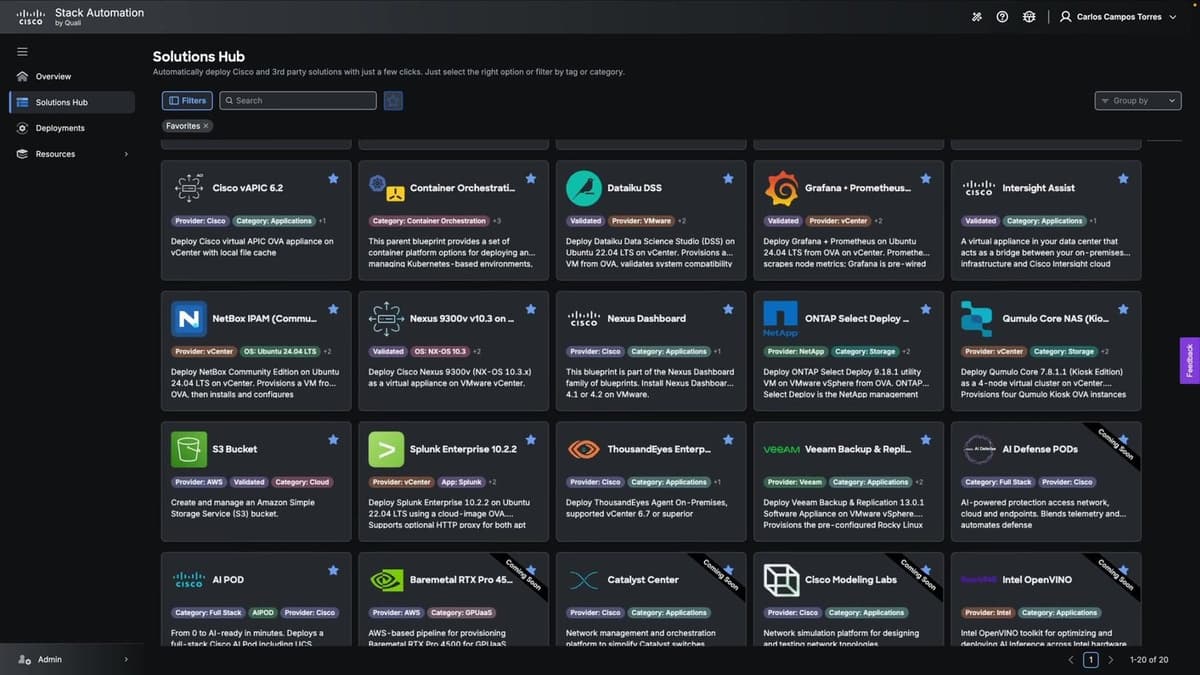
The platform's Solutions Hub offers a catalog of validated blueprints covering networking, security, observability, virtualization, AI frameworks, and enterprise applications. At general availability, the catalog includes Cisco Nexus Dashboard, Cisco Intersight, Catalyst Center, and Identity Services Engine, alongside third-party solutions including Splunk, Red Hat OpenShift, NVIDIA NIMs, VMware, Qumulo, and Veeam. Additional Cisco and partner solutions will continue rolling out.
The platform orchestrates standard infrastructure as code, supporting Terraform, Ansible, Helm, Python, and Shell, allowing teams to incorporate existing automation assets into blueprints without rewriting them. Reference architectures like NetApp and Cisco FlexPod AI designs specify what to build; Stack Automation provides the execution machinery.
Day 2 operations and cost visibility
A demonstration video from Cisco shows a deployed AI POD surfacing service health, drift detection against the original blueprint, and a running cost estimate with flagged potential savings. The demo displays live inventory of the underlying stack, including a Cisco UCS X9508 chassis, NVIDIA L40S GPUs, Nexus 93600 switching, NetApp AFF C800 storage, and a Red Hat OpenShift cluster.
For teams requiring customization beyond the catalog, the Blueprint Designer includes an agentic copilot that assembles and modifies blueprints through conversational interaction. The demo shows it working over a visual canvas to extend a Catalyst 8000V blueprint with preflight checks and snapshot steps.
Availability and pricing tiers
Stack Automation is available now through Cisco in two tiers. Essentials covers standard software deployments, while Advantage adds the Blueprint Designer, GitOps workflows, advanced customization, and agentic design capabilities. Cisco has indicated that support for AI PODs as deployable full-stack solutions will reach general availability in October 2026.
These details were first reported by StorageReview.
This is an original analysis by the Omega editorial team. Source reporting: Automation Watch.
Want systems like this working for your business?
Book a Call