Chinese Startups Race to Build Dextrous Robot Hands at Scale
Companies like LinkerBot and Wuji Technology are leveraging manufacturing advantages to solve robotics' hardest problem—and they're producing thousands of units monthly.
The Missing Link in Humanoid Robotics
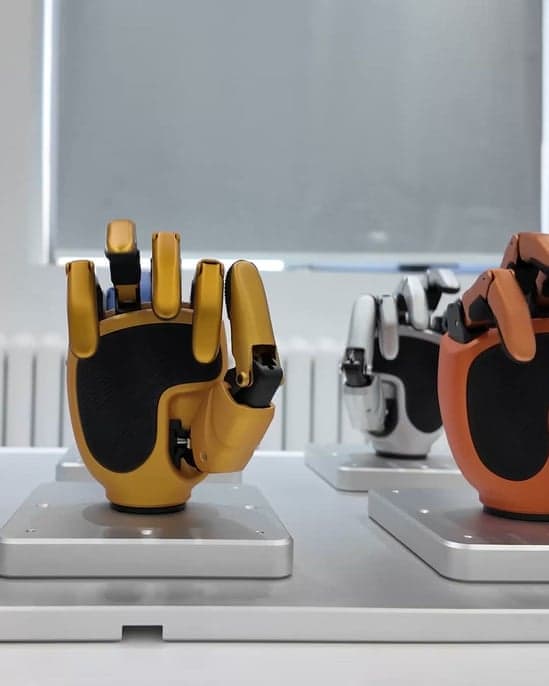
Human hands remain the most complex challenge in robotics—far more difficult than building the robots themselves. While China has deployed more than half of the world's factory robots annually, humanoid machines still lack the dexterity needed for everyday tasks like folding laundry or buttoning shirts. Now a wave of Chinese startups believes they can crack this problem through mass manufacturing and AI training.
LinkerBot founder Zhou Yong puts the challenge in stark terms: building a robotic hand is "one hundred times more difficult" than building a humanoid body. The hand's dexterity is ten times greater than other body parts, yet it occupies just one-tenth the volume. Despite this complexity, LinkerBot now produces approximately 5,000 hands monthly and plans to double that output while pursuing a $6 billion valuation.
Why it matters
Dextrous robotic hands represent the final barrier between humanoid robots as novelties and as practical tools. China's manufacturing ecosystem and government backing of "embodied AI" have created conditions for rapid iteration that Western competitors struggle to match. If Chinese companies succeed in mass-producing capable robotic hands at dramatically lower costs—Zhou targets $1,000 prosthetics versus current prices in the tens of thousands—they could dominate both industrial automation and consumer robotics markets.
Manufacturing Advantage Meets Hardware Challenge
China's electric vehicle supply chain has proven crucial to robotics development. The same factories producing lithium-ion batteries and miniaturized motors for EVs can manufacture robot components at scale. Wuji Technology founder Pan Yunzhe, who graduated from a U.S. university in 2018, returned to China specifically because American supply chains couldn't support hardware development. When he attempted to start a company in the United States, he had to ask his father to mail him parts.
The robotics enthusiasm extends beyond startups. China registered over 1 million robotic companies in 2025, up 40% from the previous year. The Chinese Communist Party's theoretical journal Qiushi identified "embodied-intelligence robots" as sectors "opening up new trillion-yuan markets." The dextrous hand segment alone grew from 13 billion yuan in 2024 to over 50 billion yuan ($7.4 billion) in 2025, according to Chinese media reports.
The Software Problem Remains Unsolved
Hardware manufacturing represents only half the equation. Nathan Lepora, a robotics and AI professor at the University of Bristol, notes that while building hands is becoming solved, "controlling them, now that's a whole different game … nobody knows how to do that."
Training robots requires massive amounts of three-dimensional data that doesn't exist in the quantities available for large language models. Current methods include teleoperation—remotely controlling robotic hands for hundreds of hours to teach simple tasks like packing groceries. Wuji has developed sensor-filled gloves that capture both movement data and subtle pressure information as humans perform daily activities. This tactile data is essential for tasks like cracking an egg without crushing it.
Zhou envisions factories where robotic hands build more robotic hands with minimal human input. Pan frames the challenge differently: "The problem of manipulation is much more important than the problem of locomotion." Humanoids can move through space, but without manipulation capabilities, they remain impractical.
These details were first reported by The Guardian.
This is an original analysis by the Omega editorial team. Source reporting: AI Watch.
Want systems like this working for your business?
Book a Call
