Building a Region Factory: How Cloud Providers Automate Expansion
Launching a new cloud region requires orchestrating infrastructure, metadata, networking, and validation—not just copying services to a new location.
The hidden complexity of cloud expansion
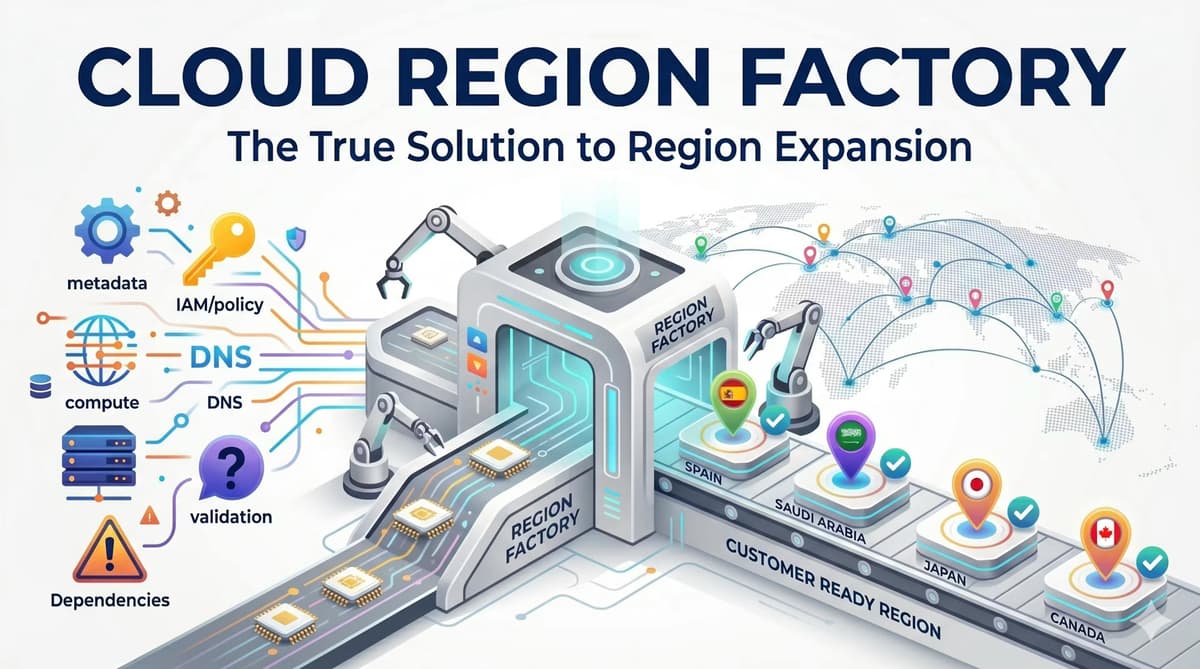
When a cloud provider lights up a new region in Spain or Saudi Arabia, the public sees a map update. Behind that announcement lies a sprawling engineering challenge: orchestrating compute, networking, DNS, identity, quotas, metadata, deployment pipelines, observability, and validation across every customer-facing service.
A new region is not simply "the same service, somewhere else." It's a control-plane problem that requires dozens of interdependent systems to converge before customers can safely use the service. If any piece—IAM propagation, DNS resolution, quota assignment, or metadata reconciliation—is wrong, the region may technically exist but remain unusable.
Why it matters
Region expansion directly impacts customer adoption, latency, data residency compliance, and disaster recovery capabilities. Organizations cannot use a cloud service until it's available in their required geography. For platform engineering teams, automating region launches prevents operational toil and configuration drift that scales poorly as cloud footprints grow.
The dependency graph problem
A production cloud service in a new region needs at minimum: compute capacity, network configuration, DNS routing, IAM enforcement, regional metadata, service registration, quotas, logging, deployment pipelines, data replication, synthetic validation, and rollback behavior.
The challenge is sequencing. A service cannot register its endpoint before DNS is ready. Deployment pipelines fail if regional artifact repositories or permissions are missing. Customers hit confusing errors if quota or policy checks are incomplete. Manual runbooks break under this complexity—configuration drifts, ordering fails, and validation checks only confirm that commands succeeded, not that services are customer-ready.
Why infrastructure-as-code isn't enough
Terraform and CloudFormation solve provisioning, but region expansion requires answering questions IaC templates cannot: Are dependent services available? Have identity policies propagated? Are DNS records safe to expose? Is replication caught up? Are synthetic tests passing?
AWS exposes this through CloudFormation StackSets and Control Tower region controls. Google Cloud requires explicit API enablement per project. Azure uses region pairs and geography-based redundancy. OCI groups regions into realms with cross-region IAM complexity. Different clouds, same underlying problem.
The region factory pattern
A region factory is an automated system that turns regional intent into customer-ready availability. It differs from simple automation by understanding lifecycle:
- Canonical manifest: Single source of truth describing target region, dependencies, compliance requirements, and rollout gates
- Dependency graph: Enforces correct sequencing—IAM before deployment, networking before endpoint registration, observability before production
- Provider adapters: Hides cloud-specific mechanics behind clean interfaces
- Validation gates: Checks real readiness through synthetic transactions, metadata reconciliation, and service-level probes
- Checkpoint behavior: Knows what completed, what failed, what can retry, what must quarantine
The metadata challenge
Much of the pain in region expansion is metadata, not infrastructure. Services need to know which regions exist, which are enabled, which endpoints map where, which quotas apply, which deployment targets are valid. This metadata lives across multiple systems, creating distributed consensus problems. If the backend thinks a region exists but the UI doesn't show it, customers are blocked.
Common failure modes
The most frequent issues: regions exist but services aren't ready, IAM policies haven't propagated, metadata updates in one system but not others, DNS cutover happens too early, replication lags behind, and observability comes last instead of first. Each requires specific gates—capability checks, auth-readiness validation, metadata reconciliation, staged DNS cutover, replication lag measurement, and pre-launch observability.
These details were first reported by HackerNoon in an analysis of multi-region infrastructure automation challenges.
This is an original analysis by the Omega editorial team. Source reporting: Automation Watch.
Want systems like this working for your business?
Book a Call