Automation Failures Go Unnoticed Until Customers Complain
WiBiz argues businesses need audit trails and human approval gates, not just faster workflows.
The silent failure problem
A payment clears, but an automated reminder still goes out. A customer cancels, yet the next scheduled message fires anyway. An inquiry vanishes between inbox and calendar. The common thread: the business learns something broke only after the customer does.
WiBiz, a Singapore-based builder of business operating systems, has published an analysis arguing that small and midsize firms don't need more automation—they need systems that record what happened, preserve context across steps, and pause before executing sensitive actions. The company uses its own platform, Pulse, to demonstrate what disciplined automation looks like when designed around recovery and accountability rather than speed alone.
Why it matters
Singapore's Ministry of Manpower reported in April 2026 that 28.5 percent of firms had begun adopting AI, but only 3.8 percent had integrated it into core operations. Cost, expertise, and security concerns remain the leading barriers, according to the Singapore Business Federation's February 2026 survey. The gap between interest and operational confidence is widening precisely because businesses lack visibility into what their automated systems are doing—and what they're doing wrong.
Event sourcing as operational discipline
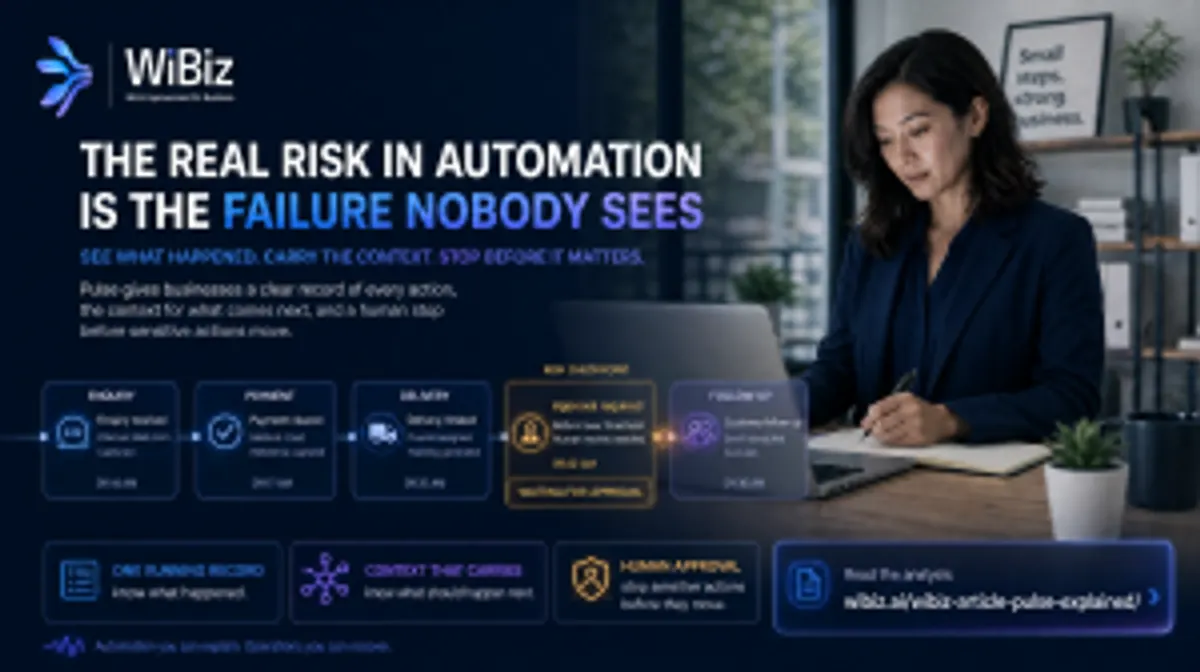
Pulse maintains a single running record of business activity. When an inquiry arrives, a payment processes, or a customer replies, the action is logged against the same continuous history rather than scattered across disconnected tools. That unified record gives the next automated step context: a customer who paid shouldn't be treated as unpaid, and a cancelled booking shouldn't trigger the next confirmation message.
The system also introduces approval gates for defined actions touching money, publishing, scope changes, or customer relationships. A named person must review and approve these steps, with the decision and supporting evidence preserved on record. The underlying architecture is event sourcing, but the business value is straightforward: owners can answer what happened, what should happen next, what was stopped, and who approved exceptions.
Operating layer versus task automation
WiBiz founder Nicklaus D'Cruz frames the distinction as the difference between adding another automation and installing an operating layer. A task automation performs a function. An operating layer carries the working chain across inquiry, payment, delivery, and follow-up while maintaining a readable account of handoffs and decisions.
The company positions Pulse as infrastructure for businesses that need to connect customer inquiries, qualification, booking, payment, delivery, and follow-up into one working chain shaped around how they actually operate—not how a generic workflow template assumes they should.
The full analysis was first reported by WiBiz and is available on the company's website.
Key technical components
- Single event log: All business actions recorded in one chronological stream
- Context propagation: Each step inherits state from previous actions
- Human approval gates: Sensitive actions held for named review
- Audit trail: Decisions and supporting evidence preserved
- Recovery design: System built to explain and correct failures, not just prevent them
This is an original analysis by the Omega editorial team. Source reporting: Automation Watch.
Want systems like this working for your business?
Book a Call
