Amazon, FedEx, DHL Deploy Robots for Trailer Loading and Unloading
Logistics giants are automating the physical handoffs that have resisted machine control longer than warehouse operations.
Robots Target Logistics' Last Manual Bottleneck
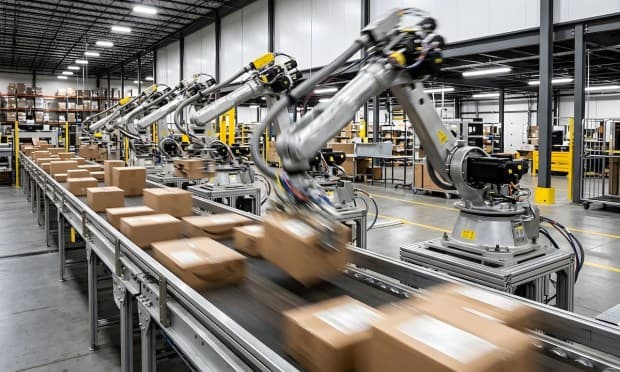
The largest logistics operators are deploying autonomous systems to handle trailer loading and unloading, operations that have proven harder to automate than warehouse picking because package sizes, shapes, and destinations vary unpredictably at network handoff points.
Amazon is developing an internal initiative called Project Tetromino designed to automate its delivery stations, which currently rely on manual sorting and loading before packages reach drivers. An internal planning document projects the system could process packages at roughly 2.5 times the rate of existing delivery-station designs, according to details first reported by Business Insider and GeekWire.
FedEx has moved beyond planning. The company expanded its partnership with Dexterity in July 2025, deploying dual-armed robots called Mech at its Hagerstown, Maryland hub to autonomously load trailers at production scale. "This expanded collaboration with Dexterity reflects our commitment to advancing capabilities that improve how we operate today while helping prepare our network for the future," said Kawal Preet, FedEx's executive vice president of planning, engineering and transformation. FedEx is separately testing an autonomous trailer unloader called Scoop from Berkshire Grey, with first systems expected in operation later this year, FreightWaves reported.
DHL Leads With 1,000-Unit Deployment
DHL has operated this technology longest. Its Stretch robots, built with Boston Dynamics, autonomously unload trailers and containers at rates up to 700 boxes per hour. The company signed a memorandum of understanding in 2025 to deploy more than 1,000 additional units globally, Boston Dynamics announced. DHL has invested over $1.1 billion in automation within its contract logistics division alone over three years, and more than 90% of its warehouses worldwide now run at least one automated solution. "Through our Accelerated Digitalization agenda, we are committed to maximizing the impact of robotics and automation across all our operations and business units," said Sally Miller, DHL Supply Chain's global chief information officer.
Why It Matters
These investments target a specific capacity constraint: physical handoffs between transportation modes. A delivery station operating 2.5 times faster can push more volume through the same real estate footprint. A trailer that unloads at 700 boxes per hour reduces dock time, freeing capacity across an entire route network. That throughput advantage explains why logistics companies are moving ahead of most industries on supply chain automation. According to PYMNTS Intelligence's "The Enterprise AI Payback Curve" report, based on a June 2026 survey of 60 senior technology executives at companies with at least $1 billion in annual revenue, 53% to 67% of large companies across various sectors remain in early exploration stage for supply chain AI functions. The companies that have scaled AI in this area concentrate specifically on order fulfillment and returns optimization, exactly where Amazon, FedEx and DHL are directing their heaviest automation spending.
These details were first reported by PYMNTS.
This is an original analysis by the Omega editorial team. Source reporting: Automation Watch.
Want systems like this working for your business?
Book a Call