Air Force X-62 VISTA flies autonomously using live infrared data
The HAVE HEAT experiment demonstrated AI-controlled intercepts guided by real-time sensor input, advancing combat autonomy research.
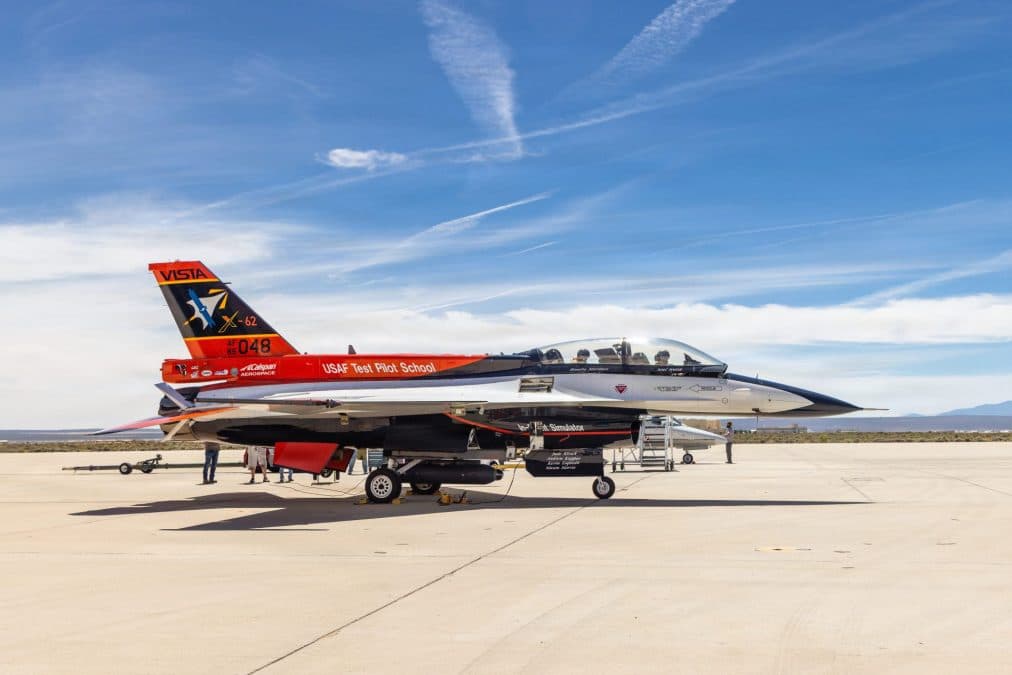
The Air Force has successfully demonstrated an artificial intelligence agent autonomously flying a fighter jet using live infrared sensor data, completing 27 autonomous air intercepts across eight flights in April at Edwards Air Force Base in California.
The experiment, called HAVE HEAT, represents a significant advance in AI-enabled combat development. Unlike previous tests that relied on simulated sensor inputs, this demonstration used real-time onboard infrared data to guide the X-62 Variable In-flight Simulation Test Aircraft (VISTA) as it intercepted a live T-38 Talon aircraft, according to an Air Force announcement Tuesday.
Why it matters
This demonstration bridges the gap between theoretical AI flight control and operational combat capability. By proving that autonomous systems can process live sensor data and execute tactical maneuvers in real time, the Air Force has validated a critical building block for future AI-enabled air combat. The ability to fuse live targeting data with autonomous flight control could eventually enable faster decision-making in contested environments where human reaction time becomes a limiting factor.
Real sensors, real targets
The Air Force Test Pilot School integrated the X-62 with Lockheed Martin's Infrared Search and Track Legion Pod, a multi-function sensor system that allows fighter jets to passively detect and track airborne threats without using radar. This passive sensing capability is particularly valuable in contested environments where radar emissions can reveal an aircraft's position.
"HAVE HEAT represents a meaningful expansion of avionics capability towards integrated, AI-driven control of multiple sensors and air vehicles for mission autonomy," said Lt. Col. Joshua Strafaccia, dean of faculty for research at the Air Force Test Pilot School. "This bridges a capability gap and positions us to test advanced autonomy faster."
Stacy Kubicek, vice president and general manager for Lockheed Martin sensors and global sustainment, emphasized the importance of connecting sensor data directly to autonomous action. "The real advantage comes when that data can connect seamlessly with AI to take action," Kubicek said.
Parallel safety and integration work
Alongside HAVE HEAT, the Air Force conducted a second experiment called HAVE HOLIDAYS, which focused on integrating modular software and hardware into the X-62's Enterprise Open Mission System Architecture computer. This effort evaluated updated safety constraints designed to prevent autonomous systems from exceeding operator-defined limits and added new processing hardware for advanced sensor exploitation.
Both experiments were conducted under the X-62's ongoing Mission Systems Upgrade program, which aims to expand the test aircraft's ability to evaluate AI-enabled flight for future combat applications.
What comes next
The Air Force plans to integrate RTX's PhantomStrike radar, expanded onboard computing capacity, and modern networking capabilities into the X-62. These upgrades will allow researchers to evaluate multiple sensors, combat systems, and autonomous software agents operating together in a networked environment.
For years, the X-62 has served as a flying laboratory for AI research, with experiments focusing on autonomous flight development, data fusion, and situational awareness missions.
These details were first reported by Defense Scoop.
This is an original analysis by the Omega editorial team. Source reporting: AI Watch.
Want systems like this working for your business?
Book a Call