Automation
AI Takes the Controls: Autonomous Flight Systems Arrive Faster Than Expected
From cross-country pilotless flights to AI traffic management, aviation is racing toward automation—but safety questions linger.
Key takeaways
- Joby Aviation completed a 3,200-mile autonomous cross-country flight in September with a safety pilot aboard but never touching controls.
- The FAA deployed SMART, an AI traffic management system, in September to optimize airspace—but couldn't rule out AI involvement in April's national groundstop.
- Amazon plans drone delivery at 500 locations by year's end; Walmart targets 270 stores by 2027, with industry predicting hundreds of thousands of drones eventually.
- eVTOL air taxis must operate autonomously to be economically viable, but achieving aviation's reliability standards remains an unsolved engineering challenge.
- The FAA cut its air traffic controller staffing target by over 2,000 positions, citing AI-enabled efficiency tools.
A single-engine Cessna Caravan recently flew 3,200 miles across the United States—from California to North Carolina, navigating busy airspace and weather systems—without a human pilot touching the controls. While a safety pilot sat aboard and monitored the journey, the aircraft operated entirely autonomously throughout the September flight.
Joby Aviation, the company behind the demonstration, marked the coast-to-coast trip as a major milestone in aviation automation. The achievement arrives as artificial intelligence penetrates the traditionally conservative aviation sector at unprecedented speed, promising to reshape how aircraft operate and how the industry manages increasingly crowded skies.
The infrastructure push
Aviation's AI transformation began in earnest with the federal government's 2007 NextGen initiative, which mandated that aircraft be equipped with ADS-B systems by 2020. These systems continuously broadcast location and trajectory data, creating the foundation for autonomous aircraft to share airspace safely.
That groundwork enabled companies like Amazon and Walmart to pursue drone delivery networks. Amazon announced plans in August to expand drone delivery to 500 locations by year's end, while Walmart targets 270 store locations by 2027. Industry executives predict hundreds of thousands of delivery drones will eventually serve most of the U.S. population within five to ten years.
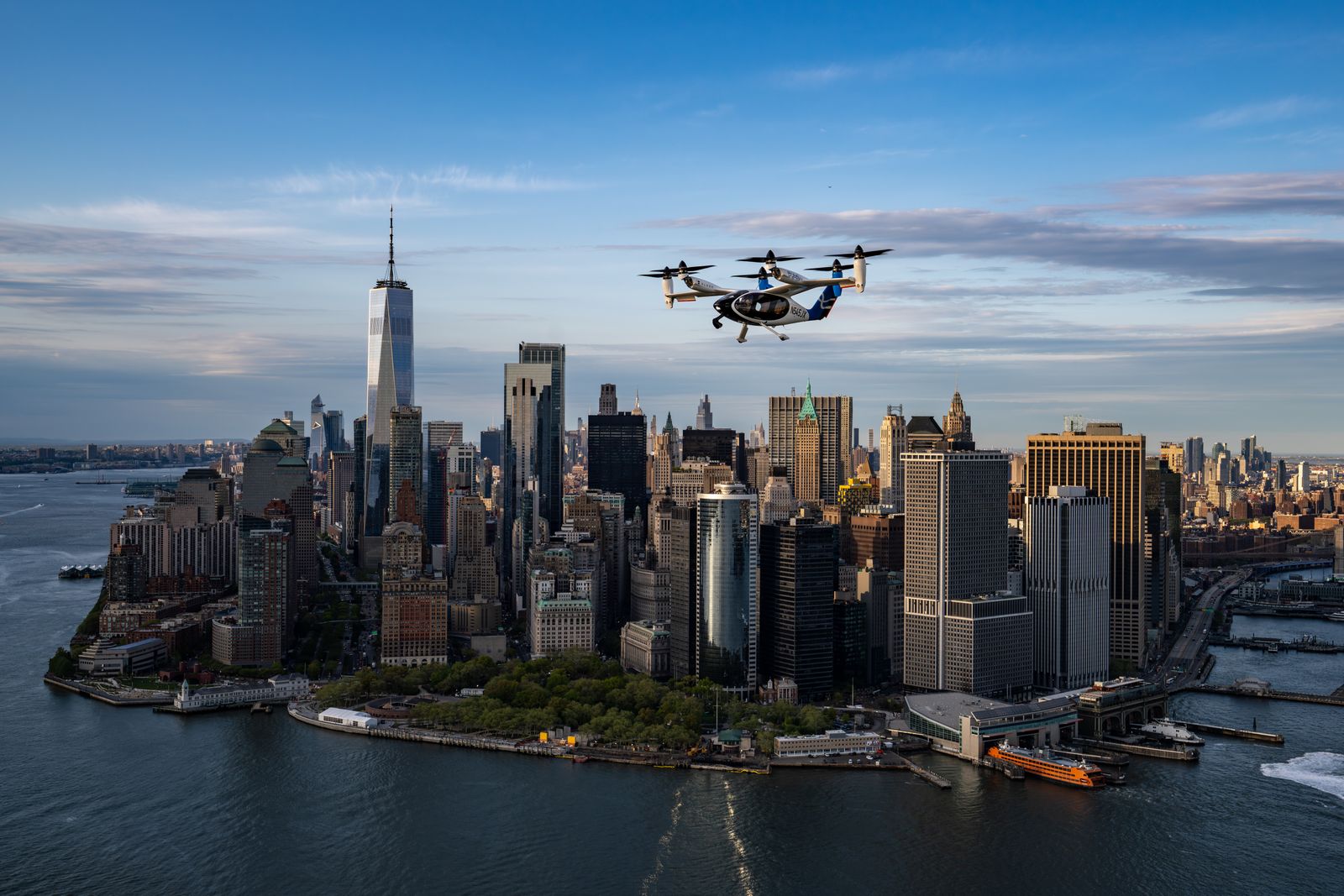
Electric vertical takeoff and landing aircraft—eVTOLs or air taxis—represent another frontier. By 2022, manufacturers were developing 600 different models. Joby's S4 model, designed to carry a pilot and four passengers up to 100 miles at 200 mph, completed demonstration flights in New York, California, and Texas under the Trump administration's eVTOL Integration Pilot Program launched in March.
AI enters air traffic control
In September, the FAA deployed SMART (Strategic Management of Airspace, Routes and Trajectories), an AI-powered system built by Boston-based Air Space Intelligence. The software uses predictive AI to help controllers optimize traffic flow and prevent scheduling conflicts before they occur.
Transportation Secretary Sean Duffy promoted SMART as a "game changer" that would reduce delays. But when a national groundstop halted flights on April 13 due to communications failures, Homeland Security Secretary Markwayne Mullin couldn't definitively rule out AI involvement, saying only "there's nothing certain right now." The FAA found no evidence SMART contributed to the failure.
The system has drawn scrutiny from lawmakers concerned about AI hallucinations in safety-critical applications. In October, nearly two dozen Democratic lawmakers requested a Government Accountability Office review of the program.
The reliability question
Aviation's conservative approach to technology stems from stark consequences: failures cost lives. "Aviation regulation has been conservative and prioritizes reliability, because the consequences of failure are severe," says Mary Schiavo, an aviation lawyer and former Department of Transportation inspector general. "Certification standards and airworthiness require proof and demonstrated safety, and that usually means incremental rather than radical change."
Researchers note that even deterministic neural networks—models that can't hallucinate—may produce dangerous outputs when encountering unfamiliar situations. A 2021 paper by Collins Aerospace researcher Darren Cofer highlighted this risk.
The FAA reduced its 2025 air traffic controller staffing target from 14,633 to 12,563, citing "modern staffing models and scheduling tools." Critics worry AI efficiency gains could justify workforce reductions even if the technology doesn't directly replace humans.
Why it matters
The aviation industry's rapid AI adoption creates a fundamental tension between Silicon Valley's move-fast culture and aviation's requirement for proven reliability. As autonomous aircraft and AI traffic management systems deploy nationwide, the industry is effectively conducting a live experiment with public safety. The economic viability of eVTOLs depends on removing expensive human pilots, but achieving the reliability standards aviation demands remains an open engineering challenge. Any failure could set the technology back years and erode public trust in air travel automation.
Looking ahead
Michael McCormick, a professor of air traffic management at Embry-Riddle Aeronautical University, expects AI-controlled airspace to emerge first in corridors near drone hubs and eVTOL vertiports, where autonomous aircraft density would overwhelm human controllers. These zones will provide real-world performance comparisons between human and AI decision-making.
For eVTOLs to become economically viable, they must eventually operate without human pilots—a requirement that raises the stakes considerably. "When human lives are at stake, it's better to be time-tested and a little dated than cutting-edge and unpredictable," one recently retired FAA employee told WIRED, which first reported these developments. "This is literally a Pandora's box that we are going to regret."