AI News Site Loses All Google Traffic After Spam Update
MediaBias.news published full methodology and audit data after August 2026 algorithm change eliminated search referrals while other channels remained stable.
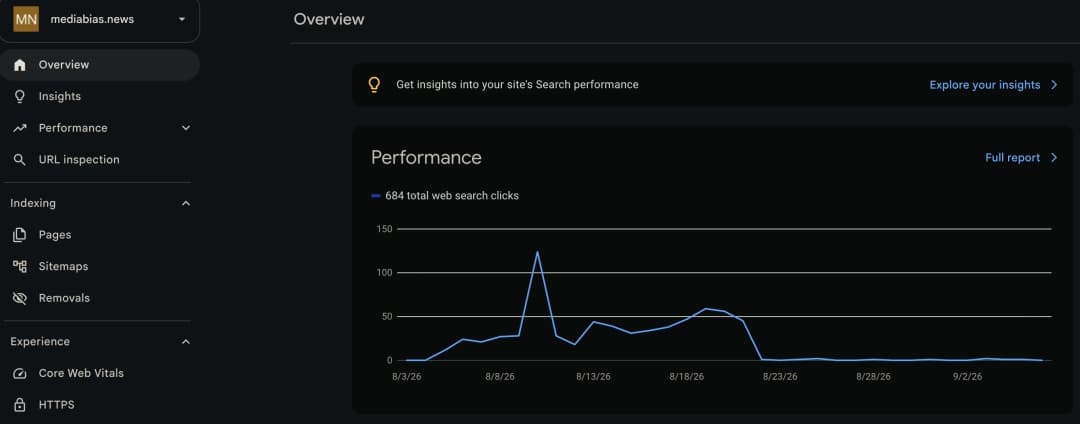
An AI-assisted news comparison site has lost all Google search referrals following the search giant's August 2026 spam update, despite maintaining transparent editorial controls and receiving steady traffic from other sources.
MediaBias.news, which tracks how hundreds of publishers cover the same news events, saw its Google referrals drop from 40-60 clicks daily to zero on August 22, 2026, according to the site's Search Console data. The timing coincided with the completion of Google's spam update, which began August 18 and finished approximately 2.5 days later. The site received no manual action notice and continues to attract roughly 300 daily visits through Bing, AI assistants, and direct traffic, according to Automation Watch.
The automation distinction problem
The case illustrates a fundamental challenge facing search systems: distinguishing between automation that adds value and automation designed solely to manipulate rankings. Both approaches share surface characteristics—rapid publication, processing of third-party material, and operation at scale beyond individual human capacity.
Google's spam policy defines "scaled content abuse" as producing many pages primarily to manipulate rankings rather than help users, with the core test being whether a page adds value. The company's guidance does not prohibit AI-generated content outright.
MediaBias.news operates by grouping reports about single events, extracting underlying articles, identifying syndicated copies to avoid counting wire stories as independent corroboration, and separating political leaning from factual reliability. The resulting pages show how outlets across the political spectrum framed events, what each emphasized or omitted, and where claims originated, with links to original reporting.
Published safeguards and methodology
Unlike most publishers, MediaBias.news has made its editorial controls public. The site performs reliability scoring on source reporting before generating its own articles, preventing self-grading. Syndicated duplicates are counted once. Trust and Craft scores are awarded for verifiable attributes including named sources, documents, independent corroboration, specific dates and figures, and right of reply.
Each draft undergoes mechanical comparison against sources and is rejected if more than 12 percent of unquoted prose matches a source across ten-word sequences. Headlines are constrained by a hype score assigned to source coverage. The site maintains a public corrections log, documents known failure modes, and publishes repeatability tests showing variance between identical model runs.
Why it matters
This case raises questions about how algorithmic systems evaluate automated content when transparency alone may not prevent classification as spam. As more publishers adopt AI tools for research and synthesis rather than simple rewriting, search engines face growing pressure to distinguish between value-adding automation and content farms. The outcome affects not just individual publishers but the broader question of whether transparent methodology can serve as a defense against algorithmic penalties—and whether small, independent operations have recourse when automated systems make classification errors.
A MediaBias.news spokesperson acknowledged the difficulty of the judgment search systems must make, stating the publication's response is transparency: publishing every score, source, and known weakness so work can be judged on content rather than tools used.
MediaBias.news, founded in 2026 by Vali Neagu and published by Web Design Studio London Ltd, accepts no funding from political parties, campaigns, or governments. These details were first reported by Automation Watch.
This is an original analysis by the Omega editorial team. Source reporting: Automation Watch.
Want systems like this working for your business?
Book a Call