AI Data Centers Raise Local Temperatures by Up to 9°C, Study Finds
Cambridge-led research reveals hyperscale facilities create measurable warming effects extending six miles from their locations, affecting 340 million people worldwide.
AI Infrastructure Creates Localized Heat Islands
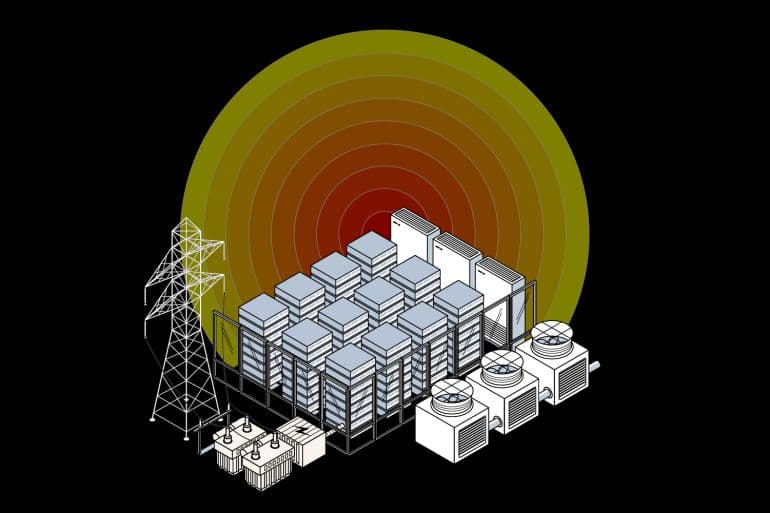
The massive data centers powering artificial intelligence are doing more than processing queries—they're measurably warming the ground around them. Cambridge-led researchers have documented what they call the "data heat island effect," finding that land surface temperatures around AI data centers rise by an average of 2 degrees Celsius after facilities open, with some locations recording increases as high as 9°C.
The study analyzed NASA satellite data from 2004 to 2024, cross-referencing temperature measurements with more than 11,000 AI data center locations worldwide. Researchers focused on 6,733 facilities outside densely populated areas, comparing post-opening temperatures against five-year baselines at identical locations. The warming effect extends up to 10 kilometers from each facility, potentially impacting more than 340 million people living within that radius.
The Energy Equation Behind the Heat
Hyperscale data centers—the largest facilities operated by companies like Google, Amazon, and Microsoft—require between 100 and 300 megawatts of continuous electricity to operate, enough to power hundreds of thousands of homes. These facilities typically house at least 5,000 servers across a minimum of 10,000 square feet.
According to the International Energy Agency, data centers consumed approximately 415 terawatt hours of electricity in 2024, representing 1.5 percent of global supply. That figure has grown at roughly 15 percent annually over the past five years and is projected to nearly double to 945 TWh by 2030.
The energy consumption generates enormous heat loads that require advanced liquid cooling systems consuming vast water quantities. A UK government report found that a single 100-megawatt hyperscale facility can use about 2.5 billion liters of water annually—equivalent to the needs of 80,000 people.
Unprecedented Construction Acceleration
More than 11,600 data centers are currently active worldwide as of June 2026, according to Data Center Map. The United States hosts over 4,300 facilities, while Europe represents the second-largest concentration with the UK leading at 540-plus facilities, followed by Germany and France.
The number of hyperscale data centers has nearly doubled since 2021, growing from 700 to 1,297 facilities globally, according to Synergy Research Group. Goldman Sachs projects $5.3 trillion in combined capital expenditure between 2025 and 2030 for the four largest hyperscalers: Microsoft, Amazon, Alphabet, and Meta.
Major projects in development include Meta's $27 billion Hyperion campus in Louisiana, Microsoft's $20 billion Wisconsin expansion, Amazon's $25 billion Mississippi investment, and Oracle's Project Stargate in Texas—a massive AI supercluster with 1.2 to 2 gigawatts of total capacity dedicated to OpenAI.
Why it matters
As AI adoption accelerates, the physical infrastructure supporting it creates environmental consequences that extend beyond carbon emissions and water consumption. The documented temperature increases could strain nearby communities through elevated cooling costs, health impacts from prolonged heat exposure, and broader effects on regional ecosystems—factors that researchers argue should inform planning decisions as the industry invests trillions in new capacity over the next five years.
These findings were first reported by Al Jazeera, drawing on research published by Cambridge University and partner institutions.
This is an original analysis by the Omega editorial team. Source reporting: AI Watch.
Want systems like this working for your business?
Book a Call
