AI Content Governance Drives New Demand for DAM Platforms
Enterprise marketers struggle to control AI-generated assets as traditional automation fails to address brand consistency and compliance risks.
The automation paradox in AI-driven marketing
Marketing organizations built their content operations around rules-based automation, expecting predictable workflows to scale production. That foundation is cracking under the weight of generative AI, which doesn't follow rules reliably and frequently adds unwanted elements to outputs.
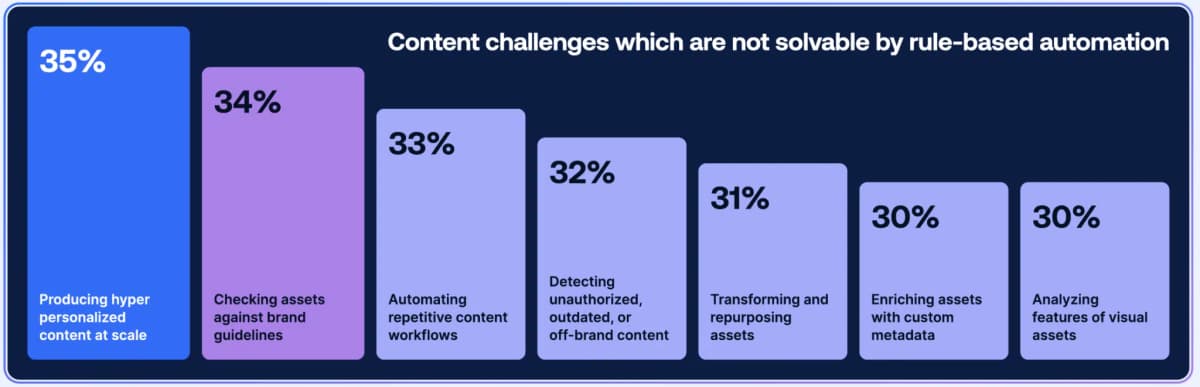
According to Bynder's "State of DAM Report 2026," 93% of enterprise organizations now face content challenges their existing automation systems cannot address. The problems extend beyond production velocity to fundamental governance issues: detecting off-brand assets, controlling AI-generated content, personalizing at scale, and managing increasingly complex approval chains.
Why it matters
As AI becomes embedded in everyday campaign execution rather than experimental projects, content governance shifts from a final review step to continuous oversight. Organizations that lack structured systems for managing AI outputs face compounding risks around brand consistency, copyright compliance, and regulatory exposure—making digital asset management platforms critical infrastructure rather than optional repositories.
Security and compliance top marketer concerns
Security has emerged as the primary concern when deploying AI in content operations, according to the report. Legal and regulatory compliance ranks second, followed by inaccurate or hallucinated outputs. Marketers also cite worries about inconsistent brand content and the risk of creating new workflow bottlenecks while attempting to scale AI adoption.
These anxieties reflect a broader shift in how marketing teams think about automation. The initial enthusiasm for AI's content generation capabilities has given way to questions about control, accountability, and risk management.
Hybrid workflows dominate AI adoption
Across critical functions including brand governance, metadata management, content quality control, and multi-channel asset adaptation, the most common approach combines AI execution with human approval. Between 40% and 44% of survey respondents report using workflows where automation performs the work while people make final decisions. Another 31% to 35% employ mixed processes that integrate automation and manual review throughout.
This pattern suggests AI is absorbing repetitive tasks while humans retain responsibility for judgment, governance, and accountability—a division of labor that requires structured handoffs and clear decision points.
DAM platforms become AI governance infrastructure
The research points to a fundamental requirement: AI performs best when it can access well-organized content, consistent metadata, explicit brand guidelines, and defined approval processes. Without that context, even sophisticated models struggle to make reliable decisions.
Many organizations are responding by repositioning their DAM platforms as the foundation for AI governance. Rather than functioning solely as storage systems, these platforms now provide the rules, permissions, and context AI needs to support content creation, review, and distribution at enterprise scale.
The strategic question has evolved from "how much work can we automate" to "where should automation end and human judgment begin." That shift makes structured content management and governance frameworks essential prerequisites for scaling AI in marketing operations.
The findings were first reported by MarTech based on Bynder's "State of DAM Report 2026," which surveyed enterprise marketing organizations about their content management challenges and AI adoption patterns.
This is an original analysis by the Omega editorial team. Source reporting: Automation Watch.
Want systems like this working for your business?
Book a Call