AI Agent Completes 27 Live Fighter Intercepts Using Real Sensors
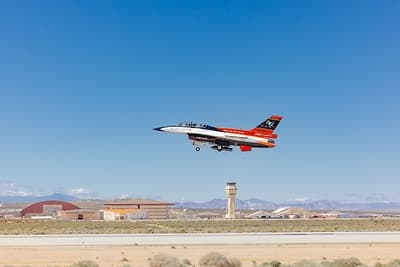
Lockheed Martin's X-62 VISTA demonstrated autonomous combat maneuvers guided by operational targeting data in partnership with Air Force Test Pilot School.
AI closes the sensor-to-action loop in fighter aircraft
Lockheed Martin's Skunk Works division has demonstrated a significant milestone in combat aviation autonomy: an artificial intelligence agent successfully piloted a fighter aircraft through 27 live intercepts using real-time sensor data. The tests, conducted across eight flights on the X-62 Variable In-flight Simulation Test Aircraft (VISTA) in partnership with the U.S. Air Force Test Pilot School, mark the first time AI has closed the loop from operational sensor input to autonomous tactical maneuver.
The X-62 was equipped with Lockheed Martin's Legion Pod, an infrared search and track system that provided classified targeting data on a live T-38 jet. The AI agent processed this sensor stream and autonomously guided the fighter into tactical intercept positions without human pilot intervention.
Why it matters
This demonstration bridges a critical gap between simulated AI testing and operational readiness. Previous autonomous flight tests relied on simulated or pre-programmed target data. By proving AI can process real sensor feeds and execute combat maneuvers in response, Lockheed Martin has validated a core requirement for deploying autonomous systems in actual air combat scenarios where pilots face unpredictable threats and must make split-second decisions.
Rapid integration timeline
The test series showcased what Lockheed Martin calls its "Supermassive" AI agent generation capability, which compressed the timeline from AI development to flight test. Full integration and ground testing of the autonomous agents with the X-62 platform occurred in just three months, according to details first reported by Lockheed Martin.
"Our autonomous agents consumed classified infrared search and track feeds and executed combat-critical maneuvers in real time," said Ron Fehlen, vice president and general manager of Lockheed Martin Skunk Works. "This achievement marks a decisive advance toward delivering AI-augmented air dominance for the United States."
Strategic implications for pilot operations
The operational concept centers on augmentation rather than replacement. By delegating complex intercept calculations and flight control to AI, human pilots gain cognitive bandwidth to focus on higher-level tactical decisions and situational awareness—factors Lockheed Martin identifies as critical to pilot survivability in contested airspace.
Stacy Kubicek, vice president and general manager of Lockheed Martin Sensors and Global Sustainment, emphasized the integration challenge: "The real advantage comes when that data can connect seamlessly with AI to take action. This project demonstrates how sensing and autonomous AI can come together as a force multiplier to make faster, more informed action in complex environments."
Next phase: mesh network integration
The X-62's planned Mission Systems Upgrade will build on this foundation by demonstrating integration of combat systems, sensors, and airborne AI agents within a next-generation mesh network architecture. Skunk Works has provided open software and hardware architectures for the X-62 platform for decades, enabling it to serve as a testbed for pathfinding flight experiments.
The partnership between the Air Force Test Pilot School and Lockheed Martin expands TPS's AI and autonomy test portfolio to include mission-critical onboard systems, creating a framework for accelerated development of operational autonomous capabilities.
Details of the test series were announced by Lockheed Martin on August 4, 2026.
This is an original analysis by the Omega editorial team. Source reporting: AI Watch.
Want systems like this working for your business?
Book a Call