80% of U.S. Factories Still Lack Robotics as Physical AI Shifts Automation Economics
New teaching methods and lightweight cobots are targeting the vast majority of manufacturing facilities that have never deployed automation.
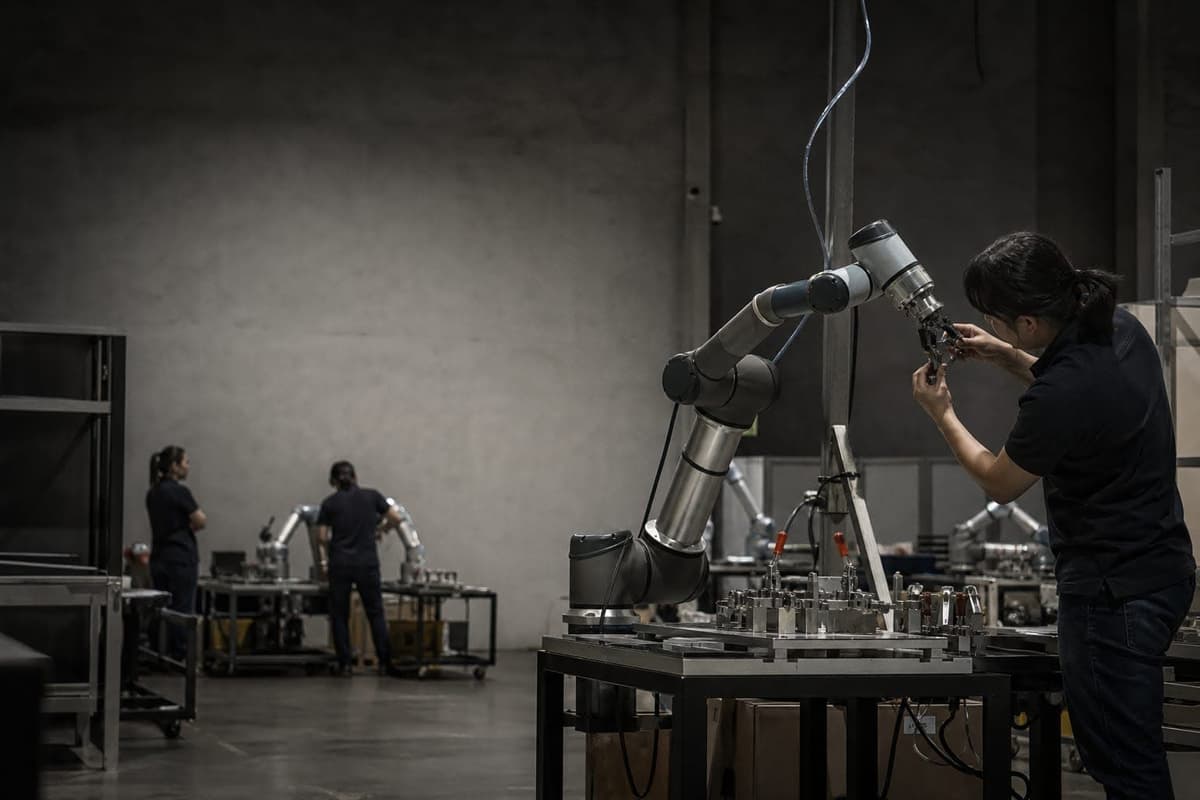
The industrial robotics market is responding to a striking reality: 80% of U.S. factories currently operate without any robotics or automation, according to MarketScale reporting from mid-2026. That gap is driving a wave of technology shifts, vendor restructuring, and capital deployment aimed at making automation accessible to facilities that have historically been unable to justify or implement it.
Why it matters
The majority of U.S. manufacturing capacity remains manual not because automation is impossible, but because traditional robotics required programming expertise and infrastructure most facilities lack. The convergence of physical AI, lighter hardware, and new distribution models is changing that equation for the first time, with direct implications for labor costs, production flexibility, and domestic manufacturing competitiveness.
Physical AI eliminates the programming barrier
Standard Bots co-founder Evan Beard explained to MarketScale that physical AI is fundamentally changing what can be automated by allowing robots to learn through physical demonstration rather than written code. This removes the need for dedicated robotics engineers, one of the steepest barriers for smaller manufacturers.
Tasks previously considered too variable for automation—irregular part handling, context-sensitive assembly—become viable deployment targets when the question shifts from "can we program this?" to "can we demonstrate this?" This approach aligns with broader mid-2026 trends in embodied robotics and agentic systems that push intelligence into the physical factory environment rather than keeping it confined to software layers.
Vendor landscape in flux
The supplier side is reorganizing rapidly. Honeywell is restructuring into standalone business units, while billions in venture capital are flowing into AI robotics startups, creating a new tier of specialized vendors alongside established integrators, MarketScale reported in early July.
For procurement teams, this creates both opportunity and complexity. Standalone units may offer sharper product focus, but evaluating funded startups requires diligence on financial stability and integration support. Distribution channels are also expanding—Mouser Electronics added nine manufacturers to its industrial automation portfolio in the first half of 2026, covering AI, IIoT, robotics, and safety categories.
Major manufacturers embed AI in production
Fanuc, Kawasaki, and Stellantis are anchoring industrial AI partnerships that incorporate imitation learning and digital twins directly into production systems, according to MarketScale coverage from July 5. Imitation learning allows robots to acquire behaviors from observed examples, while digital twins let engineers validate changes in simulation before touching live production.
Siemens and IFS are integrating industrial AI across design, production, and service phases, closing the product lifecycle loop and reducing handoff gaps where errors typically accumulate.
Hardware gets lighter and more accessible
Fanuc America debuted the CRX-3iA in April 2026, an ultra-lightweight collaborative robot designed for smaller tasks and tighter spaces. Cobots at this weight class lower infrastructure requirements significantly, eliminating the need for heavy floor loading or safety caging that traditional industrial arms require.
ABB is also pushing to make automation more accessible to the 80% of facilities still running manual operations. The combination of lighter hardware, AI-assisted programming, and expanding distribution is designed to compress the time and cost of initial deployment.
The gap persists despite installation growth
U.S. robotics installations are rebounding in 2026, with defense sector capacity buildout adding demand. Velo3D tripled its production campus footprint as part of this wave. However, rising numbers at the top of the market do not automatically close the 80% gap at the bottom, where facilities are typically smaller, higher-mix, and harder to address with traditional tools.
Physical AI and imitation learning are attracting attention precisely because the next phase of U.S. manufacturing automation depends on bringing in facilities where a dedicated automation team is not realistic. The mid-2026 product and partnership activity suggests vendors are finally building for that reality.
These details were first reported by MarketScale in their July 2026 industrial automation coverage.
This is an original analysis by the Omega editorial team. Source reporting: Automation Watch.
Want systems like this working for your business?
Book a Call
