U.S. Races China for Global AI Influence as Export Controls Backfire
Chinese models are gaining ground in the Global South while American export restrictions leave allies uncertain and seeking alternatives.
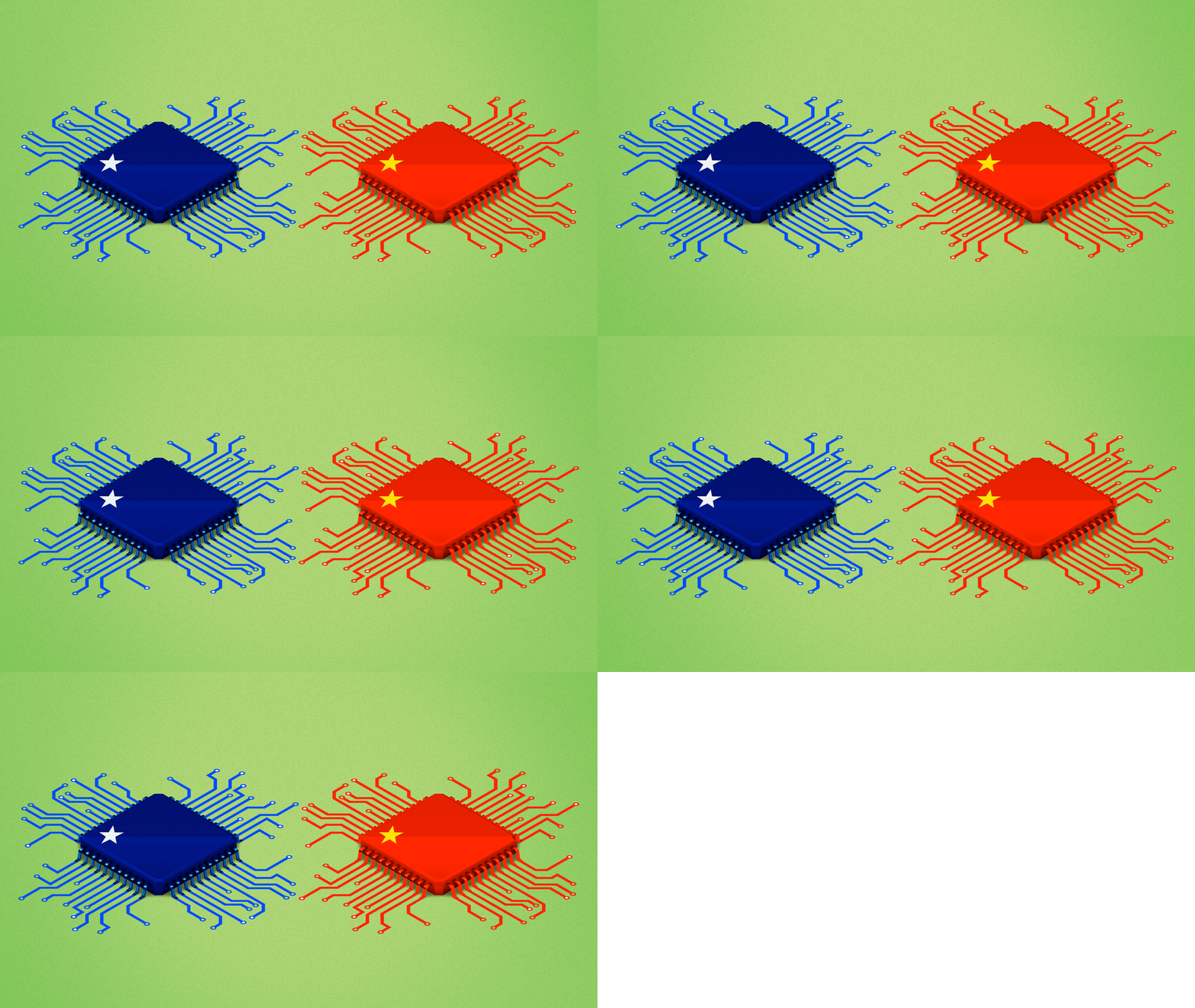
The United States is struggling to maintain its lead in the global AI race, not because Chinese models are superior, but because Washington's own export control policies are pushing potential allies toward Beijing's alternatives.
Why it matters
Dominance in AI isn't just about having the most advanced technology—it's about whose infrastructure the world builds on. If countries adopt Chinese AI systems now, they may lock themselves into ecosystems incompatible with American technology for years to come, reshaping geopolitical alliances and economic dependencies.
Export controls create uncertainty
The U.S. government's recent decision to restrict exports of Anthropic's newest AI models has left the American tech industry in limbo. According to Daniel Remler, a former State Department technology adviser now at the Center for a New American Security, "the entire industry is kind of frozen in place, waiting for something that seems kind of more coherent."
This uncertainty arrives at a critical moment. Chinese AI models are closing the capability gap with American frontier systems while offering significantly lower costs. Emily Weinstein, a former Commerce Department staffer now at the U.S.-China Economic and Security Review Commission, warns that China is deploying a "Huawei strategy" for AI—offering models and associated infrastructure at little or no cost to developing nations.
The risk, Weinstein explained during a CNAS panel this week, is creating a "Huawei model on steroids" where countries become dependent on Chinese infrastructure that doesn't interoperate with U.S. systems.
China's open-source advantage
China's strategy centers on open-source AI models that countries can adopt without the restrictions or costs associated with American alternatives. Saif Khan, former counselor for critical and emerging technologies to the Secretary of Commerce, predicts that "much of the rest of the world will likely, at least on the margin, prefer Chinese open-weight models" over U.S. frontier models.
This preference is being amplified by growing calls for "AI sovereignty"—the desire among nations to develop homegrown AI capabilities rather than depend on foreign providers.
U.S. countermeasures
The State Department is attempting to counter China's momentum through its Pax Silica initiative, which aims to build a U.S.-led AI and chip supply-chain bloc. This week, undersecretary of state for economic affairs Jacob Helberg announced that 35 countries have signed the "Declaration on AI Opportunity" as part of the effort.
Helberg dismissed digital sovereignty as "backward and counterproductive" and "synchronized mediocrity." Yet even close U.S. partners are hedging their bets. The European Union emphasized digital sovereignty following the Anthropic export decision, and the United Arab Emirates is pursuing what it calls "strategic autonomy through international collaboration with trusted partners," according to assistant foreign minister Omran Sharaf.
The deployment challenge
Experts point to two fundamental problems undermining U.S. efforts: an inconsistent export controls strategy that makes decisions about model access on an ad-hoc basis, and insufficient attention to China's systematic deployment of AI across manufacturing, healthcare, and other sectors domestically while promoting its models internationally.
The challenge for Washington isn't just maintaining its technological edge—it's persuading the world to build on American AI infrastructure rather than Chinese alternatives that are increasingly capable, widely available, and significantly cheaper.
These details were first reported by Axios.
This is an original analysis by the Omega editorial team. Source reporting: AI Watch.
Want systems like this working for your business?
Book a Call