US Army Faces 40+ Days of Mandatory Training Annually
Administrative burden has grown eight-fold since the 1980s, prompting cuts and a push toward AI-assisted drafting for routine paperwork.
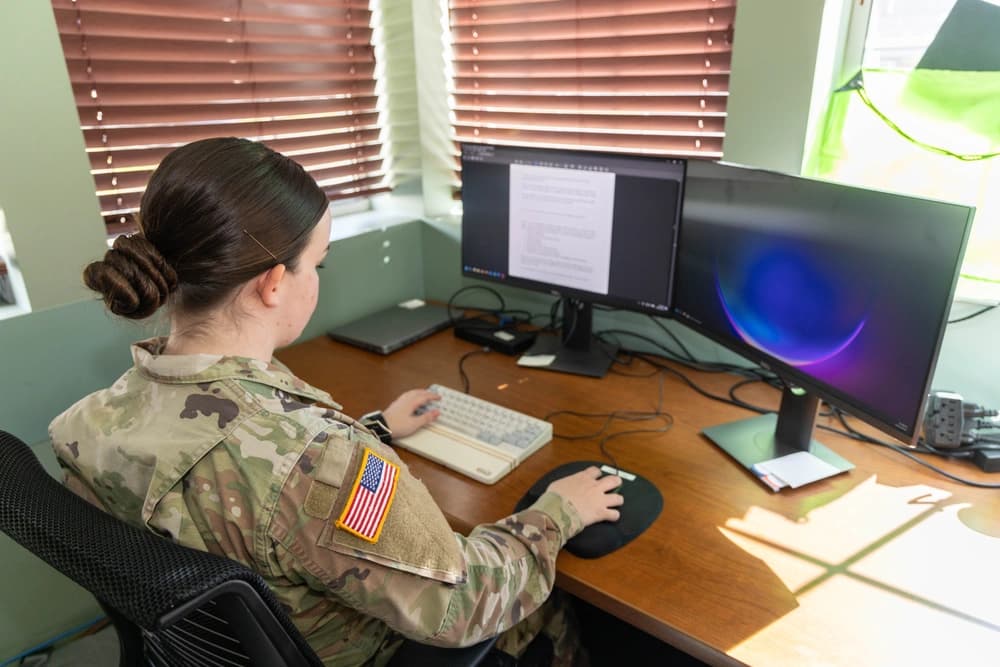
The United States Army's mandatory training requirements have ballooned from approximately five days per year in the 1980s to more than forty days by 2018, according to an Army War College count. For National Guard soldiers who receive roughly 39 paid training days annually, the compliance slate now threatens to consume the entire training calendar before weapons training begins.
The service has responded with aggressive cuts. In 2024, Army leadership eliminated roughly 350 hours of online coursework and scrapped the Structured Self-Development program. In April 2025, Chief of Staff General Randy George dropped nearly a dozen more mandatory programs and reduced the training regulation from over 250 pages to 132. Command Sergeant Major Chris Mullinax framed the goal plainly: remove distractions and burdens so warfighters can focus on warfighting.
Yet deletion is not the only available lever. Most surviving administrative work—soldier counseling, award citations, readiness reporting, evaluation support documents—consists of rote drafting that generative AI models handle well. The Department of Defense has already accredited platforms like GenAI.mil and the Army's Enterprise LLM Workspace, which reached more than a million users by February 2025.
Why it matters
The compliance burden does more than waste time. A 2015 Army War College study titled "Lying to Ourselves" by Leonard Wong and Stephen Gerras documented that officers routinely certified tasks they had not completed because the volume of requirements exceeded available hours. Each falsely certified form teaches soldiers that signatures are formalities, a lesson that does not stay confined to trivial training modules. When the Army needs those same officers to face harder ethical choices—rounding up readiness numbers, sworn statements, patrol reports—the rehearsal in small dishonesty becomes consequential.
The Army has already demonstrated AI's capacity for administrative work. When the service needed 300,000 personnel descriptions rewritten, the Workspace completed the task in approximately one week—work estimated at 50,000 human-hours of review. The Department of Veterans Affairs piloted AI-drafted disability questionnaires from medical records starting in August 2025, contributing to a 72 percent reduction in claims backlog while average decision time fell from 141 days to under 80.
Three implementation barriers
Money is not the constraint; the platforms are purchased, accredited, and available in every soldier's browser. The first real gate is data quality. AI drafting tools connected to the Army's Integrated Personnel and Pay System-Army (IPPS-A) and Army Training Information System (ATIS) would inherit existing record errors, producing confident mistakes with signature blocks attached. IPPS-A publishes a running list of known errors that must be cleaned before automation scales.
The second barrier is permission. Senior leadership must authorize AI-drafted documents—verified and signed by humans—as valid counselings, citations, and reports. This costs nothing but has not been done.
The third risk is verification discipline. People monitoring reliable automation stop checking it. A signature performed as ceremony on an unread draft would accelerate the dishonesty Wong and Gerras documented rather than solving it. Verification must remain substantive: fact-by-fact checks, liability staying with the signatory, and random audits against source records.
Soldiers are not waiting for permission. They already use commercial AI models to draft evaluations and award language. When a soldier built VECTOR, an AI talent-management tool, the Army suspended it pending compliance review. Delay has pushed demand underground rather than eliminating it.
The details were first reported by Small Wars Journal, which published the analysis alongside a working demo site showing how AI could improve the military's award citation process.
This is an original analysis by the Omega editorial team. Source reporting: AI Watch.
Want systems like this working for your business?
Book a Call