Universal Robots Unveils Gen 7 Platform Built for Physical AI
The seventh-generation system combines redesigned hardware, expanded computing power, and native AI integration for industrial deployments.
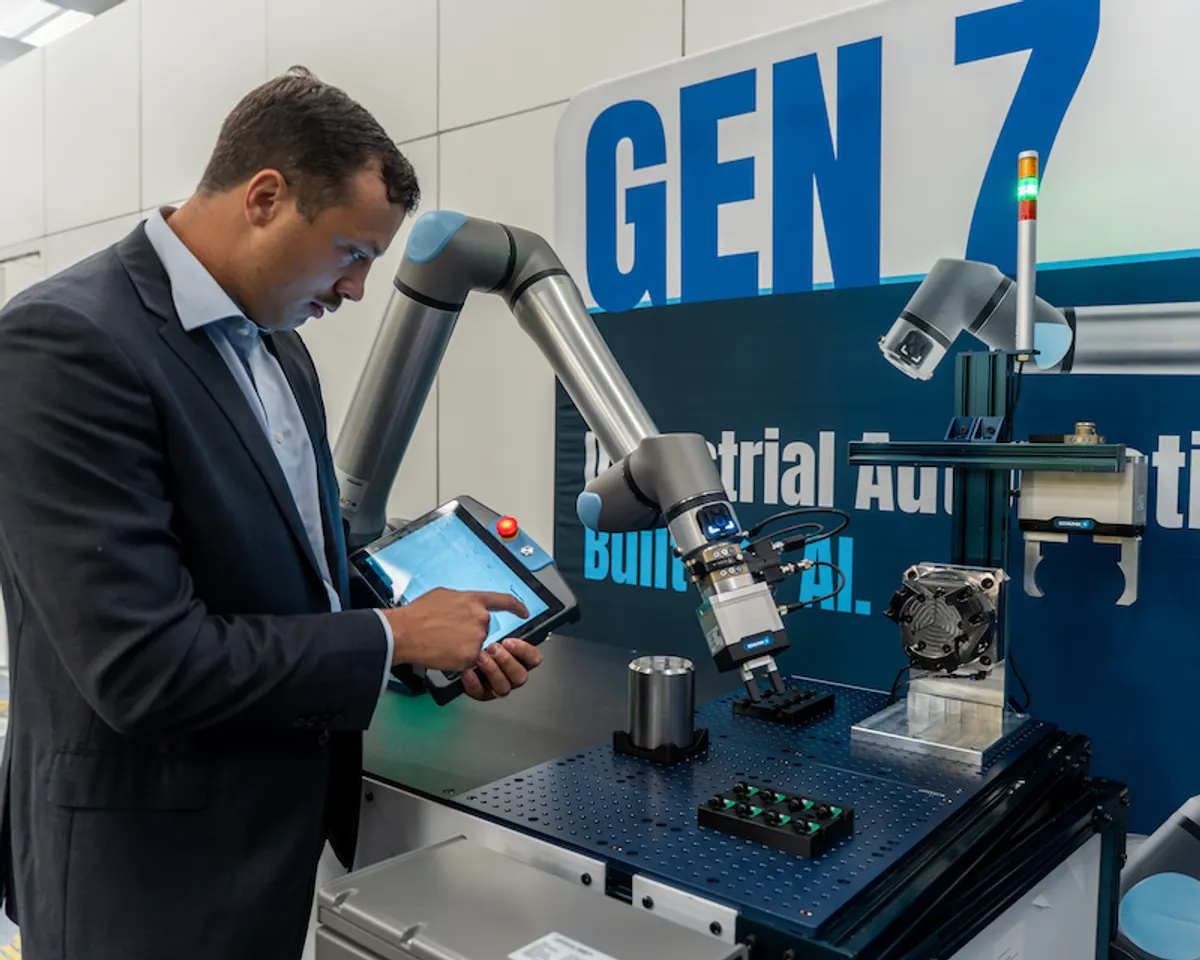
Universal Robots has introduced Gen 7, a comprehensive redesign of its industrial robot platform engineered to support AI-powered automation in manufacturing environments. The Teradyne Robotics company unveiled the system at the IMTS trade show, positioning it as infrastructure purpose-built for what it calls physical AI applications.
The platform represents an end-to-end overhaul spanning robot arms, controller hardware, operating system, and operator interfaces. According to Jean-Pierre Hathout, president of the Teradyne Robotics Group, the design draws on more than 100,000 industrial deployments and two decades of collaborative robot development to reduce integration complexity while expanding capability.
New hardware architecture
Gen 7 introduces three g-Series robot arms designated by payload and reach: the UR10g-1750, UR17g-1300, and UR18g-950. The naming convention reflects payload capacity in kilograms and reach in millimeters.
A redesigned tool flange delivers data, power, and safety connections directly at the mounting point, eliminating external cabling for cameras and high-bandwidth sensors. Universal Robots says this architecture enables vision and sensing systems to operate in real time with the robot—a requirement for AI models that need immediate feedback from their environment.
Built-in force-torque sensing and impedance control provide the force feedback necessary for applications including dexterous manipulation and force-sensitive assembly tasks.
The CB7 Core controller delivers 40 percent more computing power than previous generations while occupying 30 percent less space. It supports multi-network communication, connecting simultaneously to PLCs, HMIs, MES platforms, industrial PCs, and vision systems without requiring external network switches. The controller works with both new g-Series arms and existing e-Series and UR Series models.
Software and operator tools
PolyScope X forms the software foundation, adding programming tools, ISO 10218-1 safety functionality, and cybersecurity compliance. Open APIs and ROS 2 communication allow developers to build edge AI applications using industrial PCs and external processing hardware.
The redesigned TP7 Core teach pendant weighs more than 20 percent less than prior versions and includes multiple grip positions, configurable buttons, a full HD display, and a virtual joystick. A new SP7 Smart Panel enables teaching and programming directly at the tool flange, with safety-compliant freedrive functionality and three configurable buttons for running Smart Skills—intended to reduce setup time in high-mix, low-volume production scenarios.
Ecosystem integration
Universal Robots demonstrated Gen 7 at IMTS alongside more than 20 ecosystem partners. Inbolt CEO Rudy Cohen noted that the company's vision software now runs natively on the UR controller itself, eliminating the need for external vision PCs or additional cabling. "Manufacturers get parts localised without jigs or fixtures, and reach production in hours, not weeks," Cohen said.
The platform integrates with Universal Robots' UR+ ecosystem, a portfolio of validated third-party automation products designed to reduce integration complexity.
All g-Series robots carry TÜV certification to ISO 10218-1 and UL 1740 standards. Teradyne Robotics holds IEC 62443-4-1 ML3 certification for cybersecurity, confirming secure development practices throughout the software lifecycle.
Why it matters
The Gen 7 platform addresses a practical barrier in industrial AI adoption: the gap between laboratory demonstrations and production deployment. By integrating computing power, standardized connectivity, and native sensor support into a single architecture, Universal Robots is building infrastructure that allows manufacturers to move AI-based applications into operations without custom engineering for each installation. The backward compatibility with existing robot arms and the expanded ecosystem partnerships suggest the company is positioning Gen 7 as a platform play rather than a product refresh.
These details were first reported by Robotics and Automation News.
This is an original analysis by the Omega editorial team. Source reporting: Automation Watch.
Want systems like this working for your business?
Book a Call