Policy
UN Framework Convention on AI Governance Urged by Lawmakers
Global parliamentarians back Singapore's proposal for coordinated international oversight, calling for citizen assemblies and elected representatives to shape AI regulation.
Key takeaways
- Parliamentarians for Global Action endorsed Singapore's proposal for a UN Framework Convention on AI Safeguards to coordinate fragmented international regulation efforts.
- A recent study found 119 international institutions working on AI governance with no central coordinating body, creating a patchwork system rather than coherent oversight.
- OpenAI CEO Sam Altman and other industry leaders have called for democratic processes to shape AI development, warning against concentrated corporate power without public accountability.
- Proposed democratic mechanisms include Global Citizens' Assemblies with randomly selected participants and a UN Parliamentary Assembly for elected representative oversight.
- The framework could establish shared global principles while allowing specific rules to evolve as AI technology advances.
Global Push for Coordinated AI Oversight
Parliamentarians for Global Action, a worldwide network of elected officials, has endorsed a proposal for a United Nations Framework Convention on AI Safeguards. The initiative originated with Singapore's Foreign Minister Vivian Balakrishnan, who presented the concept at the UN General Assembly in September. Balakrishnan suggested the framework could function similarly to existing international bodies like the International Telecommunication Union or the International Atomic Energy Agency, establishing common technical standards and verification mechanisms for artificial intelligence.
The proposal comes as world leaders acknowledge AI's dual nature: its capacity to advance medicine, education, and economic development alongside risks including labor market disruption, surveillance capabilities, disinformation campaigns, and interference in democratic processes.
Fragmented Governance Landscape
Current international AI regulation efforts remain scattered and lack coordination. A recent study identified 119 international institutions working on AI governance between 2014 and 2024, revealing no central coordinating body, overlapping responsibilities, and heavy concentration in Europe. The European Union has implemented the AI Act, while the OECD and UNESCO have developed non-binding principles, but these efforts form what researchers describe as a "regime complex"—a patchwork rather than a coherent system.
A UN framework convention could establish shared global principles while allowing specific rules to adapt as technology evolves. Potential elements include rigorous pre-deployment testing requirements, restrictions on autonomous systems, and mandatory mechanisms for human intervention.
Democratic Accountability in AI Development
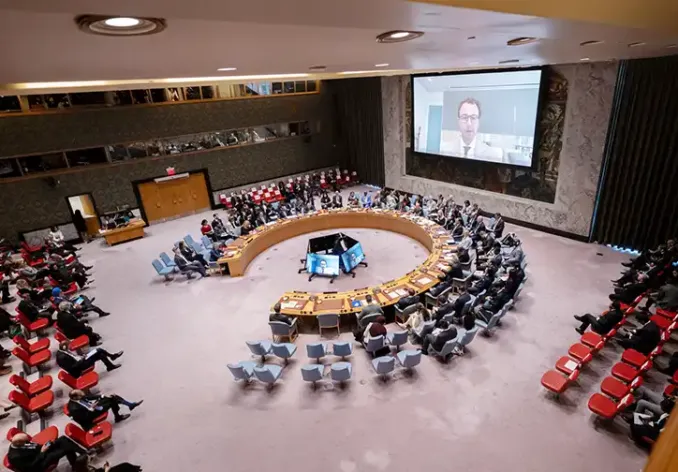
Industry leaders themselves have called for democratic oversight. At a UN Security Council hearing in September, OpenAI CEO Sam Altman argued that critical AI decisions cannot be made solely by technology companies in San Francisco. He warned that without effective public regulation, the world risks a future where "power is concentrated, decisions are opaque, and people feel that the most important technology of their lifetime is something being done to them."
Nathan Law, an exiled Hong Kong legislator, previously cautioned that concentrated corporate power in AI without public oversight threatens democratic institutions.
Proposals for Citizen Participation
Parliamentarians for Global Action emphasized that any UN framework must include structured roles for elected representatives and direct channels for affected populations. The Global Coalition for Inclusive AI, launched at the 2025 Paris AI Action Summit, proposes using deliberative processes to bring citizens into AI discussions.
One recommended mechanism is the Global Citizens' Assembly format, which convenes randomly selected, demographically representative participants to review evidence and develop recommendations. Democracy Without Borders has proposed that a UN Framework Convention on AI could establish citizen assemblies as a regular method for gathering public input on specific AI issues.
Additional proposals include creating a UN Parliamentary Assembly to provide oversight and democratic input from elected representatives worldwide. Some advocates envision an even more ambitious structure: a formal global parliament with authority over decisions affecting humanity as a whole.
Why It Matters
As AI systems increasingly influence economic activity, political discourse, and daily life, the question of who controls their development and deployment becomes critical. A fragmented regulatory landscape allows powerful technology companies to operate with minimal accountability while governments struggle to coordinate responses. Democratic oversight mechanisms—whether through citizen assemblies, parliamentary bodies, or other structures—could shift decision-making power from concentrated corporate interests to broader public representation, fundamentally changing how AI technology serves society.
These details were first reported by Democracy Without Borders.