Ukrainian Drone Maker Keeps Manual Assembly to Outpace War
Frontline Robotics updates products up to 20 times monthly, finding automation can freeze design flexibility when battlefield conditions shift weekly.
Manual production lines enable rapid iteration
A Ukrainian drone manufacturer has adopted an unconventional approach to wartime production: deliberately limiting automation to maintain the flexibility needed for constant product updates.
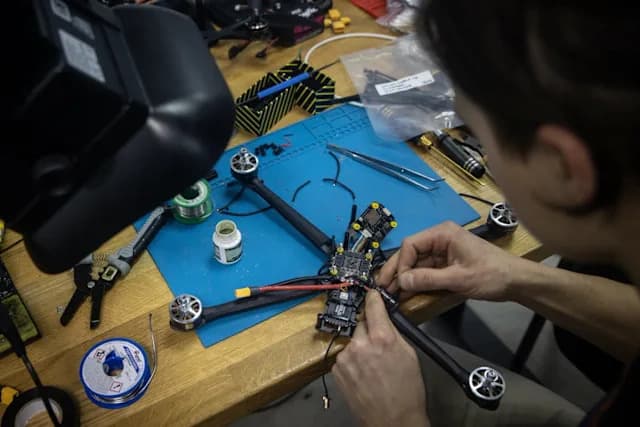
Frontline Robotics, which supplies drones and weaponry to more than 60 Ukrainian military units, makes small modifications to its products up to 20 times per month and implements major updates approximately every six months. This pace of change has led the company to rely heavily on manual assembly rather than fully automated production lines.
Mykyta Rozhkov, chief business development officer at Frontline Robotics, explained that excessive automation creates a fundamental constraint. "Automation comes with the cost of freezing the product version," he said. While automated systems excel at producing large quantities efficiently, they struggle when products require frequent modification.
The company maintains what Rozhkov describes as "lightweight, but still stable" procedures capable of sustaining 20 changes monthly. "A big part of the assembly lines relies on manual assembly because manual assembly is the most flexible one," he noted.
Battlefield conditions drive design philosophy
The rapid iteration stems from Ukraine's exceptionally dynamic battlefield environment. Taras Berezovets, head of the military cooperation department of Ukraine's Territorial Defense Forces, characterized the conflict as one where "cutting-edge technology will be completely outdated after one, maximum two, months."
Frontline maintains constant communication with soldiers using its equipment, receiving feedback "24/7 into our inbox" without needing to solicit it. This direct channel enables the company to respond quickly to emerging tactical needs.
The threat of Russian attacks on production facilities adds another dimension to the manual assembly strategy. "The big machinery, you can not rely on it if you can lose it anytime," Rozhkov said. Distributed manual processes prove more resilient than concentrated automated systems vulnerable to strikes.
Why it matters
NATO and Western defense leaders now view Ukraine's production speed as a critical learning opportunity. Officials across the alliance recognize that future conflicts may demand similar agility, with procurement cycles measured in weeks rather than years. Sir John Stringer, NATO's Deputy Supreme Allied Commander for Europe, stated the West is "in a race" requiring comfort "with procurement cycles which are faster than what we have been brought up with." Ukraine's approach challenges conventional defense manufacturing wisdom that prioritizes automation and standardization over adaptability.
Western partnerships seek balance
Frontline is now collaborating with German unmanned aerial systems company Quantum Systems to manufacture Ukrainian-designed drones in Germany. The partnership aims to combine Ukrainian battlefield experience with German production expertise.
Rozhkov described the collaboration as bidirectional learning, with Germany contributing decades of manufacturing knowledge while Ukraine offers insights on rapid wartime scaling. The challenge, he said, is "maintaining our core identity of having it as flexible as possible even in Germany."
Tarja Jaakkola, NATO's assistant secretary general for defense industry, innovation, and armaments, recently emphasized the alliance's focus on "understanding the Ukrainian industrial capacity, the technology they have, and also the innovation that is happening in Ukraine at the moment."
These details were first reported by Business Insider.
This is an original analysis by the Omega editorial team. Source reporting: Automation Watch.
Want systems like this working for your business?
Book a Call