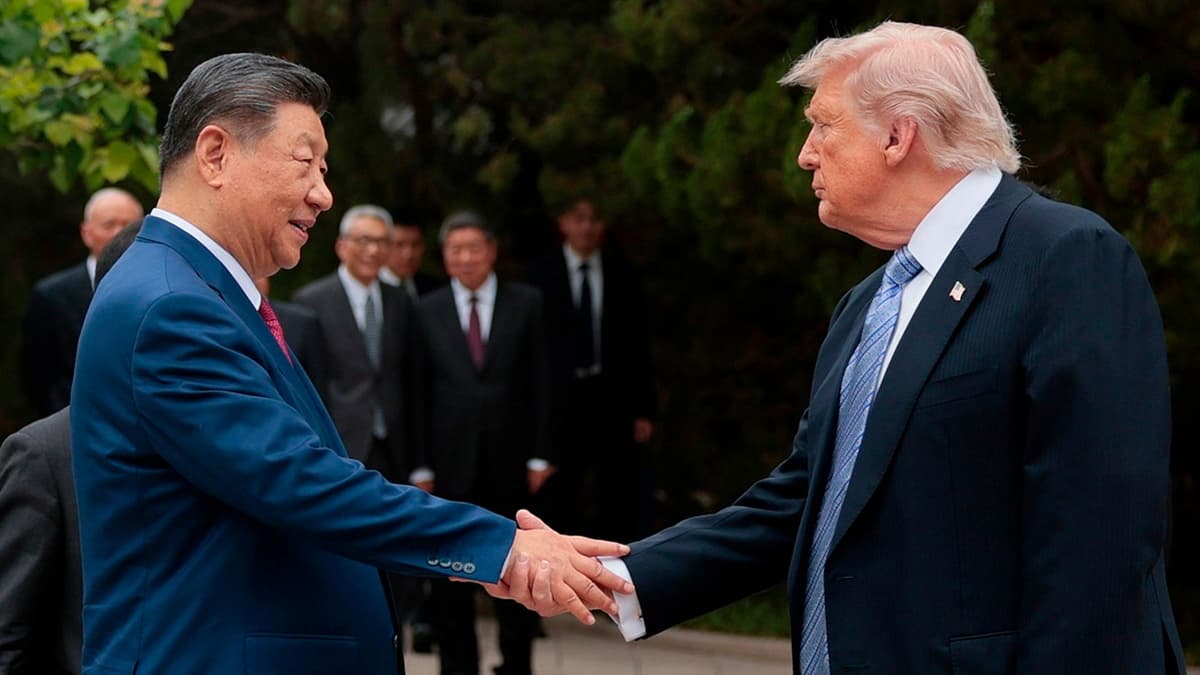
Trump-Xi Summit Puts AI Safety, Trade Truce on the Table
First US state visit by China's president in over a decade centers on technology governance and economic détente as temporary trade war ceasefire nears expiration.
Chinese President Xi Jinping arrives in Washington this week for his first US state visit in more than a decade, meeting with President Donald Trump amid fundamentally transformed relations between the world's two largest economies.
The summit marks a stark departure from Xi's 2015 visit under Barack Obama, when cybercrime, climate, and human rights dominated the agenda. This time, according to reporting first published by The Guardian, artificial intelligence and trade tensions will take center stage while climate discussions remain notably absent.
AI governance emerges as priority
Artificial intelligence is expected to feature prominently despite being absent from the leaders' May meeting in Beijing. US Treasury Secretary Scott Bessent has proposed establishing a bilateral communication mechanism for major AI safety issues, though operational details remain unclear.
The challenge lies in fundamentally different approaches: Trump has dismissed AI safety warnings as a "hoax," while Xi advocates for security in AI development but views the technology as essential to China's national advancement. Beijing bristles at US efforts to constrain its AI progress, complicating prospects for meaningful safety frameworks.
Amanda Hsiao, China director at the Eurasia Group, noted that past crisis hotlines between the nations "haven't always been effective," raising questions about implementation.
Trade war truce faces November deadline
Trade represents the relationship's biggest friction point. Trump's 2025 global trade war targeted China with heavy tariffs, prompting Chinese retaliation approaching 150% on US goods and restrictions on rare earth exports critical to American manufacturing.
A temporary truce has stabilized economic relations, with Middle East conflicts replacing US-China tensions as the primary source of global economic uncertainty. But that ceasefire expires in November. While this week's summit may not produce a comprehensive trade deal—two additional Trump-Xi meetings are planned this year—finding longer-term arrangements remains a top priority for Xi as China seeks to restore access to its largest export market.
Taiwan, human rights, and climate
China's ambassador outlined "four red lines" for the summit, with Taiwan topping the list. Beijing seeks reduced US defense support for the self-governing island, which China claims as its territory. Trump delayed a $14 billion weapons package to Taiwan after the May summit, calling it a "very good negotiating chip."
Human rights discussions will likely focus on individual cases rather than systemic issues. Trump may raise imprisoned Christian pastor Ezra Jin, whose case he mentioned in May before Jin's subsequent release, and US nuclear scientist detained since late 2024. The most difficult case involves Jimmy Lai, a British pro-democracy activist jailed in Hong Kong, whom Trump promised to free during his 2024 campaign but has found Beijing unwilling to release.
Climate cooperation, once described as a rare area of US-China alignment, will be conspicuously absent. Trump withdrew the US from the Paris agreement and shows little interest in climate discussions, according to William Yang of the International Crisis Group.
Why it matters
The summit's focus on AI governance and trade reflects how technology competition has replaced ideological differences as the defining feature of US-China relations. With AI development accelerating and both nations racing for technological supremacy, the absence of effective safety coordination mechanisms creates systemic risks. Meanwhile, the expiring trade truce and lack of climate cooperation signal that despite tactical engagement on specific issues, the strategic rivalry between Washington and Beijing continues to deepen.
Details were first reported by Amy Hawkins for The Guardian, with additional research by Yu-chen Li.
This is an original analysis by the Omega editorial team. Source reporting: AI Watch.
Want systems like this working for your business?
Book a Call