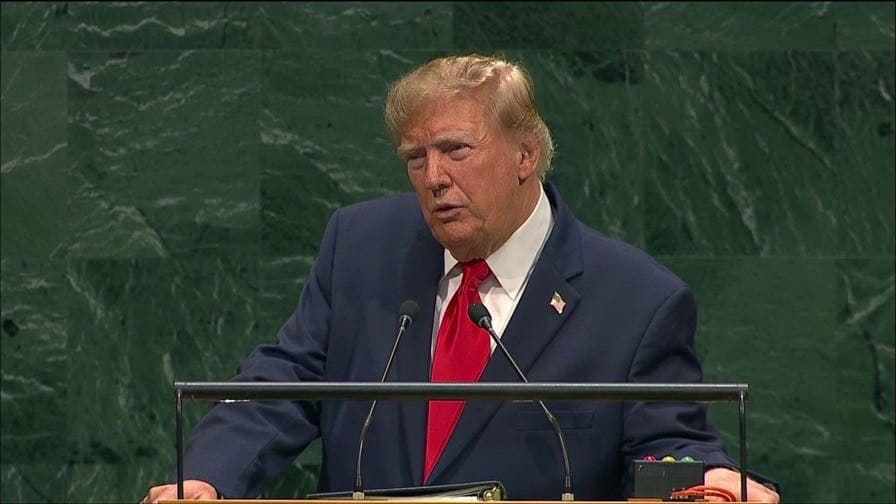
Trump rebrands AI as 'super intelligence' at UN, vows no regulation
The president dismissed safety concerns and announced the U.S. will encourage rather than constrain the technology's development.
President Donald Trump announced at the United Nations General Assembly on Tuesday that he is unilaterally changing the terminology around artificial intelligence, declaring that all U.S. government documents should now refer to "super intelligence" instead.
"From this point forward, all of United States documents and hopefully the world's, will be changed to use the much more accurate term super, as opposed to artificial," Trump told world leaders during his September 2026 address. "So it's super intelligence."
The rebrand accompanied a broader policy statement: the United States will not impose regulatory constraints on AI development. Trump characterized the technology as potentially larger than the industrial revolution and said the government would "encourage it, not rein it in."
Dismissing industry warnings
Trump's remarks directly contradicted calls from prominent technology leaders who have urged stronger government oversight as AI capabilities advance rapidly. The president dismissed these concerns by drawing a comparison to climate change warnings, which he has previously called a hoax.
"We have to be careful" with AI, Trump acknowledged, but added: "I'm not going to stifle growth of something that will be bigger than the industrial revolution." He suggested that those warning AI could "kill us" were the same voices raising alarms about global warming—a real, scientifically documented phenomenon driven by human activity.
Why it matters
The announcement signals a sharp divergence from regulatory approaches being developed in Europe and discussed in other major economies. With the U.S. adopting a hands-off stance on AI governance, the global technology landscape faces fragmentation at a moment when international coordination on safety standards could prove critical. The terminology shift, while largely symbolic, reflects an administration preference for framing AI development as an unqualified positive rather than a technology requiring careful management.
Context on press access
PBS News noted in its coverage that it was using video from the United Nations rather than White House sources, joining other news organizations in protesting the administration's decision to bar CNN, MS Now, and Politico from press access.
These details were first reported by PBS News, with coverage by Steff Staples.
This is an original analysis by the Omega editorial team. Source reporting: AI Watch.
Want systems like this working for your business?
Book a Call