Tesla Home Consolidates Energy Products Under Opticaster AI
The new platform bundles existing battery, solar, and charging hardware with software that's been optimizing energy systems for years.
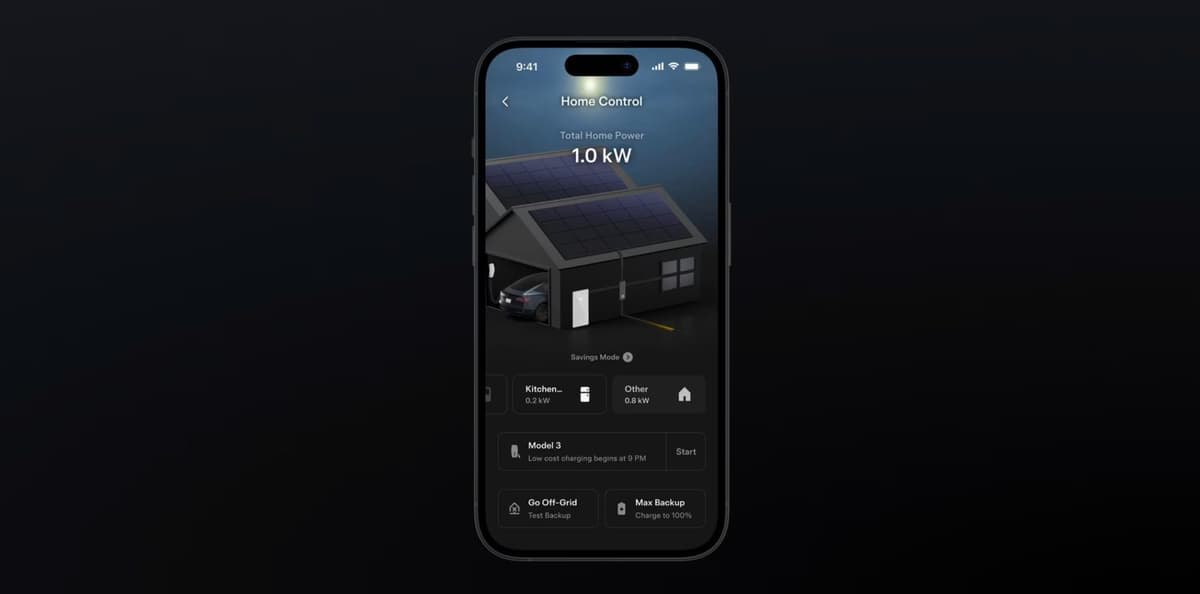
Tesla has introduced Tesla Home, a unified home energy management platform that brings together its battery storage, solar panels, EV chargers, and smart breakers under a single interface controlled by AI software called Opticaster. The system makes automated decisions throughout the day about when to store, use, or sell electricity back to the grid based on goals homeowners set in the Tesla app.
According to Tesla's support documentation, Tesla Home runs on every Powerwall with no additional hardware required. Existing owners gain access through a software update that reorganizes the Tesla app's energy controls into a streamlined interface.
What Tesla Home actually does
The platform connects hardware Tesla already sells—Powerwall batteries, solar installations, Wall Connector EV chargers, and Eaton AbleEdge smart breakers—and lets owners choose between operational modes. A "Savings" setting minimizes electricity bills by timing energy use against utility rate structures. A "Self-Powered" mode prioritizes running the home on stored solar energy after sunset.
Owners can view each decision the system makes and the reasoning behind it through the app. The platform also enables circuit-level control during outages, letting homeowners designate which loads remain powered when the grid goes down.
Opticaster has been running since 2021
The AI engine behind Tesla Home is Opticaster, which Tesla describes as the machine learning foundation for all its energy software. The company states Opticaster has accumulated over one hundred million operational hours across utility-scale deployments and virtual power plant programs that paid Powerwall owners nearly ten million dollars in 2024.
Every Tesla energy installation—from residential Powerwalls to utility-scale Megapacks—already ships with Opticaster enabled. The software forecasts solar production and household electricity demand, then builds dispatch strategies to meet whatever objective the owner selects.
Tesla Home is essentially a consumer-facing brand and interface layered over software that has been optimizing battery systems in the field for five years, according to reporting from Electrek.
What's new in the app update
The substantive changes arrived in Tesla app version 4.58.6, which began rolling out this week. The update consolidates previously scattered energy settings into a "Home Controls" menu and reorganizes configuration options.
New features include smart breaker integration for circuit-level management, a "Home Status" summary that uses AI to explain system decisions, and Rate Plan Charging that schedules EV charging during off-peak hours when paired with compatible Wall Connectors.
None of these capabilities require new equipment for current Tesla energy customers. The rollout represents a branding exercise and user experience improvement rather than a hardware launch.
Why it matters
Home energy management systems have historically required owners to juggle separate apps and settings for solar, storage, and charging. By unifying these controls under goal-based automation, Tesla is making distributed energy resources more accessible to residential customers—a necessary step as electricity rates continue climbing and grid reliability becomes more variable. The real test will be whether Opticaster delivers the same economic benefits for homeowners that it has demonstrated in commercial energy storage deployments.
Details on Tesla Home were first reported by Electrek.
This is an original analysis by the Omega editorial team. Source reporting: AI Watch.
Want systems like this working for your business?
Book a Call