Teradyne Demos AI-Trained Cobots for Assembly and Cable Routing
Three live demonstrations at Automate 2025 showed imitation learning and vision systems handling tasks traditionally too complex for conventional automation.
From Training Data to Production Tasks
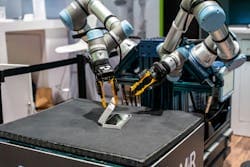
Teradyne Robotics used its Automate 2025 booth to demonstrate how AI-trained collaborative robots are moving beyond experimental phases into deployable manufacturing applications. The company showcased three distinct systems that use imitation learning and AI vision to handle assembly operations previously considered too variable for automation.
Will Healy III, Director of Product and Industry Marketing at Teradyne Robotics, emphasized the production readiness of the demonstrations. The systems on display represent capabilities manufacturers can implement now rather than conceptual future technologies.
Three Approaches to Physical AI
The first demonstration featured Universal Robots' AI Trainer, developed with Scale AI. The system uses operators to guide collaborative robots through assembly tasks while capturing force, motion, and positional data at high frequency. This data trains vision-language-action models that enable robots to perform the tasks autonomously without traditional teach-pendant programming. The software collects thousands of data points per second to build training datasets.
A second demonstration, created with robotics startup Generalist, showed two UR12e cobots performing assembly operations using a model trained through hundreds of hours of operator-guided input. The system uses imitation learning to replace conventional programming methods. When errors occur, the robots iterate until completing the task correctly.
The third application, developed with Cambrian, addressed a specific challenge in data center manufacturing: routing and inserting copper cables into high-density server racks. Two UR7e cobots used Cambrian's AI-powered 3D vision system to handle the deformable materials. Cables retain shape memory and flex unpredictably, creating variability that conventional automation typically cannot accommodate. The vision system identifies connector orientation and adjusts robot trajectories in real time before insertion.
Why it matters
These demonstrations address a critical gap in manufacturing automation: handling tasks with high variability that have resisted conventional robotic solutions. By showing production-ready applications of imitation learning and AI vision, Teradyne is positioning collaborative robots as near-term alternatives to humanoid systems for flexible assembly and labor-intensive operations. The approach allows manufacturers to begin deploying physical AI capabilities while building toward more autonomous systems.
Building Blocks for Autonomy
Healy positioned the AI Trainer as an entry point for manufacturers, with the Generalist and Cambrian applications representing logical next steps in an automation strategy. The progression demonstrates how companies can deploy physical AI incrementally while establishing infrastructure for increasingly autonomous operations.
Teradyne also highlighted the role of digital engineering tools through Universal Robots' collaboration with Vention. The MachineBuilder platform enables engineers to design, simulate, and validate robotic work cells before physical deployment using digital twins and virtual commissioning. At Vention's booth, the company demonstrated its Manufacturing Automation Platform alongside six live applications, including deep bin-picking with a UR12e cobot and AI-driven machine tending.
The details were first reported by Machine Design.
This is an original analysis by the Omega editorial team. Source reporting: Automation Watch.
Want systems like this working for your business?
Book a Call
