Telecom Operators Deploy AI Agents for Autonomous Network Operations
NVIDIA and partners demonstrate secure runtime environments, synthetic data tools, and GPU-accelerated simulation platforms that enable long-running AI agents to manage network infrastructure with minimal human intervention.
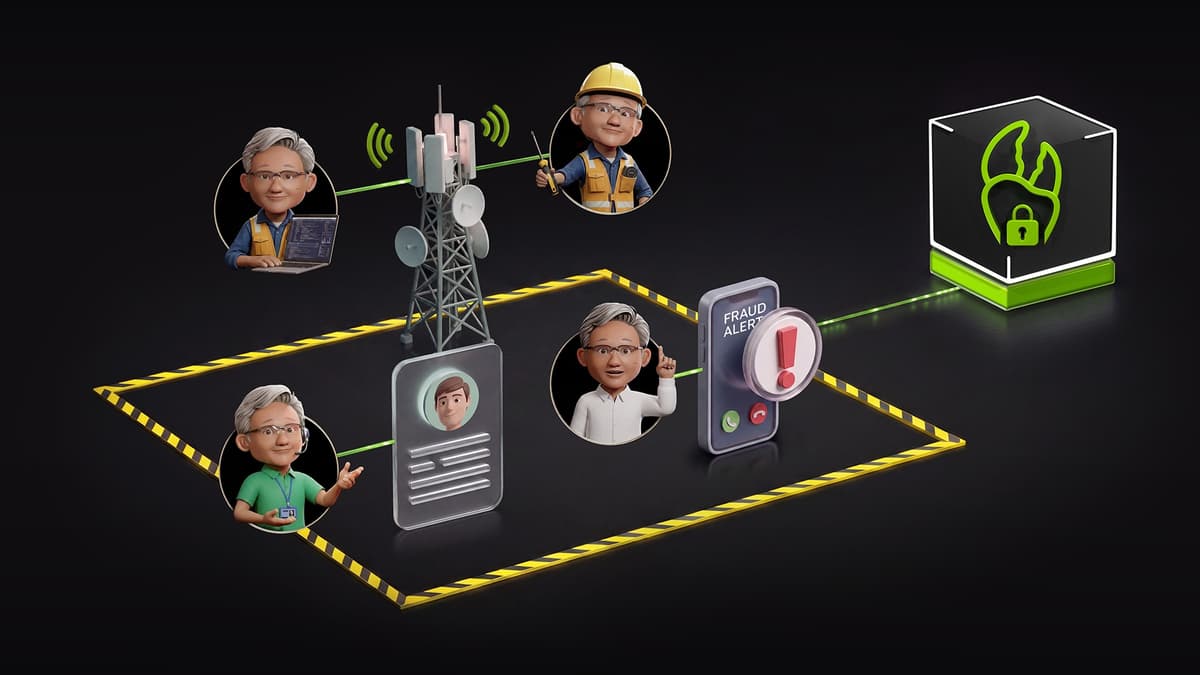
Telecommunications companies are advancing from task-based automation to deploying autonomous AI agents capable of managing entire network operations workflows without constant human direction. The shift requires specialized infrastructure that addresses data privacy, security constraints, and the need to validate decisions before they affect live systems.
NVIDIA and multiple telecom technology partners showcased autonomous network platforms this week at TM Forum's DTW Ignite 2026 conference in Copenhagen, according to details first reported by NVIDIA. The demonstrations centered on three technical foundations: privacy-preserving synthetic data generation, secure agent runtime environments, and GPU-accelerated simulation for decision validation.
Why it matters
Autonomous networks represent a fundamental change in how telecom infrastructure operates. Rather than speeding up individual tasks, AI agents can now handle complex, multi-step workflows across network, IT, and business systems—potentially reducing operational costs while improving service reliability. The technology also addresses a critical barrier: 54% of operators identify data-related issues as their biggest obstacle to AI deployment, particularly the inability to use sensitive network and customer data for model training.
Synthetic Data Unlocks Model Training
SoftBank Corp. is using NVIDIA NeMo Safe Synthesizer and NeMo Anonymizer to create synthetic datasets that mirror real network performance and configuration data without exposing actual customer records. These privacy-preserving datasets enable the company to fine-tune large telecom models and develop specialized network agents while maintaining data protection standards.
Secure Runtimes Enable Long-Running Agents
The NVIDIA NemoClaw blueprint framework and OpenShell secure runtime provide policy-based guardrails and sandboxed system access for AI agents operating under strict service-level agreements and regulatory requirements.
AdaptKey is piloting security-hardened agents for self-healing 5G operations that detect connectivity issues and submit remediation requests through its KeySmith platform, which orchestrates fixes across core network, radio access network, and billing systems.
Amdocs is demonstrating proactive customer-care agents that identify roaming customers approaching data limits and execute approved responses within defined business policies. The company is also deploying autonomous data-science agents that analyze customer accounts for migration eligibility to modern billing platforms.
NTT DATA is building anomaly detection agents using NVIDIA Nemotron models with NemoClaw to track long-term network performance trends and escalate cases requiring detailed telemetry analysis.
ServiceNow is bringing its Project Arc platform to telecom, enabling network operations center agents that manage incident response from initial alerts through work order completion. Every action remains auditable and policy-compliant through NVIDIA OpenShell and ServiceNow AI Control Tower.
Tata Consultancy Services is developing a multi-fidelity AI sensor architecture where NemoClaw orchestrates agents that scan for network issues and selectively trigger deeper diagnosis.
GPU-Accelerated Simulation Validates Decisions
Forsk integrated an AI-based radio propagation model into its Naos RAN planning platform, achieving ray-tracing accuracy up to 200 times faster than CPU baselines on NVIDIA RTX PRO 6000 Blackwell Server Edition GPUs. The resulting digital twin enables network self-healing and automated antenna optimization.
VIAVI Solutions is accelerating its TeraVM AI RAN Scenario Generator by moving large-scale simulations to NVIDIA RTX PRO 6000 GPUs, showing order-of-magnitude throughput improvements that let operators test network changes at deployment scale before implementation.
KDDI and KDDI Research are collaborating with NVIDIA, Keysight, and Samsung Research America to build a high-fidelity RAN digital twin using NVIDIA Aerial Omniverse Digital Twin for 6G development, where multiple agents can safely simulate scenarios ranging from area optimization to future radio conditions.
These developments were detailed in an NVIDIA blog post published this week.
This is an original analysis by the Omega editorial team. Source reporting: AI Watch.
Want systems like this working for your business?
Book a Call