SoundHound Rises to Leader in Gartner's 2026 Conversational AI Report
The Magic Quadrant shows dramatic shifts as generative AI reshapes the market, with Salesforce debuting strong and Boost.ai falling from the top tier.
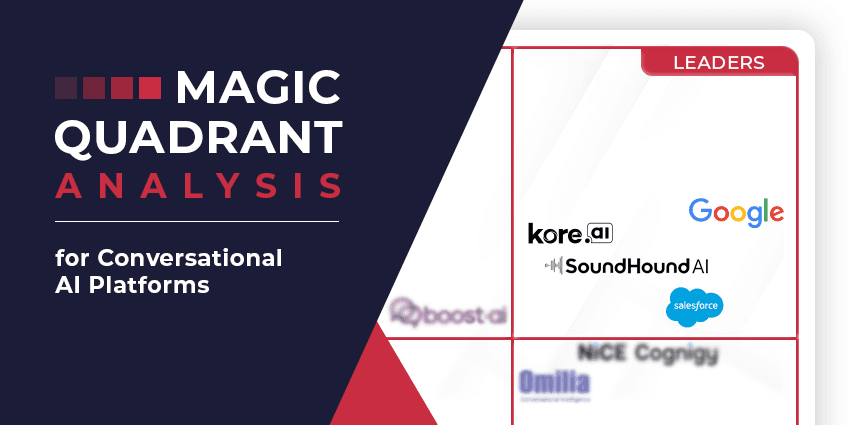
Major vendor repositioning signals market turbulence
The conversational AI platform market underwent substantial reshuffling in the past year, according to Gartner's newly released 2026 Magic Quadrant. The report evaluated 14 vendors and documented movement dramatic enough to suggest the category remains far from settled as generative and agentic AI capabilities force rapid evolution.
SoundHound AI made the most notable climb, advancing from Visionary to Leader status. The company's acquisitions of Amelia and Interactions over the past year expanded its product suite significantly, while its native automatic speech recognition engine and real-time voice-to-voice models strengthened its position in voice AI specifically. Gartner also noted the vendor's shift toward a partner-first revenue model as evidence of strategic maturation.
Two vendors entered the quadrant for the first time in 2026. Salesforce landed directly in the Leaders quadrant with its Agentforce platform, earning recognition for pricing transparency through its Flex Credits model and more than 300 prebuilt AI agent templates spanning multiple industries. Netomi debuted in the Challengers quadrant, distinguished by customer retention rates that consistently exceed most competitors, though its geographic concentration in North America limits global appeal.
Why it matters
The degree of repositioning in a single evaluation cycle reflects genuine uncertainty about what constitutes a mature conversational AI platform. As generative models become table stakes and agentic architectures move from experimental to production-ready, vendors are being measured against rapidly shifting criteria. Enterprises evaluating platforms today face a market where last year's leader may be this year's visionary, and where CRM giants can enter at the top tier based on integration depth rather than conversational AI heritage alone.
Notable declines and removals
Boost.ai dropped from Leaders to Challengers despite maintaining strong professional services quality and rapid deployment times. Gartner cited slower customer base growth in 2025, a smaller recent funding round compared to peers, and modest investment in fundamental research as factors in the repositioning.
Cognigy, now operating as NiCE Cognigy following its acquisition, fell from Leader to Visionary. The report flagged the acquisition itself as a risk factor due to potential roadmap changes and R&D reductions that often follow major corporate transactions. LivePerson was removed from the evaluation entirely.
Google retained its top position, with Gartner describing its AI innovation capabilities as substantially ahead of most peers. The company's proprietary chip infrastructure and Google DeepMind's advances in large language models provide scalability advantages few vendors can match. Kore.AI held its Leaders position based on R&D investment and proprietary tools including Arch and the Agent Blueprint Language.
Industry pushback on methodology
The report drew criticism from some CX industry observers. Wayne Butterfield, founder of STX and head of AI at Fractional, questioned the decision to downgrade NiCE Cognigy following its acquisition by a contact center platform provider, arguing the integration actually strengthened its position. He also challenged Salesforce's Leaders placement, suggesting marketing spend rather than conversational AI capability drove the positioning.
The criticism underscores a broader point about vendor evaluation: while Gartner maintains significant influence in enterprise technology decisions, organizations conducting serious platform assessments need multiple research sources and direct product evaluation to identify the best fit for specific requirements.
The full report details were first published by CX Today, which noted the findings reflect a market still determining what maturity looks like as AI capabilities continue to advance rapidly.
This is an original analysis by the Omega editorial team. Source reporting: Automation Watch.
Want systems like this working for your business?
Book a Call