Singapore Deploys 16 Million Living Neurons in Data Center Prototype
A partnership between NUS Medicine, DayOne, and Cortical Labs has created the first biological computing server rack using lab-grown human neurons alongside silicon hardware.
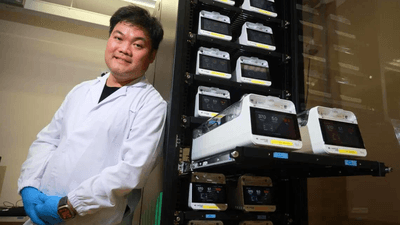
Singapore has become home to the world's first biological data center prototype that integrates living human neurons into standard server-rack infrastructure. The system, demonstrated at the National University of Singapore on August 6, represents an attempt to move biological computing from laboratory curiosity to practical computing infrastructure.
The prototype consists of 20 CL1 biological computing units, collectively containing an estimated 16 million lab-grown human neurons. The project brings together NUS Medicine's Yong Loo Lin School of Medicine, Singapore-based data center operator DayOne, and Melbourne's Cortical Labs, each contributing distinct expertise to the effort.
How the system works
Unlike conventional servers, the CL1 units grow neurons from human stem cells and place them on silicon platforms containing microelectrode arrays. These electrodes send electrical signals into the neural network and record the cells' electrical activity in response.
The biological networks connect to Cortical Labs' biOS operating system, which enables software to interact with living neurons in real time. Information reaches the neurons through electrical stimulation, and their responses can influence simulated environments or computing tasks. An API allows researchers to record neural activity, stimulate the network, and create closed-loop interactions where biological and digital systems work together.
The CL1's internal life-support system maintains neural cultures for up to six months, creating a computing platform that requires biological maintenance alongside conventional hardware support.
From game-playing cells to server racks
The Singapore installation builds on Cortical Labs' earlier DishBrain system, which demonstrated that approximately 800,000 human and mouse neurons could learn to play Pong. In those experiments, electrical stimulation represented game information while neural activity controlled the paddle.
The CL1 packages this concept into a system researchers can deploy and program. The Singapore rack scales the approach by connecting 20 units within standard data center infrastructure. The 16 million neuron figure comes from multiplying the roughly 800,000 neurons per unit by 20, though NUS has not independently published a total neuron count for the complete rack.
Why it matters
The prototype addresses a pressing challenge in AI infrastructure: energy consumption. Living neural networks operate using a fraction of the power required by digital computers, potentially offering efficiency gains as AI workloads continue to grow. The system also provides a platform for studying biological learning and adaptation, with potential applications in drug discovery, biomedical research, robotics, and cybersecurity.
However, the advantages remain theoretical at this stage. The prototype has not demonstrated that biological computers can replace GPUs or outperform conventional AI infrastructure on mainstream workloads. Claims about major reductions in computing energy should be viewed as potential rather than proven results.
Real-world deployment challenges
The Singapore facility at NUS Life Sciences Institute serves as a validation phase before transitioning to a live deployment within a DayOne commercial data center. Unlike silicon processors with multi-year lifespans, these computing elements are living cells requiring controlled conditions and ongoing biological care, with reported lifespans measured in months.
NUS and its partners plan to establish a larger Biological Data Centre in Singapore, which would be the first major facility of its kind outside Australia. More than 80 guests from academia, technology, and the private sector attended the August demonstration, viewing microelectrode-array integration and real-time neural network activity.
The project should be understood as a proof of concept rather than an immediate replacement for silicon data centers. Its significance lies in establishing a physical platform for testing whether living neural networks can become practical components of future AI infrastructure.
These details were first reported by The Times of India.
This is an original analysis by the Omega editorial team. Source reporting: AI Watch.
Want systems like this working for your business?
Book a Call