Safety Certifications and Physical AI Reshape Automation Buying
Three forces—new safety standards, integrated intralogistics AI, and vendor consolidation—are changing how operations teams evaluate industrial automation suppliers in 2026.
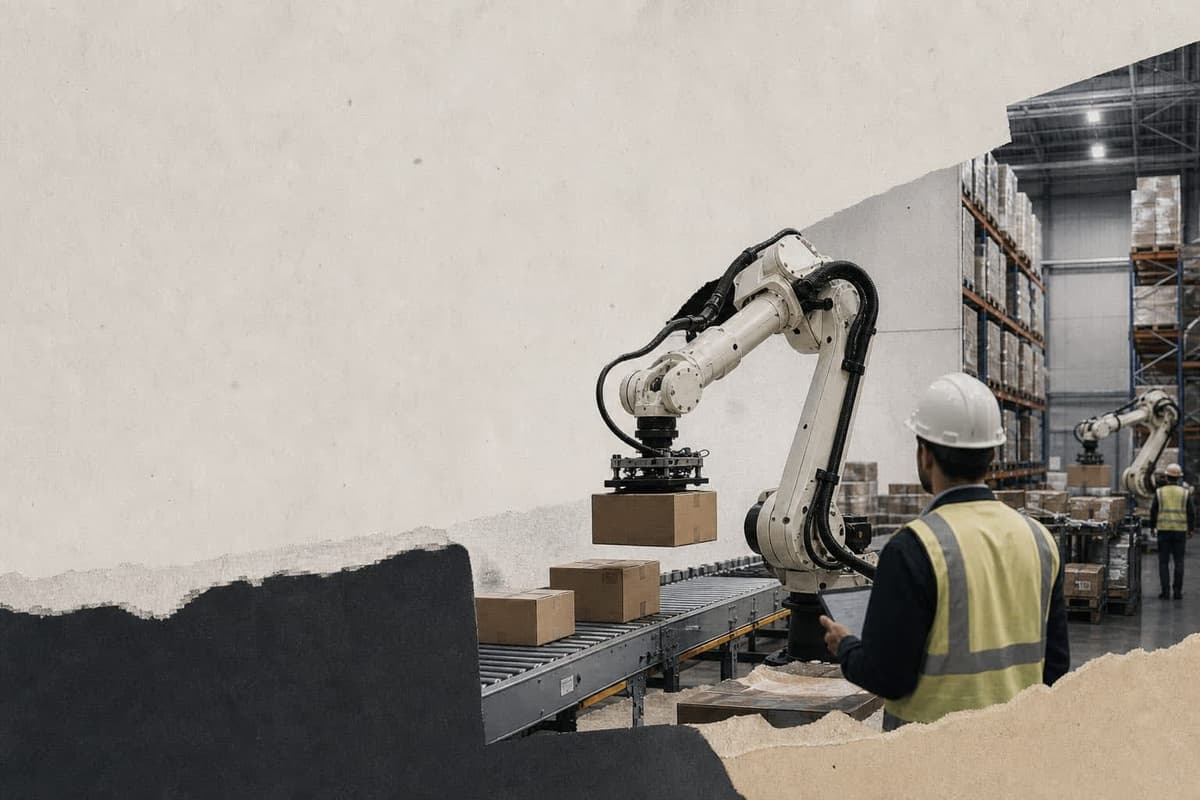
Three forces reshaping industrial automation procurement
Industrial automation buyers face a changed landscape in mid-2026, shaped by three converging trends: stricter safety and cybersecurity certification requirements that separate vendor tiers, physical AI systems moving from pilot to production in warehouse operations, and accelerating platform consolidation through acquisition. Each trend carries concrete implications for operations and procurement teams making capital equipment decisions over the next 12 to 18 months.
Cybersecurity and functional safety certifications create vendor tiers
Yaskawa secured ISO/IEC 27001:2022 certification this month, the international standard for information security management systems. For industrial robotics suppliers, this credential extends beyond IT compliance—connected robots are operational technology assets, and the certification signals that internal controls over networked systems have been independently audited, according to Robotics 24/7.
On the functional safety front, Sonair announced in early July that its ADAR One 3D ultrasonic sensor achieved SIL 2 and PL d safety ratings, which the company describes as the first safety-certified 3D ultrasonic sensor designed for human-robot collaboration. SIL 2 and PL d are IEC and ISO performance levels that define how reliably a safety function must operate in close-proximity human-robot environments. Achieving these ratings on a sensor component gives integrators a certified building block for collaborative cell designs.
The timing aligns with a July 5 Interact Analysis report examining organizational readiness for incoming industrial robot safety standards. The report found uneven supplier readiness—a procurement signal that capital equipment buyers should explicitly ask vendors which updated standards their products conform to and request certification schedules.
Physical AI transitions from research to integrated warehouse systems
Ambi Robotics and Pickle Robot announced an integrated system combining truck unloading and palletizing into a single physical AI platform for inbound logistics, Robotics 24/7 reported June 30. The integration automates the full inbound sequence: Pickle's truck-unloading robotics feed directly into Ambi's palletizing technology, addressing a workflow that historically required heavy human labor or separate, difficult-to-synchronize systems.
Physical AI in this context means machine-learning models embedded in robots that handle unstructured loads, variable packaging, and mixed SKUs without exhaustive pre-programming. This capability matters operationally because traditional fixed automation fails at the dock door, where cargo arrives in unpredictable states.
At Automate 2026 in Chicago in late June, the same theme dominated. Dexterity and Kawasaki Robotics expanded their collaboration to scale physical AI for warehouse logistics using the RL030N robot arm and Mech platforms. Doosan Robotics launched PalletizHD+, integrating AI, robotics, and its PalletizOS platform. Vention announced a digital twin platform optimized for Universal Robots deployments with AI-powered programming and collision-free motion planning. The consistent message: physical AI is now an active deployment option for distribution centers.
Intralogistics consolidation accelerates
Comau's acquisition of Invent Smart Intralogistics Solutions, a Brazilian warehouse and intralogistics specialist, extends the company's platform into South American markets and reflects a broader pattern: intralogistics vendors are acquiring specialists rather than building point solutions, compressing the number of viable integration partners.
For procurement teams evaluating warehouse automation vendors, platform breadth and acquisition trajectory are increasingly relevant criteria alongside unit cost and throughput specifications. A vendor actively consolidating capabilities can simplify integration contracts but also creates dependency on a single roadmap.
Why it matters
These shifts change the vendor evaluation calculus. Safety certifications like ISO/IEC 27001:2022 and SIL 2/PL d ratings are becoming table stakes rather than differentiators, creating a compliance baseline that buyers must verify before equipment reaches the floor. Physical AI integration at the software layer—not just co-deployment of separate systems—determines whether automation can handle the variability at dock doors and distribution centers. And ongoing M&A activity means the vendor landscape will look different in 12 months, making platform stability and acquisition strategy relevant to longevity assessments.
These details were first reported by Robotics 24/7 across multiple announcements from Automate 2026 and vendor releases throughout June and July.
This is an original analysis by the Omega editorial team. Source reporting: Automation Watch.
Want systems like this working for your business?
Book a Call
