Rural Communities Block Data Centers Over Water, Power Strain
More than 300 U.S. localities have imposed bans or moratoriums as hyperscale facilities threaten local resources and drive up electricity costs.
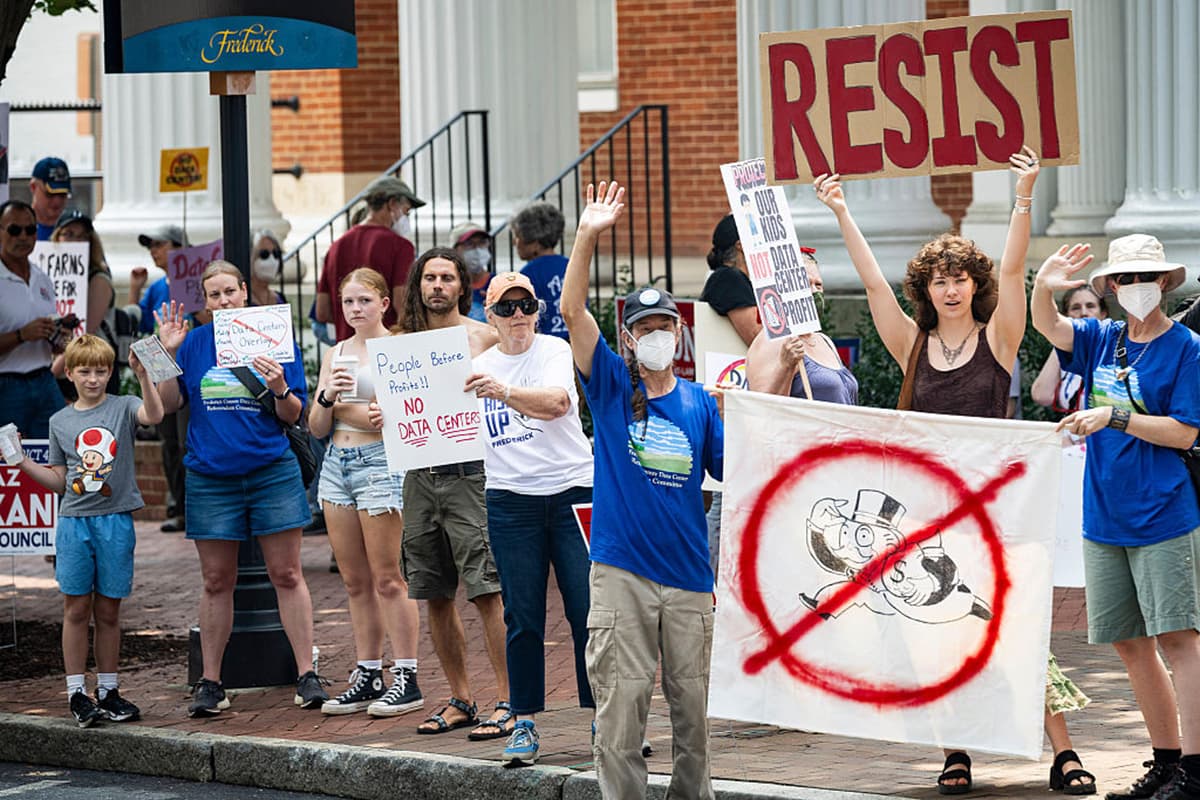
When Laura Beth relocated to Coweta County, Georgia in 2023, she sought rural tranquility away from urban sprawl. Early in 2025, she discovered a 4.9 million square foot hyperscale data center had been approved for the land behind her home. Her response—a Facebook group called "Stop Project Sail"—now has more than 8,000 members organizing legal challenges against the county and Atlas Development.
Coweta County is one battleground in a nationwide conflict over data center expansion. According to reporting first published by TIME, more than 300 U.S. cities, towns, and counties have enacted bans or moratoriums on hyperscale data center construction. In the first quarter of 2026 alone, 75 major projects worth over $130 billion were delayed or canceled due to local opposition.
Why it matters
The infrastructure powering AI is colliding with finite local resources. Data centers now account for 4% of total U.S. electricity consumption—a figure expected to more than double by 2030—while mid-sized facilities consume as much water as small towns. In areas with concentrated data center development, electricity prices have jumped as much as 267% over five years, and residents report wells running dry or becoming contaminated. New York became the first state to impose a moratorium on new hyperscale facilities in July 2026, with Pennsylvania, Michigan, and South Carolina considering similar measures.
Resource demands driving backlash
Hyperscale data centers built to support AI workloads require dramatically more resources than earlier generations of facilities. A mid-sized center uses water equivalent to a small town's consumption, while larger installations demand up to 5 million gallons daily—matching a city of 50,000 people. The electricity burden often transfers directly to nearby residents through higher utility rates.
Steve Swope, another Coweta County resident who relies on well water, fears construction could damage septic systems or contaminate groundwater. "Our wells will either run dry or they'll become polluted and caked with sediment and mud," he told TIME.
Similar concerns proved warranted in neighboring Newton County, where Meta's $750 million data center construction damaged local wells and sent municipal water prices soaring after breaking ground in 2018. The New York Times reported the facility could push the county into water deficit by 2030, though Meta disputed the connection based on its own commissioned study.
Political momentum shifts
A June Reuters poll found only one-third of Americans support the current pace of data center construction, with just 14% comfortable having one built nearby. On July 18, 2026, coordinated protests against data centers took place in 142 locations across 42 states.
Coweta County approved a moratorium on future data center projects in May—after authorizing Project Sail and four additional facilities. For residents like Beth, who hesitate to invest in home improvements given the uncertainty, the damage is done. "They're everywhere," she said. "We feel like there's no safe place to move."
These details were first reported by TIME.
This is an original analysis by the Omega editorial team. Source reporting: AI Watch.
Want systems like this working for your business?
Book a Call
