Automation
Rockwell Automation Shifts AI Strategy to Agent-Ready Systems
Manufacturing giant prepares for future where half of its product users will be autonomous AI agents, not humans.
Key takeaways
- Rockwell Automation predicts AI agents will account for half of its product users within a decade, fundamentally changing product design priorities.
- The company is shifting from embedding AI in products to making products agent-ready—usable as tools by autonomous AI systems.
- FactoryTalk Conductor, launching early 2027, will provide governance and security layers for coordinating AI agents across industrial operations.
- Effective AI governance in manufacturing requires continuous policy adaptation rather than static compliance frameworks.
- System-wide optimization matters more than maximizing intelligence at individual machines when deploying agentic AI.
A fundamental shift in industrial AI architecture
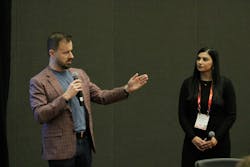
Rockwell Automation is preparing for a manufacturing environment where artificial intelligence doesn't just enhance products—it operates them independently. Speaking at Automation Fair 2026, company executives outlined a strategic pivot that reimagines how AI interacts with industrial automation systems.
Ryan Gariepy, vice president of Frontier Labs at Rockwell Automation, described the transformation: "AI is now using our products, rather than our products having AI in them." The distinction marks a departure from embedded intelligence toward autonomous AI agents that leverage large language models to orchestrate workflows across automated systems.
Allie Farley, director of co-innovation at Rockwell, projected that within the coming decade, half of all users interacting with Rockwell solutions will be AI agents rather than human operators. This forecast is driving fundamental changes in how the company designs both software and hardware.
From embedded AI to agentic orchestration
The traditional model places humans directly at the controls of industrial products. The emerging paradigm inserts AI agents between human intent and machine execution. These agents interpret goals, determine optimal product deployment, and interface with systems to deliver outcomes—essentially treating Rockwell's portfolio as a toolbox.
Gariepy emphasized that effective implementation requires system-wide thinking rather than maximizing intelligence at every individual machine. His Frontier Labs group experiments with agentic AI applications within existing governance frameworks, maintaining focus on broader production optimization.
Crucially, both executives stressed that AI agents augment rather than replace skilled workers. Understanding how humans currently perform tasks, Gariepy noted, informs the best strategies for agent-assisted work.
Governance frameworks for moving targets
Adapting governance policies to rapidly evolving AI capabilities presents unique challenges. Gariepy pointed to advantages in Rockwell's approach: AI systems draw on legacy data and tools trusted across decades of industrial use, plus accumulated human expertise.
The company plans to release FactoryTalk Conductor in early 2027—an AI-native orchestration platform designed to coordinate agents, workflows, and industrial knowledge across automation lifecycles. Gariepy described it not as autonomous factory management but as a governance and security layer ensuring standards compliance enterprise-wide.
Farley detailed how her team works with Rockwell's internal AI Governance Council to continuously review policies against both internal standards and external regulations. She noted that governance must function across the entire industrial stack, from edge devices through manufacturing execution systems.
Why it matters
This architectural shift has immediate implications for manufacturers planning AI investments. Rather than evaluating products based on embedded intelligence features, procurement teams will need to assess how well systems can be orchestrated by external AI agents. It also signals that governance frameworks must become as dynamic as the AI they regulate—static policies won't suffice when the technology reinvents itself continuously. Companies that treat AI governance as a one-time compliance exercise rather than an ongoing adaptive process risk either stifling innovation or exposing operations to unmanaged risk.
These details were first reported by Automation Watch in coverage of Rockwell Automation's Automation Fair 2026 presentation on industrial AI governance.