Public Backlash Against AI Marks Historic Shift in Tech Sentiment
Unlike past technology waves, Americans view artificial intelligence negatively—and the industry's own messaging shares much of the blame.
A Departure From Tech Optimism
When Eric Schmidt delivered a commencement speech championing artificial intelligence, students booed him loudly. The moment captured a broader sentiment shift: Americans have turned decisively against AI in ways that mark a clear break from how previous technologies were received.
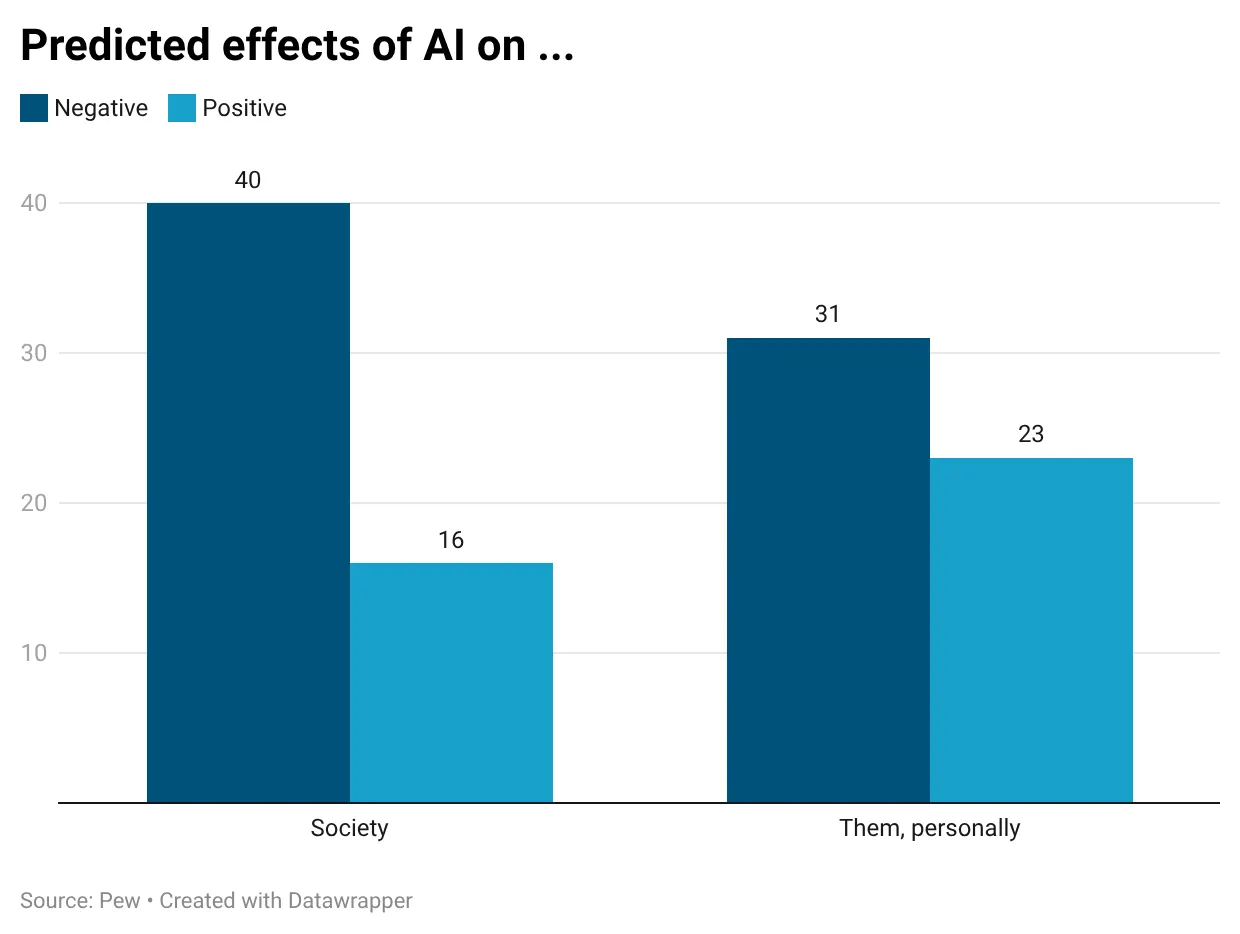
Recent Pew Research data shows American adults believe AI will be negative for society by a wide margin, with a smaller majority expecting personal harm as well. This stands in stark contrast to historical patterns. When the internet emerged in 1999, Pew found extremely positive views about computers and technology. In 2015, 71 percent of Americans said tech companies had a positive impact on the country, with only 17 percent disagreeing.
Five Forces Driving the Backlash
The current hostility stems from multiple reinforcing factors, according to an analysis by economist Paul Krugman.
First, AI companies themselves seeded fear by predicting catastrophic job losses to attract investment and pressure businesses into adoption. Anthropic CEO Darius Amodei told Axios last year that AI could eliminate half of entry-level white-collar jobs and drive unemployment to 20 percent within one to five years. These apocalyptic warnings succeeded as a financial strategy but created lasting public alarm. Microsoft CEO Satya Nadella recently criticized this approach, telling the Wall Street Journal that companies cannot simultaneously threaten mass job destruction and expect public support.
Second, workers and consumers feel AI is being imposed on them without choice. Companies are mandating AI tools for employees, responding to financial market pressure rather than demonstrated productivity gains. Google replaced its traditional search engine with AI-powered results without offering an opt-out, forcing users toward workarounds to access conventional search.
Third, massive data centers have made AI's costs highly visible. Facilities consume enormous land—one proposed Utah site would be twice Manhattan's size—while demanding vast electricity and water resources. A Reuters-Ipsos poll found 57 percent of Americans would oppose a data center in their neighborhood, with only 14 percent supportive.
Fourth, tech companies had already lost public trust before AI's emergence. Between 2015 and 2022, positive sentiment toward tech companies evaporated, driven by social media's documented harms and what Krugman describes as the "enshittification" of tech products.
Finally, AI is linked to wealth concentration and tech oligarchs. Americans outside the MAGA base overwhelmingly favor policies to reduce wealth inequality, and AI is widely perceived as technology that will further concentrate power at the top—a view the industry's own job-loss predictions have reinforced.
Why It Matters
This backlash carries immediate political consequences. Despite heavy AI industry spending on elections, most efforts to boost friendly politicians have failed. Association with AI or tech money is becoming politically toxic, demonstrating that even in an era of outsized corporate influence, public opinion retains power. The industry's deliberate choice to appear menacing as a marketing strategy has backfired, creating an opposition that extends across demographic and political lines.
These findings were detailed in Paul Krugman's analysis on his Substack newsletter.
This is an original analysis by the Omega editorial team. Source reporting: AI Watch.
Want systems like this working for your business?
Book a Call