Physical AI Lets Robots Learn by Demonstration, Not Code
Standard Bots CEO says demonstration-based training makes previously uneconomical automation projects viable for manufacturers.
Physical AI Lets Robots Learn by Demonstration, Not Code
U.S. manufacturing employment has dropped from nearly 20 million workers in 1979 to approximately 13 million today. Standard Bots co-founder and CEO Evan Beard presented that figure to Congress in April 2026, arguing that robots must become dramatically easier to deploy before the trend can reverse.
In testimony before the House Science, Space, and Technology Committee's Subcommittee on Research and Technology, and in subsequent remarks to the Association for Advancing Automation, Beard outlined how physical AI addresses a core barrier: the cost and complexity of programming and retraining industrial robots.
Why it matters
Most automation projects fail not because robots lack mechanical capability, but because programming, integration, and changeover costs make them economically unviable. Physical AI shifts that calculation by eliminating traditional coding requirements, potentially opening automation to the majority of manufacturing tasks that remain manual today.
How demonstration-based training works
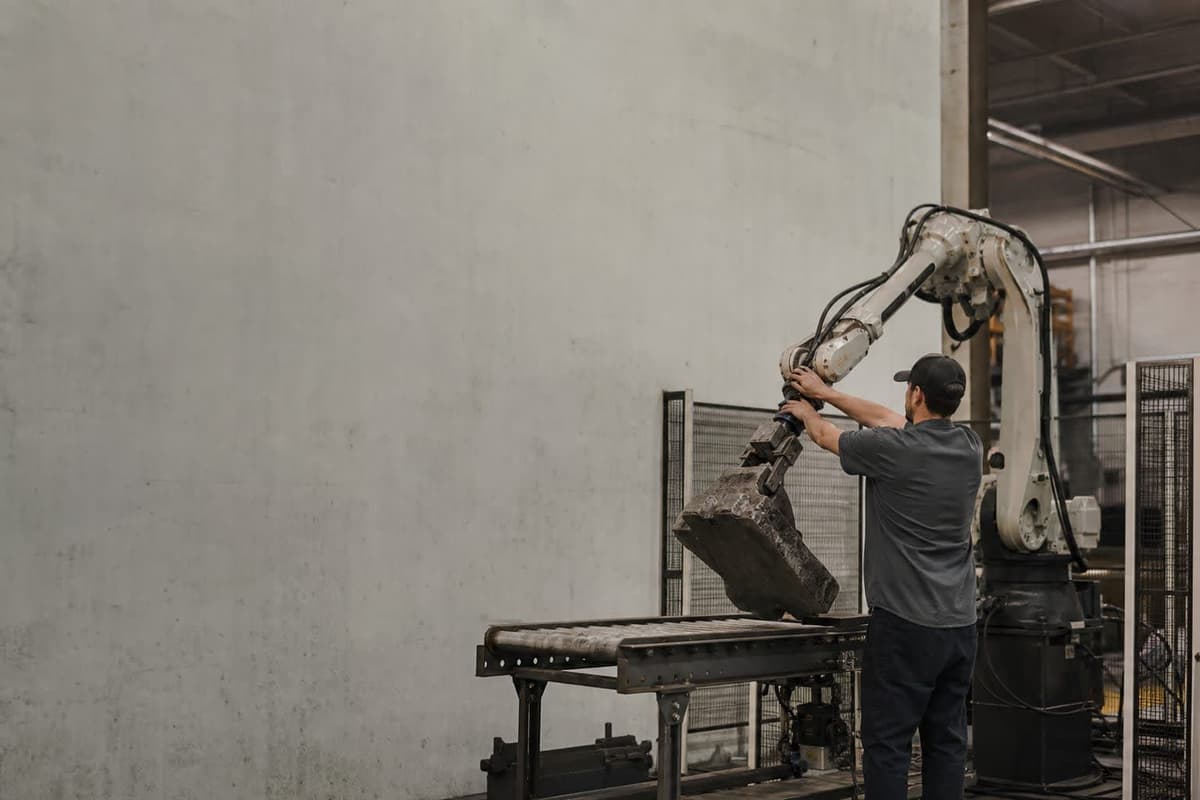
Instead of writing code for every motion, an operator guides the robot through a task using a handheld device or teleoperation. The robot records the movement and converts it into training data for an AI model, which then executes the task autonomously. Beard connects this capability directly to advances in large language models, noting that the same progress behind tools like ChatGPT now applies to physical systems.
The approach targets two categories of work. The first includes established applications where robots already operate—machine tending, welding, palletizing, painting—but where Standard Bots competes on faster, cheaper deployment. The second category covers what Beard calls "impossible jobs": tasks that integrators have deemed technically infeasible or economically unjustifiable once integration costs are factored in.
Variation typically drives those rejections. A robot programmed for one specific object, surface, or orientation often cannot handle small deviations without reconfiguration. Physical AI-based systems, Beard argues, can extrapolate from demonstrated examples rather than fail when encountering new variants.
Cycle time and the automotive example
Beard described an automotive application where a task needed completion within a one-minute station time—a cycle-time constraint that had historically ruled out automation. Using demonstration-based training, the robot learned the job, identified the work area, and met the required window. The same principle applies to handling new object sizes or shapes the robot has never encountered, because the underlying model generalizes rather than requires explicit reprogramming.
Domestic manufacturing and support infrastructure
Standard Bots, founded in 2017 by Beard, James Cordle, and David Golden, manufactures its robots in the United States. Beard frames this as both a supply chain decision and a service consideration. An American-made robot comes with an American support team reachable when equipment fails on the production floor—a distinction with direct uptime implications for operations leaders.
In his April testimony, Beard appeared alongside A3 President Jeff Burnstein. Both advocated for a coordinated national robotics strategy, pointing to countries that established robotics policies earlier and now dominate global markets.
Beard also emphasized that the industries and tasks most in need of automation remain largely untouched. Most manufacturers have at least one process they would automate if cost, complexity, and risk were manageable. Physical AI's proposition is that it lowers all three barriers simultaneously.
Operational implications
For manufacturing teams, the shift suggests revisiting automation candidates previously rejected due to variability, cycle-time constraints, or integration expense. Vendor evaluations should now include questions about demonstration-based programming and documented changeover times when product variants or process steps change.
Domestic support availability should also factor into total cost of ownership calculations. Response time for on-floor technical issues directly affects uptime and belongs in vendor scoring criteria.
Congressional attention on domestic robotics manufacturing, as evidenced by the April 2026 hearing, may influence incentive programs, procurement preferences, or sourcing requirements relevant to capital planning in the coming quarters.
Details on Beard's remarks and Standard Bots' approach were first reported by the Association for Advancing Automation's Automate publication and MarketScale.
This is an original analysis by the Omega editorial team. Source reporting: Automation Watch.
Want systems like this working for your business?
Book a Call