Automation
Physical AI Drones Close the 'Ground Truth Gap' in Warehouses
Autonomous systems from Gather AI deliver real-time inventory verification, achieving 99.9% accuracy while eliminating manual cycle counts.
Key takeaways
- Gather AI's Physical AI drones close the "ground truth gap" between warehouse system records and actual inventory conditions, achieving up to 99.9% verified accuracy.
- The platform extends beyond autonomous drones to include vision sensors on forklifts and material handling equipment, capturing data continuously during normal operations.
- Companies typically see ROI within 4-6 months through reduced shrink, eliminated manual cycle counting, and improved throughput.
- Physical AI systems interpret real-world conditions dynamically rather than following fixed paths, adapting to moving equipment and changing layouts.
- Strongest adoption comes from third-party logistics providers, retail distribution centers, and cold storage facilities where accuracy and speed are critical.
Warehouse management systems can tell operators where inventory should be, but not whether it's actually there, correctly positioned, or undamaged. This persistent disconnect—what Gather AI calls the "ground truth gap"—drives inventory distortion, mispicks, and operational inefficiencies even in facilities that have invested heavily in automation.
Pittsburgh-based startup Gather AI is deploying autonomous drones and vision-equipped material handling equipment to close that gap. The company's Physical AI platform continuously captures and interprets visual data across warehouse floors, transforming static inventory records into verified, real-time intelligence.
Why it matters
Labor shortages and supply chain volatility demand warehouse operations that can self-verify and self-correct without manual intervention. Physical AI systems enable warehouses to shift from periodic audits to always-on monitoring, identifying discrepancies before they cascade into fulfillment failures or customer service issues. With ROI typically realized in four to six months, the technology addresses both immediate operational pain and longer-term resilience needs.
Beyond pre-programmed routes
Traditional warehouse automation—automated storage and retrieval systems, automated guided vehicles—follows fixed paths and requires significant infrastructure investment. These systems excel at specific workflows but struggle to adapt when conditions change.
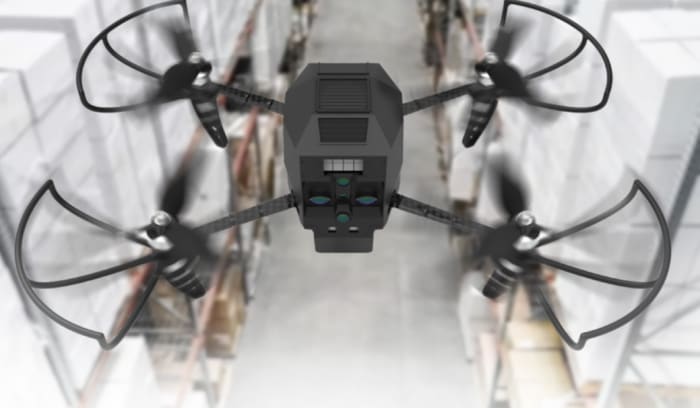
Physical AI takes a different approach. Gather AI's drones use onboard cameras and sensors to dynamically map their environment, avoid obstacles like moving forklifts, and interpret what they observe in real time. The systems identify pallets, read labels, and understand spatial context, making decisions on the fly rather than following predetermined routes.
"Physical AI enables warehouses to operate with a continuously updated understanding of their environment, allowing them to respond quickly to disruptions and optimize performance," said Joseph Mirabile, Vice President of Operations at Gather AI, in an interview with Tech Briefs.
From drones to platform
While autonomous drones provided the initial entry point, Gather AI has expanded into what Mirabile describes as a broader physical intelligence platform. The company's Material Handling Equipment Vision solution embeds sensors directly on forklifts and other equipment, capturing data continuously as operators work. Every pallet movement becomes a data point without requiring dedicated scans or workflow changes.
Core use cases include automated inventory tracking, location validation, damage detection, and workflow visibility. The platform integrates with warehouse management systems, ERP platforms, and analytics tools to provide unified operational insights.
Customers are achieving inventory accuracy rates up to 99.9 percent, even in complex environments. The systems eliminate manual cycle counting, freeing teams to focus on exception handling and process improvement—often saving hundreds of labor hours weekly. Third-party logistics providers, retail distribution centers, and cold storage facilities have shown the strongest adoption.
Implementation considerations
For engineering teams evaluating Physical AI-enabled drones, Mirabile recommends starting with clearly defined operational problems rather than technology features. Critical design considerations include flexibility to work within existing infrastructure, seamless integration with current software systems, robust safety mechanisms for dynamic environments, and scalability from single-site pilots to network-wide deployments.
Safety protocols combine redundant systems, geofencing, and integration with warehouse workflows to minimize disruption while drones operate alongside human workers and mobile equipment.
Details on Gather AI's drone-powered inventory solutions were first reported by Tech Briefs in an interview with Joseph Mirabile.