AI
Penn State AI Model Detects Crop Stress Using 90% Less Computing
PSUMamba analyzes hyperspectral images through three parallel pathways, achieving 94% accuracy while drastically cutting resource requirements.
Key takeaways
- PSUMamba uses 10 times fewer computational operations than comparable AI models while achieving 94% accuracy in detecting crop stress.
- The model processes hyperspectral images through three parallel pathways analyzing spectral, temporal, and spatial information.
- Validation tests on white button mushrooms achieved 98.98% sensitivity using 204 spectral bands across eight timepoints.
- The architecture is designed to detect stress from drought, disease, nutrient deficiency, and physical damage across multiple crop types.
- Real-world field trials with diverse crops and integration with sensing platforms are planned as next steps.
Efficient AI architecture promises practical crop monitoring
Researchers at Penn State have developed an artificial intelligence model that can identify stress in agricultural crops with high accuracy while consuming a fraction of the computing resources required by current methods. The system, called PSUMamba, uses hyperspectral imaging to detect subtle physiological changes caused by drought, disease, nutrient deficiency, and other factors before they become visible to human observers.
The model achieved 94.47% accuracy in controlled tests while requiring approximately 10 times fewer computational operations than the Vision Transformer model used for comparison, according to findings published in Scientific Reports. That efficiency gap matters for real-world deployment, where growers need rapid analysis without expensive hardware.
Three-pathway architecture reduces computational load
PSUMamba processes hyperspectral data—information captured across many wavelengths of light—through three separate but complementary pathways. The first analyzes spectral information to identify changes in biochemical properties. The second examines temporal patterns as crop conditions evolve. The third evaluates spatial features and patterns within images.
"These three pathways are combined to improve the model's ability to identify crop stress," said Shirin Ghatrehsamani, assistant professor of agricultural and biological engineering at Penn State and senior author of the study.
The architecture draws on Mamba, a type of neural network designed to process long sequences of data efficiently. By merging spectral, temporal, and spatial information streams, the researchers created a system that captures stress-related patterns without the computational burden that has kept hyperspectral imaging largely confined to laboratory settings.
Validation tests used Pennsylvania mushroom industry
The research team validated PSUMamba using white button mushrooms, an economically significant crop in Pennsylvania, which produces 74% of the nation's Agaricus mushrooms. National mushroom sales fell 16% to $922 million last season, according to USDA data, making postharvest quality degradation a pressing industry concern.
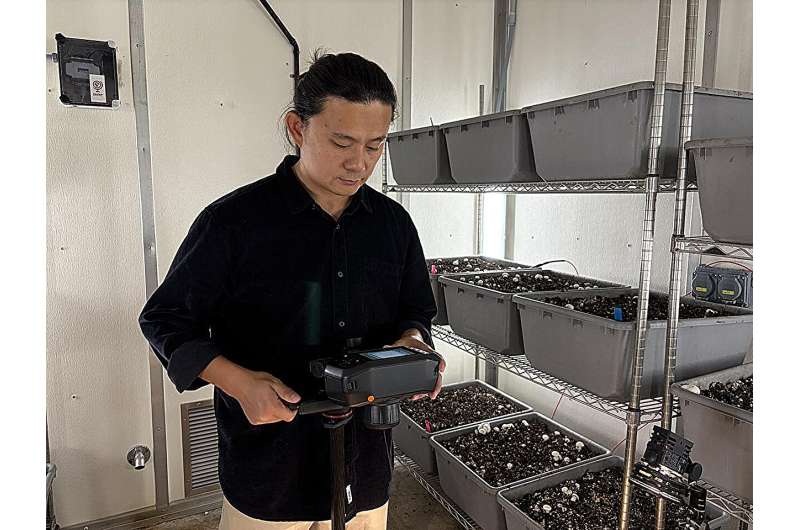
Researchers subjected mushrooms to three controlled stress treatments: thermal shock at 140°F for 30 seconds, microwave radiation for 30 seconds, and mechanical injury through punctures and impact damage. The model analyzed 204 spectral bands collected across eight timepoints, achieving 98.98% sensitivity and an AUC-ROC score of 99.36%.
"Crops often show subtle physiological changes long before symptoms become visible to the human eye," said Weiqun Wang, doctoral candidate and first author of the study. "Our work addresses this challenge by developing an AI model that can accurately identify stress while requiring substantially fewer computational resources."
Why it matters
The computational efficiency of PSUMamba could make advanced crop monitoring practical for field deployment, where speed and cost constraints have limited adoption of hyperspectral imaging. Early stress detection enables growers to intervene before yield losses occur, potentially reducing input costs and waste while improving sustainability. The framework was designed to capture fundamental stress patterns applicable across crops and conditions—not just mushrooms in controlled environments.
Field trials ahead
Ghatrehsamani emphasized that real-world validation remains the critical next step. The team plans to test whether the model performs under actual agricultural field conditions with different crops and stress factors, and to explore integration with field-based sensing systems, greenhouse monitors, robotic platforms, and aerial imaging technologies.
The findings were first reported by Penn State and published in Scientific Reports.