Oregon Tests First AI Deepfake Election Law in 2026 Midterms
A congressional candidate's attack ads featuring glowing red eyes and fabricated scenarios trigger the state's 2024 disclosure requirement.
Oregon has become a proving ground for state-level regulation of artificial intelligence in political campaigns, with its first enforcement case now underway following complaints about AI-generated attack ads in a congressional primary race.
First Enforcement Test
The Secretary of State's office launched an investigation in July after receiving complaints about ads created by Jonathan Lockwood during his unsuccessful primary challenge to U.S. Rep. Janelle Bynum in Oregon's 5th Congressional District, according to Oregon Public Broadcasting.
The ads in question included imagery of Bynum and Gov. Tina Kotek with glowing red eyes pursuing frightened children, and another depicting Bynum in a McDonald's uniform handing a drag queen keys to a girl's locker room. Lockwood defended the content by arguing the ads were too outlandish to be mistaken for authentic material.
If found in violation, Lockwood could face prosecution and fines reaching $10,000. The investigation remains active, state officials confirmed.
Why it matters
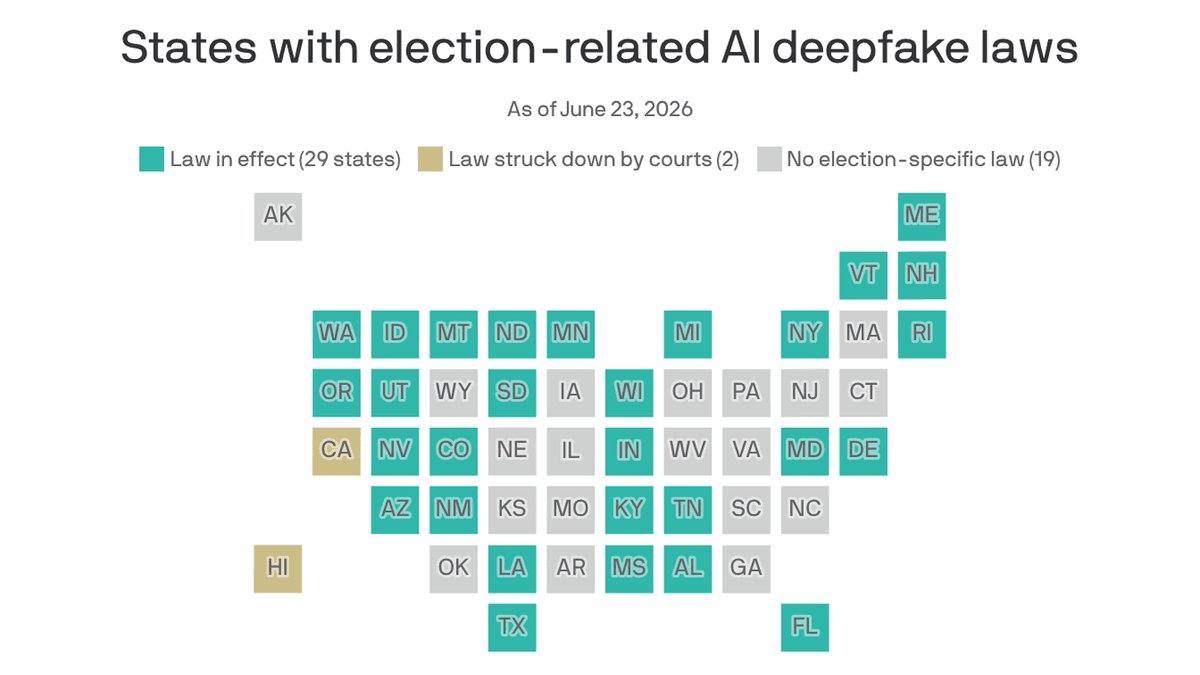
With AI-generated campaign content proliferating ahead of the midterms and no federal baseline standards in place, state enforcement actions will establish the practical boundaries for synthetic media in elections. How Oregon handles this case could influence both regulatory approaches and campaign tactics in the 29 states that have enacted similar measures.
Patchwork of State Rules
Oregon Senate Bill 1571, enacted in 2024, mandates that candidates disclose when they deploy AI to produce campaign advertisements. The state joins 28 others in regulating deepfakes in electoral contexts, though approaches vary significantly.
Minnesota and Texas impose prohibitions on political deepfakes during specific windows before elections, while Maryland maintains a year-round ban. However, legal challenges have emerged: courts struck down comparable laws in California and Hawaii on First Amendment grounds, according to the National Conference of State Legislatures.
Federal Inaction Continues
Congress has not established uniform standards for AI deepfakes in elections despite years of proposed legislation. Lawmakers did attempt to address nonconsensual intimate deepfakes—an issue that has intersected with attack ads targeting women in office—but advocates report implementation challenges, including inconsistent content removal processes and the likelihood that litigation will be necessary for meaningful enforcement.
House Democrats have indicated plans to advance election deepfake legislation if they reclaim majority control next year.
State Leadership by Default
The absence of federal action has positioned states as the primary regulators of synthetic media in political campaigns. Oregon's current case represents a critical test of whether disclosure requirements can be enforced without running afoul of free speech protections that have invalidated more restrictive state laws.
These details were first reported by Axios.
This is an original analysis by the Omega editorial team. Source reporting: AI Watch.
Want systems like this working for your business?
Book a Call
