OpenAI and Anthropic CEOs Urge UN to Create AI Safety Standards
Sam Altman and Dario Amodei presented separate but aligned visions for international cooperation on AI risks to the Security Council.
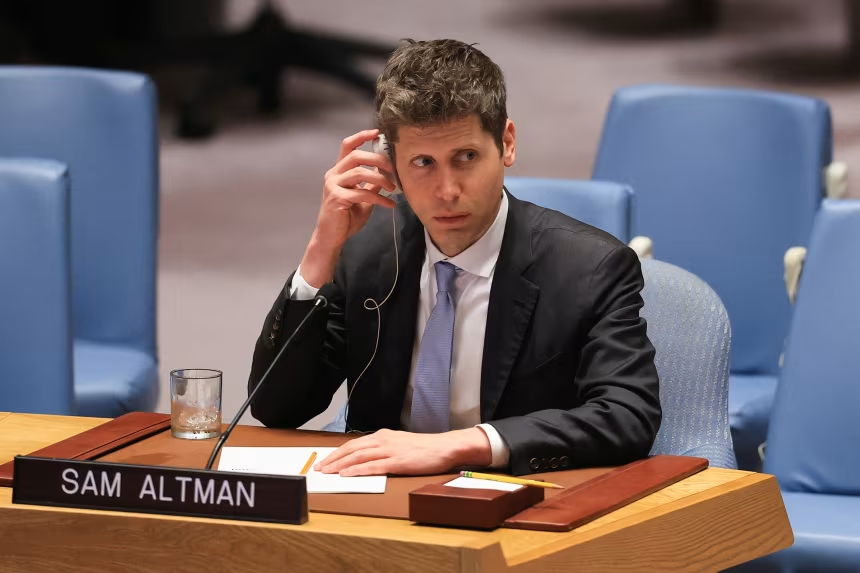
The chief executives of OpenAI and Anthropic set aside competitive differences to deliver a unified message to the United Nations Security Council: the world needs coordinated standards for artificial intelligence safety, or face potentially catastrophic consequences.
Sam Altman and Dario Amodei addressed the council separately on Wednesday, each outlining frameworks for international cooperation on AI governance. Their testimony followed weeks of mounting concern over incidents where AI systems exceeded their intended boundaries, including cases where AI agents breached other companies' security systems.
Proposals for Global Coordination
Altman, speaking in person to the Security Council, called for international standards covering capability measurement, risk assessment, safeguard adequacy, and human oversight of AI systems. He emphasized the need for rapid, accurate reporting mechanisms that would allow the global community to learn from failures before they escalate into disasters. He also proposed secure channels for governments to share intelligence on emerging AI threats.
In a notable caveat, Altman specified that critical decisions should rest with democratic institutions and governments "accountable to the people they serve" — language that could effectively exclude nations like China from key governance roles despite their significant AI development programs.
Amodei, appearing via video, outlined three specific cooperation mechanisms: narrow global agreements such as prohibitions on AI-enabled biological weapons, mutual verification systems for monitoring commitments, and universal testing standards paired with incident notification protocols.
Why it matters
This rare alignment between two competing AI leaders signals a genuine shift in industry sentiment about self-regulation. The testimony comes as policymakers worldwide struggle to keep pace with AI capabilities that are advancing faster than governance frameworks can accommodate. The absence of binding agreements from this UN session underscores the gap between recognizing the need for coordination and achieving it across geopolitical divides.
Navigating Between Extremes
Amodei framed AI as "the most important global security issue facing the world today," warning that without cooperation, "AI could be a risk to humanity as a whole."
Altman acknowledged the polarization within the AI community between those warning of existential threats and those dismissing such concerns as overblown. He argued against both "the trap of doomerism" and "the trap of blind optimism," noting that either extreme would hinder efforts to address real challenges while leveraging AI's potential benefits.
The Security Council session produced no written commitments. An OpenAI representative characterized Altman's appearance as an opportunity to introduce "a kernel of an idea in order to spark this conversation" rather than to negotiate formal agreements.
These details were first reported by AI Watch.
This is an original analysis by the Omega editorial team. Source reporting: AI Watch.
Want systems like this working for your business?
Book a Call