NVIDIA Unveils Physical AI Agent Skills for Autonomous Vehicles
New automation tools aim to streamline fragmented workflows in robotics, AV development, and vision AI research.
NVIDIA Tackles Physical AI Development Bottlenecks
NVIDIA has introduced a suite of physical AI agent skills designed to accelerate research and development across autonomous vehicles, robotics, and vision AI systems. The announcement, made at the Computer Vision and Pattern Recognition (CVPR) conference, addresses a persistent challenge in the field: fragmented workflows that slow experimentation and iteration.
According to details first reported by NVIDIA's AI Watch blog, the core problem isn't model strength but the complexity of building complete workflows around those models. Researchers currently struggle to connect disparate tools for scene reconstruction, synthetic scenario generation, policy training, and behavior evaluation.
The new skills work alongside NVIDIA Cosmos 3, the company's recently announced open frontier model for physical AI, which unifies vision reasoning, world modeling, and action generation. Together, these tools aim to create end-to-end workflows that reduce manual integration work.
Why it matters
Physical AI development has historically required researchers to manually stitch together multiple specialized tools, creating friction that slows the pace of innovation. By automating common workflow steps—from 3D scene reconstruction to policy evaluation—NVIDIA's approach could significantly compress development cycles for autonomous systems. This matters particularly for edge-case testing in autonomous vehicles and synthetic data generation in robotics, where rare scenarios are difficult to capture but critical for safety validation.
Autonomous Vehicle Workflows
For AV researchers, the new skills address the "long tail" problem: rare driving interactions and unusual conditions that are hard to collect repeatedly but essential for training. Neural Reconstruction skills convert fleet-captured data into editable 3D scenes, using technologies including Omniverse NuRec and InstantNuRec for fast reconstruction without per-scene optimization.
NVIDIA AlpaGym, an open-source reinforcement learning framework, connects policy rollouts with high-fidelity simulation, scaling across thousands of GPUs. OmniDreams, an action-conditioned generative world model, adds photorealistic rendering that responds to policy actions in real time.
The company also released Alpamayo 2 Super, a 32-billion-parameter vision-language-action model for level 4 autonomous driving.
Vision AI and Robotics Applications
New Metropolis skills help vision AI researchers generate synthetic visual scenarios, including rare defects for inspection models. The Defect Image Generation skill creates examples across different surfaces using real images, combining Isaac Sim simulation with Cosmos 3 and OSMO for orchestration.
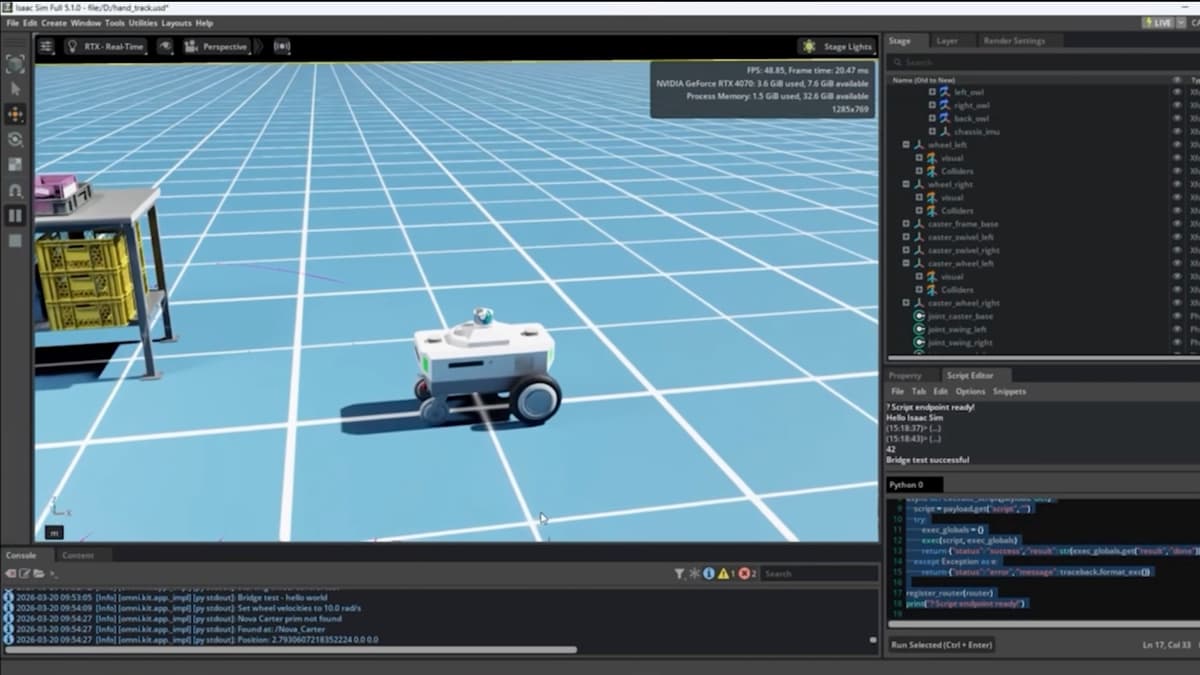
For robotics, Isaac Sim 6.0 includes agent-friendly skills that automate scene preparation, simulation control, and data capture. Specialized mobility skills support navigation workflows, while manipulation skills assist with sim-to-real tasks including environment building and physics tuning.
Cosmos-H-Surgical-Simulator generates realistic surgical robotics data by learning from actual surgical procedures rather than hand-engineered physics models.
Research Infrastructure
NVIDIA reported that its technologies were referenced in the majority of accepted CVPR 2026 papers. The company's Physical AI Dataset has exceeded 15 million downloads on Hugging Face, while Isaac GR00T X Embodiment Sim has become one of the most-downloaded robotics datasets.
The physical AI agent tools and skills are now available through GitHub, with select capabilities accessible on NVIDIA Brev as "Physical AI Launchables"—preconfigured environments running on hosted H100 GPUs with free trial credits for researchers.
Details were first reported by NVIDIA's AI Watch blog.
This is an original analysis by the Omega editorial team. Source reporting: AI Watch.
Want systems like this working for your business?
Book a Call