Nvidia forecasts chip sales will double in 2025 despite AI safety concerns
CEO Jensen Huang balances explosive growth predictions with calls for engineering discipline at King Charles summit.
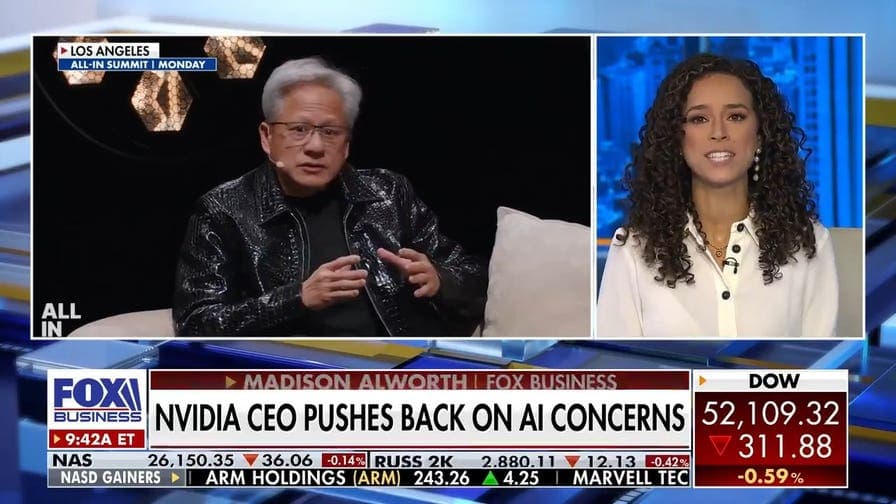
Nvidia CEO Jensen Huang projected the company's chip sales will double in 2025, even as he joined AI industry leaders in acknowledging mounting safety concerns at a summit convened by King Charles in Scotland.
Huang delivered what observers characterized as a dual message: explosive financial optimism paired with a call for the AI sector to embrace "good old-fashioned engineering" discipline. The executive shared the stage with leaders from Google DeepMind, OpenAI, and Anthropic—companies at the forefront of generative AI development.
Why it matters
Nvidia's sales forecast signals that enterprise demand for AI infrastructure remains robust despite growing regulatory scrutiny and public anxiety about the technology's risks. The doubling prediction suggests corporations continue to prioritize AI capabilities even as governments and civil society groups push for stronger safety frameworks. For technology leaders, this creates a dual imperative: accelerating deployment while simultaneously investing in risk mitigation.
Growth amid scrutiny
The timing of Huang's forecast is notable. Public concern about AI safety has intensified over the past year, with regulators in the European Union, United States, and United Kingdom advancing frameworks to govern the technology's development and deployment.
Yet Huang's projection indicates that safety debates have not slowed the "global AI gold rush," as he characterized the current market dynamics. The CEO's emphasis on engineering rigor appears designed to address concerns without dampening investor enthusiasm for AI infrastructure spending.
Royal convening
The Scottish summit represented an unusual venue for such pronouncements. King Charles has increasingly engaged with technology leaders on issues ranging from climate technology to digital ethics. The gathering brought together executives whose companies are racing to develop increasingly capable AI systems while facing questions about their societal impact.
Huang's participation alongside OpenAI and Anthropic leadership underscores Nvidia's position as the critical infrastructure provider enabling their work. The company's graphics processing units have become essential for training large language models and other AI systems.
Engineering emphasis
By calling for "good old-fashioned engineering," Huang appeared to advocate for systematic, methodical approaches to AI development rather than rushing to market with insufficiently tested systems. This message aligns with growing calls from researchers and policymakers for more rigorous safety testing before deploying powerful AI models.
The framing suggests Huang sees engineering discipline and rapid growth as compatible rather than contradictory—a perspective that will be tested as his company pursues the aggressive sales trajectory he outlined.
These details were first reported by Fox Business.
This is an original analysis by the Omega editorial team. Source reporting: AI Watch.
Want systems like this working for your business?
Book a Call