New York warns AI threatens women in administrative roles
Governor Hochul convenes task force as state projects decline in office jobs disproportionately held by women.
AI automation threatens middle-class administrative jobs
New York Governor Kathy Hochul has identified artificial intelligence as a significant threat to administrative positions predominantly held by women, as the state develops strategies to address workforce displacement. Women currently hold approximately 84% of administrative roles statewide, making them disproportionately vulnerable to AI-driven job elimination.
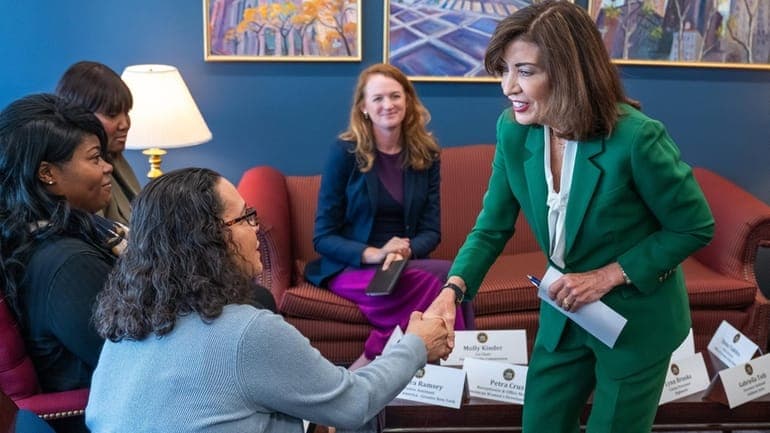
The governor convened a meeting in Manhattan with women from across New York to discuss concerns about AI's use in hiring processes and workforce reductions. The gathering comes as state labor projections paint a sobering picture for administrative employment.
On Long Island, office and administrative positions account for roughly 13% of employment, encompassing approximately 169,000 workers in roles such as executive assistants, bookkeepers, and customer service representatives. State Labor Department forecasts show these positions will grow at just 0.3% annually through 2032 in the region. Statewide projections are grimmer, anticipating a decline of 7,100 administrative job openings per year through 2034—a 0.6% annual decrease.
Why it matters
The AI displacement threat arrives precisely as New York has made measurable progress closing its gender pay gap, with women's median full-time earnings reaching 91.9% of men's wages in 2024, up from 86.9% a decade earlier. Administrative roles represent middle-class employment that provides economic stability without requiring advanced degrees—making their potential elimination particularly consequential for working women who may lack financial cushions during rapid transitions.
Different displacement pattern expected
Molly Kinder, co-chair of the governor's FutureWorks Commission and former Brookings Institution researcher, explained that administrative jobs face heightened risk from large language model technologies like ChatGPT. Unlike previous economic disruptions such as factory closures, this displacement may occur gradually—one or two positions at a time within individual offices rather than through mass layoffs.
Kinder acknowledged potential benefits, noting AI could free workers for higher-value tasks and better-compensated responsibilities. However, she emphasized the commission's focus remains on displacement risks.
Petra Cruz, an administrative assistant at the Dominican Women's Development Center in Washington Heights, challenged the notion that AI could fully replace human workers in her field. She described scenarios requiring empathy and judgment that automation cannot provide, such as assisting domestic violence victims who arrive in crisis.
State response in development
The FutureWorks Commission plans to deliver recommendations by fall for incorporation into Hochul's January State of the State proposals. The governor indicated forthcoming policies would address worker retraining for AI tool usage and transitions to industries more resistant to automation, specifically citing healthcare as one such sector.
These details were first reported by Newsday.
This is an original analysis by the Omega editorial team. Source reporting: AI Watch.
Want systems like this working for your business?
Book a Call
