Enterprise
Lumen exec: AI infrastructure is distributed, not confined
Rob Ward says power constraints, edge inference, and network programmability will define the next phase of enterprise AI deployment.
Key takeaways
- Lumen's Rob Ward says AI infrastructure is inherently distributed across data centers, clouds, and edge locations, not confined to centralized facilities.
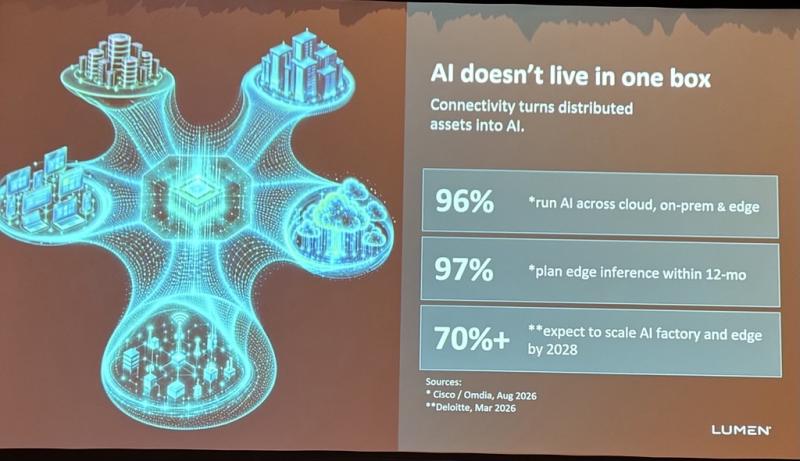
- Power availability is emerging as a growing constraint alongside silicon, with 97% of surveyed enterprises planning edge inference within a year.
- Network sales must shift from fixed circuits to programmable, outcome-based connectivity that adapts at machine speed as workloads move.
- Lumen has accelerated fiber deployment from 20 terabits every 18-24 months five years ago to 50 terabits every six to nine months today.
- The company targets Level 4 network autonomy—removing human latency while preserving human judgment—rather than full autonomous operation.
The defining infrastructure challenge for artificial intelligence is no longer just compute power inside data centers, but how data moves between facilities, clouds, and edge locations, according to Lumen Technologies' senior vice president of global network engineering.
Rob Ward told attendees at Broadband Nation Expo in New Orleans that the popular image of AI as rows of GPU racks with glowing lights captures only part of the reality. Models, training data, users, and inference workloads all exist in different physical locations, creating what he described as an AI factory without walls.
Why it matters
As enterprises scale AI deployments beyond centralized data centers, network architecture becomes a strategic bottleneck. The shift from static circuits to programmable, outcome-based connectivity represents a fundamental change in how telecom infrastructure is sold and operated—with implications for capital planning, vendor relationships, and competitive positioning in AI-dependent industries.
Power emerges as the binding constraint
While silicon availability remains a limiting factor, Ward identified power as an increasingly critical constraint. The question is no longer just whether facilities can house enough racks, but whether they can deliver sufficient electricity to run them.
Survey data supports the distributed infrastructure thesis. Research from Cisco and Omdia covering roughly 1,200 enterprises found that 96 percent operate across a mix of cloud, edge, and on-premises infrastructure. Ninety-seven percent plan to deploy edge inference within approximately one year. A separate Deloitte study of 500 large enterprises found 70 percent expect to extend their AI infrastructure to the edge, Ward said.
Different workloads demand different network characteristics
Interactive inference requires proximity to users, Ward explained, while synchronized training cares less about absolute latency than consistency and bandwidth. The ideal network would offer maximum throughput, minimal latency, and zero packet loss, but cost and geography force trade-offs.
Sovereignty requirements may need to be resolved first, he added, noting the industry lacks consensus on what AI sovereignty means in practice—whether it refers to country boundaries, regional zones, or something else entirely.
The sales model must evolve
Traditional network sales involve purchasing a circuit between two fixed endpoints, with engineers designing and implementing the connection behind the scenes. Ward said AI fundamentally changes this model. Instead, customers or their agents will define desired outcomes, and programmable networks must deliver those results autonomously.
Those outcomes must be continuously assured as locations and workloads shift during model retraining and data movement. "Those are dynamic, and those are moving at machine speed," Ward said. "We need a network at machine speed."
Physical infrastructure under pressure
Demand is driving rapid innovation in physical network architecture. Ward said he has not seen such acceleration in his career. Five years ago, Lumen was lighting one fiber at roughly 20 terabits every 18 to 24 months. Two years ago, the company was lighting two fiber pairs at 50 terabits each every six to nine months.
Newer equipment has delivered a 12-fold space improvement, Ward said, reducing 12 racks to one in small locations while cutting power consumption in half. The company is exploring multi-core fiber, which places four optical cores in one strand, and hollow-core fiber, which could significantly reduce signal attenuation.
Autonomy with human oversight
Ward described a cycle of translating intent into solutions, enforcing them, then verifying and adapting. Energy-aware orchestration, for example, shifts workloads based on power availability and cost, with networks adapting in near real time.
On autonomy, he drew a clear boundary. Using the TM Forum's zero-to-five autonomous network maturity scale, Lumen aspires to Level 4, not Level 5. The goal is removing human latency from operations while preserving human judgment. AI agents should multiply existing expertise, not replace it or enable uninformed execution, he said.
Ward outlined a security framework for agents: verify identity and accountability, define capabilities and permissions, ensure traceability and audit trails, and maintain the ability to intervene.
The remarks were first reported by Fierce Wireless, which covered Ward's keynote address at the Broadband Nation Expo.