Level 4 Autonomous RAN Networks Move From Trials to Production
Leading mobile operators are deploying AI-driven systems that optimize networks with minimal human intervention, achieving measurable gains in energy efficiency and performance.
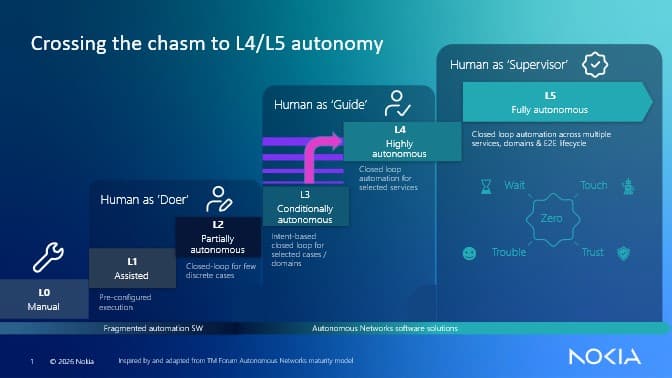
From automation to autonomy
Mobile network operators face a structural challenge: data traffic continues growing at double-digit rates while revenue has increased just 1% annually over the past decade. This squeeze is pushing the industry toward Level 4 autonomous networks—systems that can analyze conditions, make decisions, and take action with minimal human oversight.
According to a new analysis from Dell'Oro Group, several operators have now moved beyond pilots to production deployments of Level 4 Radio Access Network automation, marking a fundamental shift from automating individual tasks to automating decisions themselves.
The TM Forum's autonomy framework defines Level 4 as "high autonomy" where networks execute closed-loop automation across domains, predict and resolve issues before they impact users, and continuously optimize performance through real-time decisions. This sits between Level 3 conditional automation and the theoretical Level 5 full autonomy with zero human intervention.
Real deployments, measurable results
Rakuten Mobile has achieved TM Forum-validated Level 4 autonomy at scale in its live RAN, delivering 20% energy savings through AI-driven closed-loop control without affecting customer experience. In June 2025, TDC NET and Ericsson received Level 4 certification for a live deployment focused on energy optimization, reducing the power required to transmit one gigabyte by approximately 5%.
China Mobile earned Level 4 certifications across multiple operational domains including service assurance and wireless energy optimization at the TM Forum's Innovate Asia 2025 event. China Telecom and China Unicom are implementing targeted Level 4 automation in optimization, assurance, and energy management, with some AI initiatives delivering double-digit efficiency improvements.
Nokia and STC demonstrated Level 4 autonomy during the Hajj period, when the network executed 10,000 autonomous operations per hour as traffic surged 40%, improving downlink throughput by roughly 10%. Huawei reports engagements with more than ten international operators implementing Level 4 systems in production environments.
Vendors cite varied performance gains: Ericsson estimates 15% spectral efficiency improvements, Huawei has shown up to 50% user experience gains in specific scenarios, Nokia reports 80% efficiency gains with zero-touch optimization, and ZTE has demonstrated 30% reductions in fault recovery times with 20%-plus improvements in resource utilization.
Why it matters
The economics of mobile networks have fundamentally changed. Operators cannot scale operational spending in line with network complexity while revenue growth remains flat. Level 4 autonomy addresses this by reducing the human intervention required to maintain performance, optimize spectrum usage, and manage energy consumption—all critical as networks support increasingly diverse use cases from enhanced mobile broadband to fixed wireless access and private networks. The operators achieving Level 4 today gain operational advantages that will compound as 5G matures and 6G planning accelerates.
The path ahead
Most operators worldwide remain at Level 1 or 2, where automation is domain-specific and rule-based. Current Level 4 deployments focus on single domains such as energy optimization or traffic management rather than network-wide autonomy. Dell'Oro Group outlines a two-phase roadmap: near-term single-domain automation with AI-assisted decision-making within defined guardrails, followed by medium-term cross-domain autonomy enabling end-to-end service orchestration across RAN, transport, and core networks.
RAN agents—systems that interpret intent, assess real-time conditions, and take action while learning from new data—are emerging as key enablers of this transition. Unlike traditional rule-based systems, these agents enable context-aware decision-making and continuous optimization.
The shift is taking longer than anticipated; many operators projected large-scale Level 4 by 2025. Today's autonomy operates within well-defined guardrails with humans setting policies and objectives. Yet the trajectory is clear: networks will grow more complex while revenue constraints persist, making the transition to autonomous operations increasingly essential.
These findings were detailed in a white paper published by Dell'Oro Group.
This is an original analysis by the Omega editorial team. Source reporting: Automation Watch.
Want systems like this working for your business?
Book a Call
