Hyundai's $7.6B Georgia Plant Blends AI, Robotics for EV Flexibility
Metaplant America uses modular design and advanced automation to pivot between electric, hybrid, and ICE vehicles as market conditions shift.
Hyundai's $7.6B Georgia Plant Blends AI, Robotics for EV Flexibility
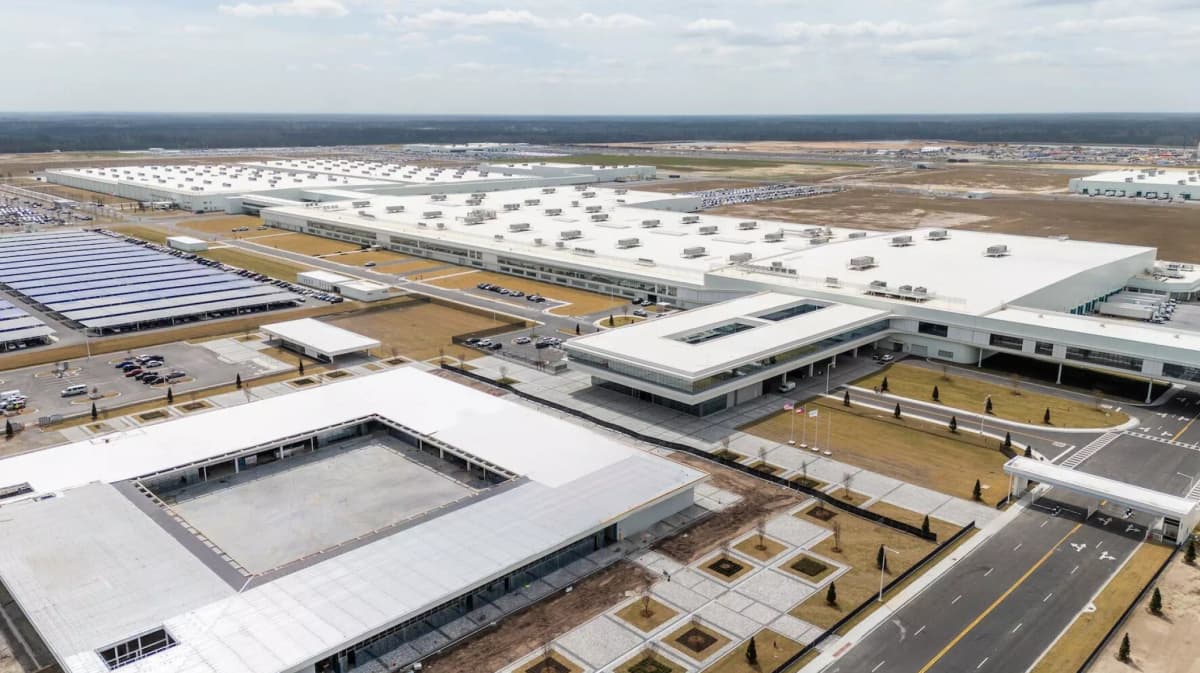
Hyundai Motor Group has opened a $7.6 billion manufacturing facility in Ellabell, Georgia, that represents a new approach to vehicle production: a software-defined factory designed from the ground up to handle electric, hybrid, and internal combustion vehicles on the same line. Hyundai Motor Group Metaplant America (HMGMA) currently produces the Ioniq 5 and Ioniq 9 EVs and is adding the Kia Sportage hybrid, with plans to reach 500,000 units annually across 10 models for Hyundai, Genesis, and Kia brands.
Why it matters
The facility's modular architecture addresses a critical challenge facing automakers: volatile EV demand. When the Trump administration eliminated EV tax incentives in September, Hyundai adjusted its production mix without major line disruptions—a flexibility that legacy plants retrofitted for electrification often lack. As policy and consumer preferences remain uncertain, the ability to pivot between powertrains without costly retooling becomes a competitive advantage.
Integrated supply chain and localization
HMGMA anchors a $12.6 billion investment ecosystem in Georgia, the largest in state history. An on-site battery plant operated by HLBMA—a Hyundai and LG Energy Solution joint venture—receives cells from SK On's Bartow County facility under a 50:50 partnership. Hyundai has committed an additional $6 billion to localize parts, strengthen logistics, and invest in US steel production. Battery sub-assemblies are delivered by conveyor directly to the assembly area, where automated systems marry them to the vehicle underbody with precision positioning.
Jerald Roach, head of general assembly at HMGMA, explained that the plant was designed specifically for battery electric vehicles rather than adapted from an ICE facility. "Plants that are specifically designed to build ICE vehicles are forced to undergo significant structural modifications, or to make compromises in assembly process and/or vehicle design," he noted. Hyundai maintains common locating schemes for major components so automation can easily accept new models regardless of powertrain type.
Robotics and vision systems
The plant deploys robotics and AI-powered vision systems for tasks requiring high precision or exceeding human physical limits. "The integration of robotics and vision lend themselves very well to applications where an assembly operation requires using vision data to precisely position a component to the vehicle," Roach said. Automated guided vehicles (AGVs) move along programmed paths guided by QR codes, replacing traditional conveyors and reducing safety risks associated with forklifts and tuggers.
Boston Dynamics' Atlas humanoid robots are scheduled for deployment in January 2028, starting in the external scheduling area to unload and sort inbound parts—particularly large or heavy components difficult for humans to handle. In October, Hyundai tested Atlas sorting roof racks using a machine learning process where an engineer in a VR headset guides the robot's movements until the task is learned. The robot's external battery allows it to replace its own power source, supported by fast-charging technology for fleet operations.
Workforce and sustainability
HMGMA will employ 8,500 workers by 2031, whom Hyundai calls "Meta Pros." The company positions automation as a way to eliminate repetitive and hazardous tasks while enhancing productivity and safety. The facility incorporates renewable energy sourcing, solar generation, and an advanced wastewater treatment system. Through a 15-year power purchase agreement with Matrix Renewables, Hyundai secured 147 MW of generation capacity from a Texas solar project, expecting to reduce carbon emissions by 140,000 tons annually across US facilities.
Roach said Hyundai's core strategy remains unchanged despite policy shifts, with the company adjusting production mix as needed while maintaining its long-term electrification investment outlook. The details were first reported by Automotive Manufacturing Solutions.
This is an original analysis by the Omega editorial team. Source reporting: Automation Watch.
Want systems like this working for your business?
Book a Call
