Huawei's LogicFolding Chip Architecture Tests Workaround to US Sanctions
The Kirin 9050 Pro stacks computing layers vertically instead of shrinking transistors, a strategy forced by export controls on advanced lithography.
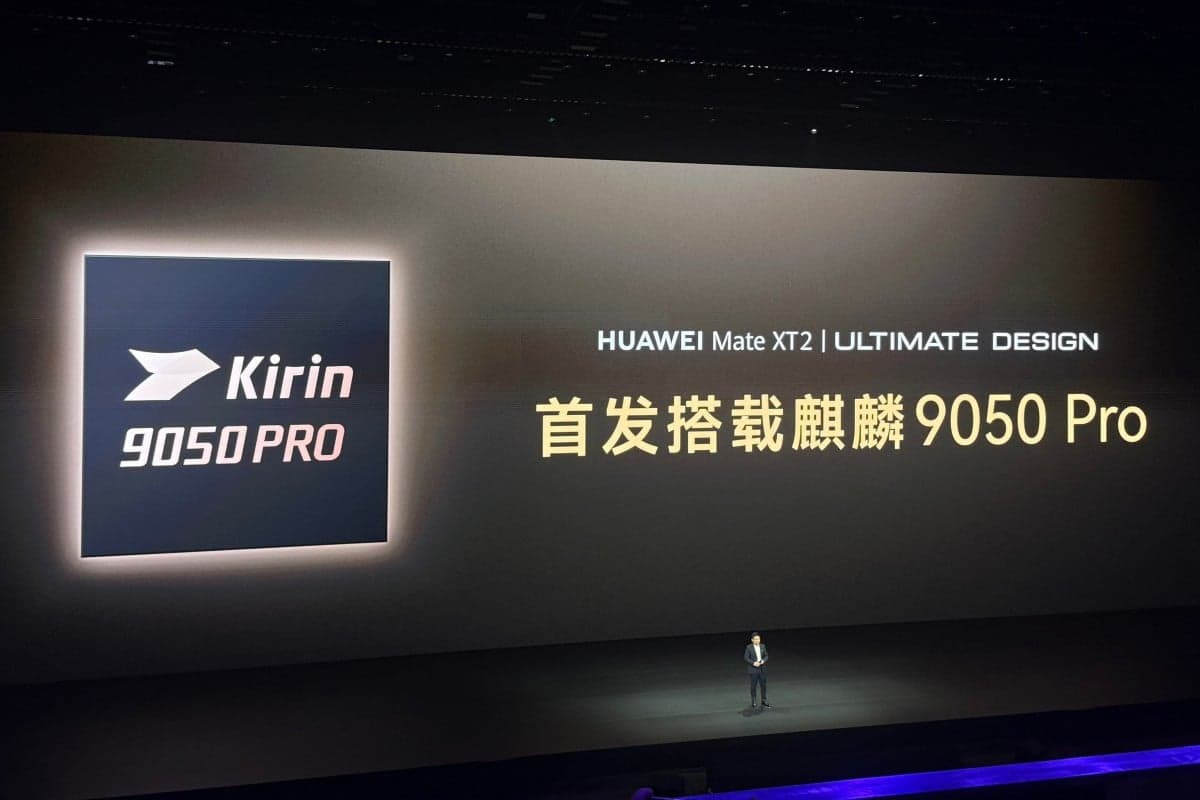
Huawei Technologies has launched its first commercial processor using a novel chip architecture designed to work around US technology restrictions, marking a critical test of whether the Chinese tech giant can maintain competitiveness without access to the world's most advanced semiconductor manufacturing equipment.
The Kirin 9050 Pro, unveiled Monday in the company's new Mate XT 2 trifold smartphone, employs what Huawei calls LogicFolding—a technique that stacks active computing circuits vertically rather than relying on traditional transistor miniaturization. The Shenzhen-based company reports the chip delivers 42 percent better overall performance than its predecessor while improving power efficiency.
Why it matters
This architectural approach represents a fundamental shift in how a major chipmaker responds to geopolitical constraints. If successful, LogicFolding could establish a template for other companies facing similar restrictions, potentially reshaping competitive dynamics in the global semiconductor industry. The technology also signals that innovation pathways exist beyond the traditional roadmap of ever-smaller transistors, though at potentially higher manufacturing costs.
A compensatory strategy
For most global semiconductor manufacturers with access to cutting-edge lithography tools, 3D integration serves as a supplementary technique used alongside transistor shrinking. Huawei, however, has made advanced packaging and architectural innovation its primary strategy due to US export controls that block access to extreme ultraviolet (EUV) lithography and other leading-edge equipment.
The distinction between conventional 3D stacking and LogicFolding is significant. Traditional approaches stack largely independent chip components—separate dies that communicate but function autonomously. Huawei's method splits core computing functions across two active silicon layers engineered to operate as a unified processor.
Manufacturing complexity and trade-offs
The approach introduces substantial manufacturing challenges. According to Leslie Wu, CEO of semiconductor consultancy RHCC, bonding two active silicon layers demands complex production steps including precise wafer thinning and microscopic vertical wiring. These requirements can reduce factory yields—the percentage of chips that meet quality standards—making production more expensive.
For companies that can access advanced lithography equipment, the economics may favor simply printing smaller transistors on a single layer rather than accepting the complexity and potential yield issues of LogicFolding. Wu characterized the technique as "first and foremost a compensatory route—a choice born of external constraints."
The Kirin 9050 Pro's commercial deployment will provide crucial data on whether this architectural strategy can deliver competitive performance at viable production costs. The results could influence not only Huawei's semiconductor roadmap but also broader industry thinking about alternative paths to chip performance improvements.
These details were first reported by the South China Morning Post.
This is an original analysis by the Omega editorial team. Source reporting: AI Watch.
Want systems like this working for your business?
Book a Call