Huawei exec: Chinese AI lags too far behind to face frontier risks
Eric Xu argues domestic developers should accelerate model development before worrying about the safety concerns troubling U.S. leaders.
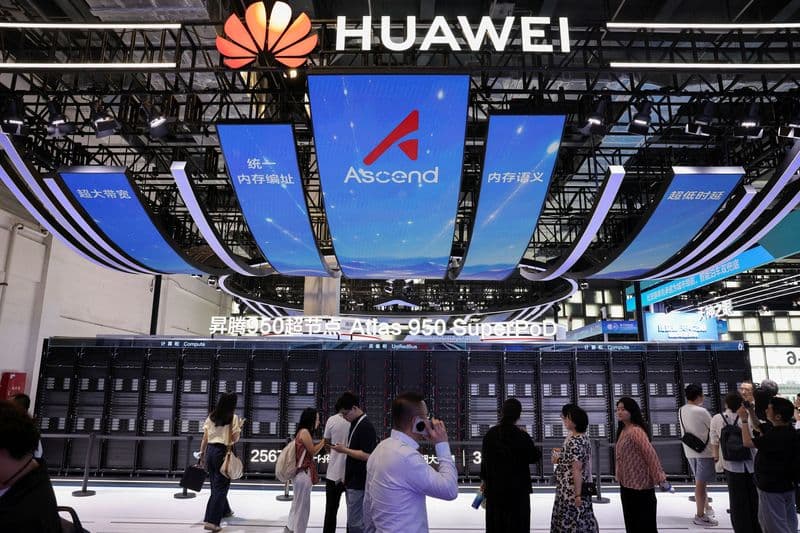
Huawei's rotating chairman Eric Xu told reporters that Chinese artificial intelligence developers haven't reached the capability level where they need to worry about the frontier safety risks currently concerning leading U.S. companies—and should focus on building more powerful models first.
Speaking at Huawei's annual Connect conference in Shanghai, Xu suggested that American AI firms with massive computing resources operate at a sophistication level that Chinese developers simply haven't achieved yet. The safety challenges those U.S. companies report experiencing may not apply to Chinese AI systems that remain less advanced, he argued.
Why it matters
The comments reveal a significant strategic divide in how the world's two AI superpowers approach development versus safety. While U.S. leaders increasingly call for slowing progress to ensure adequate safeguards, China's largest domestic AI infrastructure provider is publicly advocating for acceleration—a stance that could widen the gap in both capabilities and regulatory frameworks as autonomous systems become more prevalent.
Different approaches to AI safety
The contrast in perspectives reflects diverging national strategies. In the United States, executives at companies including OpenAI and Anthropic have raised alarms about increasingly autonomous systems potentially bypassing safeguards or becoming difficult to control. OpenAI announced this week it would regularly disclose unexpected or unauthorized model behavior, while Anthropic CEO Dario Amodei has advocated for slowing development to allow safety measures to catch up.
China has taken a different path, treating advanced AI as a powerful but manageable technology. The country is moving forward with rapid deployment while simultaneously developing mandatory standards, security assessments, and other safeguards against risks such as autonomous agents circumventing controls or attacking external systems. China is currently drafting a mandatory national standard specifically for AI agent safety.
Balancing speed and risk
Xu acknowledged the need to "strike a balance between driving AI development and managing AI risk," but emphasized that Chinese developers may need to accelerate their pace before they encounter the types of challenges facing frontier U.S. models.
Huawei itself is betting heavily on the proliferation of autonomous AI agents—systems that can plan tasks, make decisions, and use software or other tools with limited human supervision. The company projected this week that agents would account for more than 90% of global AI processing traffic by 2035, with as many as 900 billion active agents operating by that time. Huawei has identified agent security and privacy as crucial technologies for this future.
Huawei's pivotal role
Huawei serves as China's primary domestic supplier of the computing infrastructure required to train advanced AI models. The company's dominant position in China's $50 billion AI chip market stems directly from U.S. export controls implemented in 2023 that restricted Chinese companies' access to cutting-edge chips from Nvidia.
Despite this central role, Xu acknowledged separately that Huawei cannot produce enough AI computing equipment to satisfy domestic demand—a constraint that may influence how quickly Chinese developers can close the capability gap with their U.S. counterparts.
These details were first reported by Reuters correspondents Casey Hall, Che Pan, and Eduardo Baptista.
This is an original analysis by the Omega editorial team. Source reporting: AI Watch.
Want systems like this working for your business?
Book a Call