Automation
Honeywell CEO: Industrial automation now too complex for humans
Vimal Kapur says 50 years of layered software has created systems that exceed human ability to monitor, making physical AI essential for critical infrastructure.
Key takeaways
- Honeywell's CEO says 50 years of layered automation has made industrial systems too complex for human operators to monitor effectively.
- Physical AI layers built on existing automation aim to embed domain knowledge rather than replace workers, though the approach requires access to proprietary facility data.
- U.S. manufacturers could face 1.9 million unfilled positions by 2033, making AI-assisted operations increasingly necessary rather than optional.
- A 1983 paper warned that advanced automation makes human operators more crucial but gives them impossible monitoring tasks—a problem AI layers must solve.
- Honeywell expects its own 50,000 employees to reskill within 18 to 24 months as physical AI becomes standard across industrial operations.
The industrial automation systems controlling hospitals, data centers, and refineries have become too complex for the humans still monitoring them, according to Honeywell Technologies chairman and CEO Vimal Kapur.
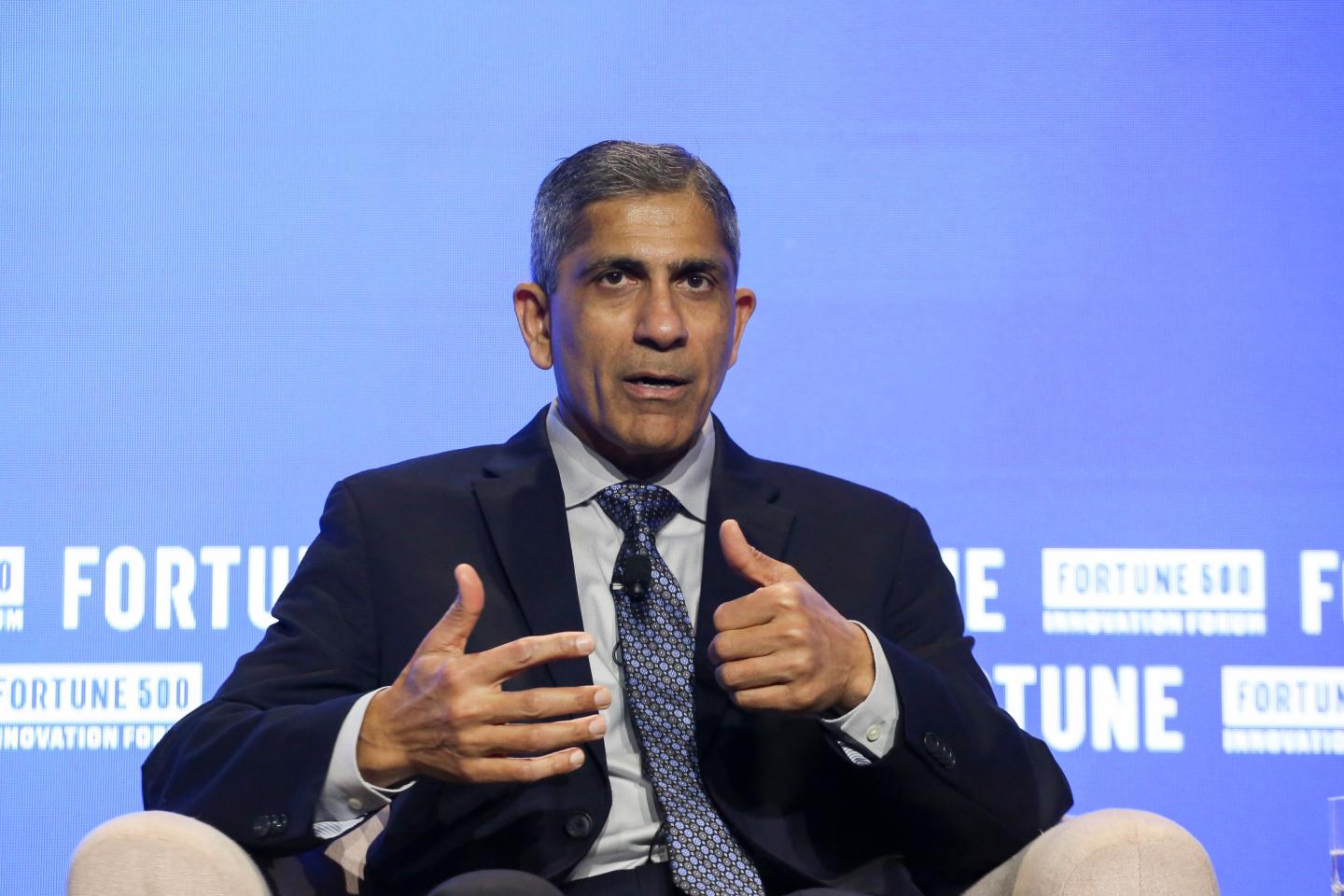
Speaking at the Fortune 500 Innovation Forum in Detroit, Kapur explained that these facilities now run themselves approximately 95% of the time, with operators handling only exceptions. The problem emerged gradually: "Over the last 50 years since this got created, the systems have become highly complex because we kept adding more and more software and physical infrastructure to it," he said. "So human cannot keep up with that at this point of time."
Kapur pointed to recent infrastructure failures as evidence, including the November 13 FAA nationwide ground stop triggered by a copper-to-fiber upgrade that flooded routers, and a Microsoft 365 outage lasting more than a day. These incidents, he suggested, reflect systems that have outpaced human capacity to manage them.
The physical AI solution
Honeywell's answer involves what the industry calls "physical AI"—not humanoid robots, but intelligent layers added on top of existing automation infrastructure. The approach aims to embed "a layer of learning system, the human knowledge" into large assets to make operators more productive rather than replace them.
The challenge lies in data accessibility. Unlike consumer AI trained on internet data, industrial systems contain information locked inside specific buildings and facilities, unavailable in the public domain. Converting that data into useful intelligence requires people with deep domain expertise, Kapur noted.
Since spinning off its aerospace business in June, Honeywell has positioned itself to lead "the industrial sector's transition from automation to autonomy." In October, the company launched Forge Cognition, an AI platform developed with Nvidia and Dell that can operate buildings autonomously, though those capabilities haven't been fully activated.
The workforce pressure
Kapur identified skilled labor shortages as the driving force behind this urgency. "The skill shortage is the biggest problem we all face," he said, noting that workers willing to perform hands-on technical tasks are becoming increasingly scarce.
A 2024 Deloitte and Manufacturing Institute study quantifies the problem: U.S. manufacturers could need 3.8 million additional workers between 2024 and 2033, with 1.9 million positions potentially going unfilled. Sixty-five percent of surveyed manufacturers called attracting and retaining talent their primary business challenge.
For his own organization's 50,000-plus employees, Kapur set an aggressive timeline: "Next 18 to 24 months, we all have to reskill ourselves."
The 1983 warning
The core problem Kapur describes isn't new. In 1983, psychologist Lisanne Bainbridge published "Ironies of Automation" in the journal Automatica, arguing that designers automate what they can and leave operators to handle tasks they cannot automate—including taking over during abnormal conditions. Her central irony: "The more advanced a control system is, so the more crucial may be the contribution of the human operator."
Bainbridge also warned that operators' skills deteriorate without use, and that monitoring automated systems gives humans "an impossible task." Her paper suggested automation "may expand rather than eliminate problems with the human operator"—a test that any new AI layer must pass.
Why it matters
This shift represents a fundamental acknowledgment that decades of incremental automation have created a complexity crisis in critical infrastructure. The solution isn't more traditional automation but intelligent systems that can handle the cognitive load humans can no longer manage. For enterprises running complex physical operations, the question is no longer whether to add AI layers, but how quickly they can deploy them safely while reskilling their workforce.
These details were first reported by Fortune.