Hollywood Writers Train AI Models to Pay Rent as Jobs Vanish
Entertainment professionals are taking side gigs improving the same AI systems they fear will replace them, raising thorny questions about survival versus complicity.
Creatives caught in an AI paradox
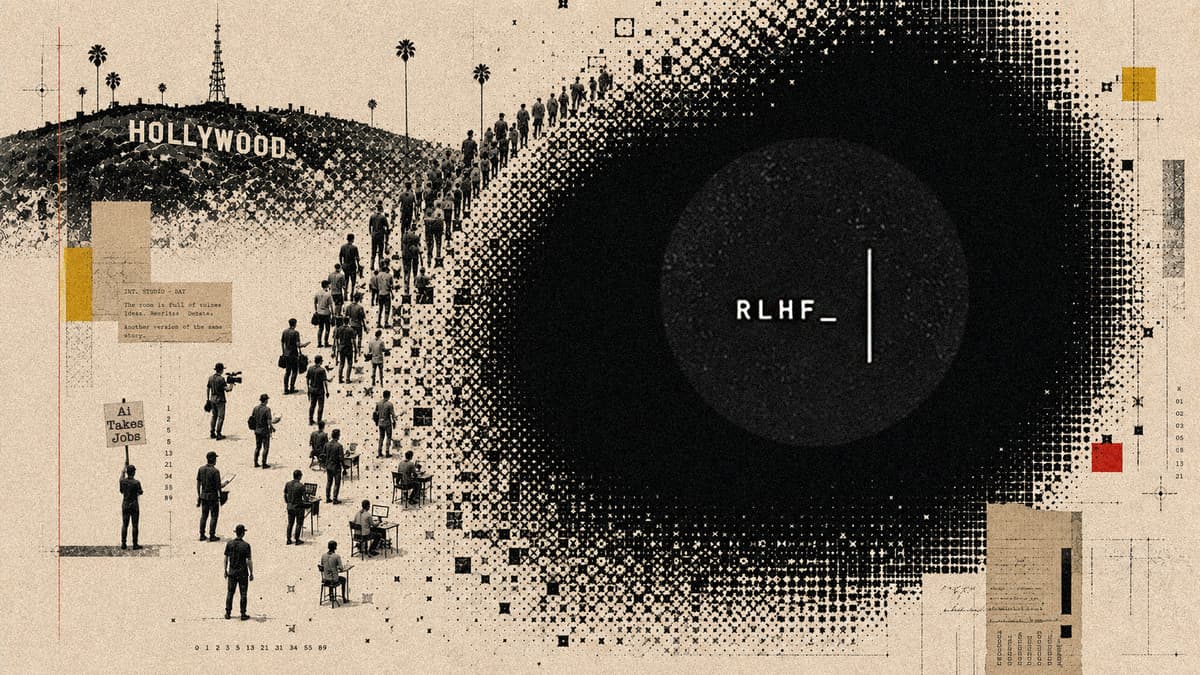
Hollywood professionals who walked picket lines in 2023 over AI concerns are now quietly taking jobs training the very systems they protested. Writers, editors, and development executives are turning to Reinforcement Learning from Human Feedback (RLHF) work as traditional entertainment opportunities evaporate—earning between $44 and $100 per hour to teach AI models how to sound more human.
Editor Gabe Sena, who typically works on documentaries and nonprofit videos, decided to dive into AI training during a gap between projects. "I'm mid-career and I don't want to be a dinosaur in my field," he told The Hollywood Reporter. His work involves comparing AI-generated outputs against prompts to assess accuracy—tasks covered by strict non-disclosure agreements.
Former HBO development executive Steven Woolworth found his way into the field after 18 months of fruitless job searching. A friend in the Writers Guild of America forwarded him an opportunity through Mercor, a recruiting platform valued at $10 billion that connects domain experts with AI companies. "I can keep my head buried in the sand or I can enter this world and get a very inside perspective," Woolworth explained.
The work itself: tedious and isolating
RLHF operates in three stages. Humans first score an AI model's outputs—rating whether responses are appropriate, accurate, or coherent. That scored data trains a "reward model," which then trains the original AI without further human input. One veteran writer described the experience as mind-numbing: "How many times can you tell a machine it's wrong without losing your mind?"
The sector is expanding rapidly. Data from Indeed shows AI-related job postings in arts categories doubled from 5 percent to 11 percent between May 2025 and April 2026—outpacing AI job growth overall. Major firms like Surge AI and Scale AI have faced lawsuits alleging unpaid wages, worker misclassification, and exposure to traumatizing content.
Why it matters
This trend exposes a brutal economic reality: Hollywood professionals are being forced to choose between financial survival and potentially accelerating their own obsolescence. The guilds face a paralyzing dilemma—they cannot tell struggling members to refuse paid work, yet allowing it may train systems that eliminate those same jobs permanently. Voice actor advocate Tim Friedlander warns that "$1,200 for four hours worth of work" may represent "the only four hours you're ever going to work in that job."
Sympathy without solutions
Breaking Bad creator Vince Gilligan expressed understanding for workers facing impossible choices: "I've been extraordinarily lucky throughout my career, so I'm not going to judge folks who are simply trying to provide for their families." Storyboard artist Sam Tung added that people taking this work "are not doing it because they're eager to undercut other human workers."
Yet the National Association of Voice Actors found that 20 percent of surveyed members have knowingly lost jobs to AI tools. The organization's position is clear: no licensing or training deals should occur in voiceover work.
Major Hollywood unions contacted for this story either declined to comment or did not respond when asked about policies on members working in AI training. When asked if he knows others doing this work, Woolworth replied simply: "Yes. And a lot that are certainly trying."
These details were first reported by The Hollywood Reporter.
This is an original analysis by the Omega editorial team. Source reporting: AI Watch.
Want systems like this working for your business?
Book a Call